
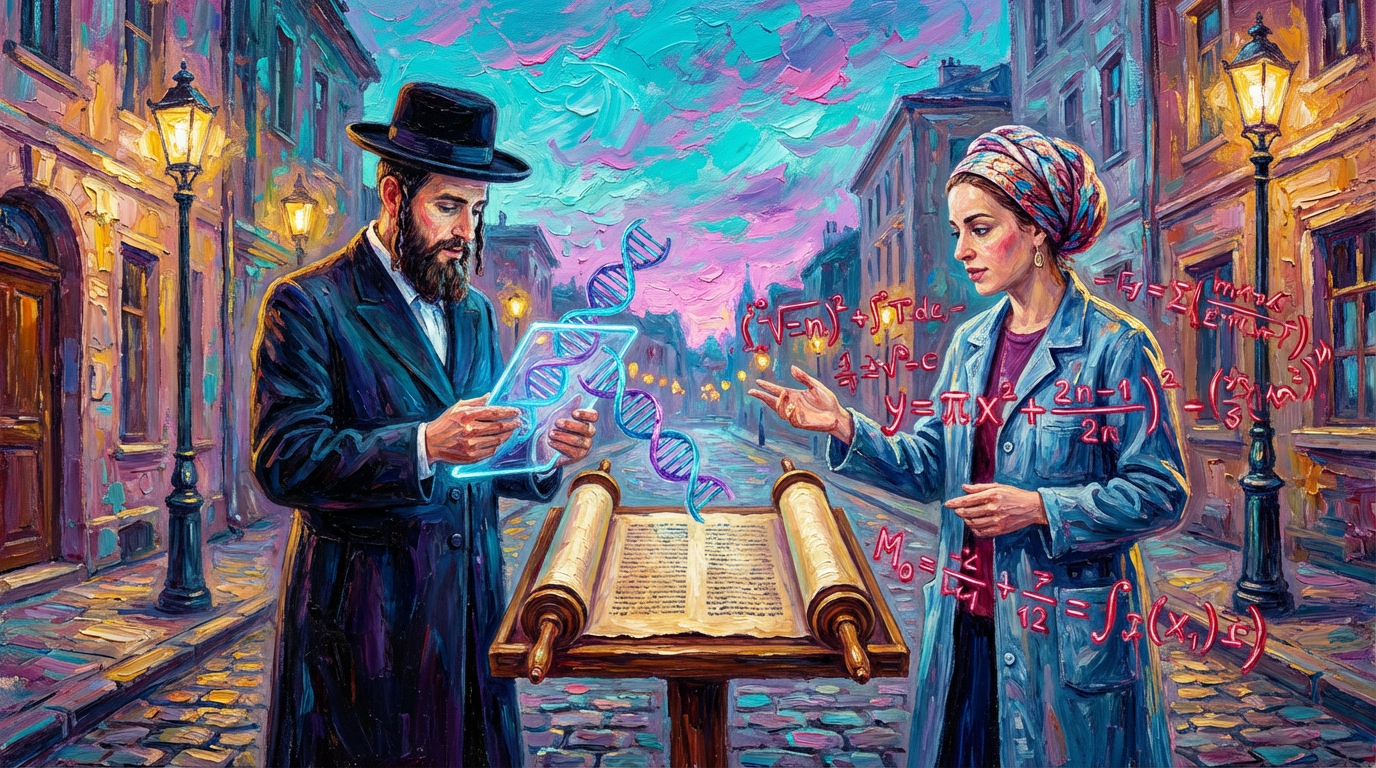
Torah Science: Modern Guide to Faith and Reason
Torah Science: Modern Guide to Faith and Reason
Is it possible to accept the theory of evolution and still believe the Torah is divine? Can the universe be billions of years old if Genesis counts six days? For many modern adults, these questions are not just academic exercises – they are stumbling blocks to faith. We live in a world dominated by scientific discovery, yet we carry a heritage rooted in ancient texts. This tension often feels like a battleground where one side must defeat the other – but the conversation surrounding Torah Science offers a surprising third path. In the Jewish tradition, faith and reason are not enemies. This article explores how Jewish thinkers throughout history have navigated these conflicts and offers practical ways to reconcile your intellectual curiosity with spiritual heritage.
The Jewish View on Science and Faith
Before we dive into specific conflicts, we need to establish the general Jewish approach to knowledge. In Western culture, science and religion are often framed as opposing forces – the “God of the Gaps” argument where God only exists where science has not yet explained a phenomenon. Judaism rejects this binary. The Torah is not a science textbook, and science is not a belief system. They are different languages describing the same reality.
The fundamental principle in Jewish thought is that there is only one truth. If God created the universe, then the physical laws that science discovers are essentially the “handiwork” of God. Therefore, there cannot be a genuine contradiction between a proven scientific fact and the Torah. If there is a conflict, Maimonides (the Rambam), one of the most prolific medieval Jewish philosophers, teaches us that we have either misunderstood the science or misinterpreted the Torah.
This perspective frees us from the anxiety of having to deny scientific evidence to protect our faith. It allows us to approach the world with curiosity rather than defensiveness. When we study the natural world, we are studying God’s creation. When we study Torah, we are studying God’s will. The two are meant to harmonize, providing us with a holistic understanding of existence.
Ancient Wisdom Meets Modern Knowledge
There is a common misconception that ancient rabbis were anti-science or primitive in their understanding. On the contrary, the sages of the Talmud were deeply engaged in the science of their time, including astronomy, medicine, and biology. The Talmud itself contains detailed discussions about the phases of the moon, the anatomy of the human body, and agricultural cycles.
For example, the Talmud in tractate Shabbat (75a) explicitly states that a person is obligated to understand astronomy and the geometry of the earth in order to pray properly and calculate the calendar. Rabbis did not fear knowledge – they embraced it as a way to better appreciate the Creator. They believed that understanding the mechanics of the world enhanced one’s ability to serve God.
However, the sages also acknowledged that science changes. What was considered scientific fact in the 3rd century might be disproven in the 21st. The rabbis distinguished between “wisdom of the nations” (external knowledge) and Torah wisdom. They were willing to adopt the best scientific knowledge available to them, while maintaining that Torah’s ethical and spiritual laws were eternal and unchanging.
💡 Did You Know?
The calculation of the Hebrew calendar, which determines the exact dates of holidays like Rosh Hashanah and Passover, was fixed by Hillel II in the 4th century CE using complex mathematical formulas based on the mean motion of the moon and sun – proving that Judaism has long relied on mathematical precision to guide religious life.
Maimonides and the Art of Interpretation
No discussion of Torah and science is complete without Rabbi Moses ben Maimon, known as the Rambam. Living in the 12th century, he was both a leading Torah scholar and a court physician. In his philosophical masterpiece, The Guide for the Perplexed, he tackles the apparent contradictions between Aristotelian science and the Bible.
Maimonides argued that the Torah frequently speaks in the language of human beings. It uses allegory, metaphor, and anthropomorphism (describing God in human terms) to convey deep truths to a broad audience. He famously taught that if the literal meaning of a verse contradicts established reason or sensory evidence, we must interpret that verse metaphorically.
For Maimonides, the creation story in Genesis is a prime candidate for non-literal interpretation. He believed the “days” of creation were not 24-hour periods but distinct stages or eras of creation. This view, written over 800 years ago, aligns remarkably well with the modern scientific understanding of a universe that unfolded over billions of years. Maimonides shows us that intellectual honesty and religious devotion are not mutually exclusive.
Different Movements, Different Answers
Today, different Jewish movements respond to scientific challenges in varied ways. There is alot of diversity in the community, and understanding these perspectives can help you find where you fit.
Orthodox Judaism generally maintains that the Torah is divinely authored and infallible. However, Orthodox thinkers are not monolithic. Many engage with science rigorously. Some, like Rabbi Natan Slifkin (the “Zoo Rabbi”), explicitly integrate evolution and geology into a Torah framework, citing ancient commentators who support non-literal readings. Others, particularly within the Haredi (Ultra-Orthodox) world, may reject certain scientific theories if they feel those theories contradict the literal reading of the text as understood by tradition.
Conservative Judaism embraces the critical study of both Torah and science. They view the Torah as a document that records the Jewish people’s encounter with God over time. Conservative Jews generally have no issue accepting the Big Bang or evolution, seeing them as the “how” of creation, while the Torah provides the “why” and the moral purpose.
Reform and Reconstructionist Judaism prioritize modern knowledge and ethical sensibilities. They are generally comfortable viewing the biblical stories as myths or metaphors – sacred narratives that convey truth without being historically or scientifically factual. For these movements, the tension is minimal because science is the primary language for understanding the physical world.
Practical Examples: Evolution and The Big Bang
Let’s look at two specific areas where questions arise – the age of the universe and the origin of species.
The Age of the Universe: Science estimates the universe is 13.8 billion years old. A literal reading of the Bible counts roughly 6,000 years. How do we bridge this gap? Jewish thinkers like Dr. Gerald Schroeder suggest that the stretching of time in relativity theory explains the six days of creation as 15 billion years from our perspective. Others point to the word yom (day) in the creation account, which can also mean an indeterminate period of time, as seen in the verse “This will be a day of great trouble” (Zephaniah 1:15), referring to a year or era.
Evolution: Does Judaism believe in Darwin? The Torah says God created animals “according to their kind.” Some interpret this as special creation. However, many Jewish scholars see no conflict with the idea that God used the mechanism of evolution to bring life to its current state. The Kabbalistic idea of Tzimtzum (divine contraction) suggests God withdrew to make space for the universe to develop naturally, allowing for a process like evolution to unfold without constant miraculous intervention.
Understanding “Ma’aseh Bereishit”
A crucial concept in navigating these waters is “Ma’aseh Bereishit” (the Act of Creation). The Talmud (Chagigah 11b) forbids teaching the secrets of creation to more than one student at a time, indicating that the opening chapters of Genesis contain deep, hidden mysteries. It suggests that the surface-level text is merely a garment for deeper cosmic truths.
This means we dont have to panic if the surface meaning of the text clashes with science. The surface meaning is often there for moral instruction, not scientific data. For instance, the seven days of creation serve to teach us the value of work and rest, leading into the sanctification of Shabbat (the Jewish Sabbath). Whether the physical creation took six literal days or billions of years, the moral lesson – that the world belongs to God and we must rest one day a week – remains intact and binding.
How to Approach Conflicts Intellectually
So, how should a modern Jew approach a new scientific discovery that seems to contradict tradition? Here is a step-by-step method based on Jewish wisdom:
- Verify the Science: Is it actually a proven fact, or just a theory that is still being debated? Don’t overturn tradition based on a hypothesis.
- Check the Translation: Are you reading the text in English? Hebrew often has multiple meanings. A word translated as “firmament” might have a different nuance in the original context.
- Consult Commentaries: Before deciding there is a conflict, look at Rashi, Ramban, or Ibn Ezra. You may find that they already addressed this issue centuries ago in a way you hadn’t considered.
- Hold the Tension: It is okay to say, “I don’t know yet.” You don’t have to solve every puzzle immediately. Judaism respects the struggle.
Quick Takeaways
- Faith and reason are partners. In Jewish thought, science explores God’s creation, while Torah explores God’s will.
- The Torah is not a science textbook. It uses the language of man to convey moral and spiritual truths.
- Maimonides supports metaphor. If science contradicts a literal reading, we are often obligated to interpret the text more deeply.
- Diverse movements offer options. From Orthodox to Reform, there is a Jewish approach that fits your intellectual stance.
- One truth exists. If God is real, there can be no ultimate contradiction between truth found in a lab and truth found in a scroll.
- Questions are welcome. Wrestling with these conflicts is a sign of a healthy, engaged mind and spirit.
Putting This Into Practice
Here is how to bring this wisdom into your daily life:
If you’re just starting: Read the Torah portion (the parsha) with the mindset of looking for moral lessons rather than scientific facts. Ask yourself, “What is this teaching me about how to treat others?” rather than “Is this scientifically accurate?”
To deepen your practice: Pick one “conflict” between science and Torah that interests you, such as dinosaurs or the flood. Read a book by an Orthodox scientist who addresses these topics, such as works by Nathan Aviezer or Gerald Schroeder, to see how they reconcile the two.
For serious exploration: Study The Guide for the Perplexed by Maimonides. It is a difficult text, so find a study partner or a class. Engaging with this master logician will sharpen your mind and deepen your appreciation for the complexity of Jewish theology.
Frequently Asked Questions
- Q – Do Jews believe in evolution?
- A – Many Jews do. While some Orthodox interpretations reject it, many Jewish thinkers, including rabbis and scientists, view evolution as the mechanism God used to create life, seeing no conflict with the Torah’s narrative.
- Q – Is the universe really 6000 years old according to Judaism?
- A – The traditional Jewish calendar counts 5700+ years, but many sages explain these as years since Adam’s soul, not the earth’s creation. Others interpret the ‘days’ of creation metaphorically as long eras.
- Q – What did Maimonides say about science and Torah?
- A – Maimonides taught that if a literal reading of Torah contradicts proven reason or science, we must interpret the verse allegorically. He argued that truth is one and cannot contradict itself.
- Q – Can I be a scientist and still be religious?
- A – Absolutely. Judaism encourages studying the natural world as a way to appreciate God’s wisdom. Many great rabbis were also doctors, astronomers, and scientists throughout history.
- Q – How do I handle doubt about Torah stories?
- A – Doubt is a natural part of growth. Judaism encourages questions. Study commentaries that separate moral lessons from historical claims, and consult teachers who respect both science and tradition.
The relationship between Torah and science is not a battlefield where one side must lose for the other to win. It is a dialogue. The Torah provides the moral compass, telling us why the world exists. Science provides the map, telling us how the world works. When we integrate these two perspectives, we achieve a more complete understanding of reality.
We don’t need to fear scientific discoveries. Whether we are looking through a telescope at distant galaxies or studying a page of Talmud, we are searching for truth. The ultimate Jewish goal is not to blindly accept ancient myths nor to bow to the latest scientific trend, but to live a life of meaning, purpose, and ethical action. As the psalmist says, “The heavens declare the glory of God” (Psalms 19:2). In the end, the study of God’s world and the study of God’s word are two sides of the same sacred coin.
For further reading on Maimonides and philosophy, visit Sefaria’s Guide for the Perplexed. For more on the intersection of Judaism and evolution, see resources at MyJewishLearning.