Parashat Terumah: Sacred Space Blueprint
How Ancient Israel’s First Crowdfunding Campaign Can Transform Your Home Into a Sanctuary
TL;DR: Parashat Terumah shows God asking the Israelites for voluntary contributions to build the Mishkan (Tabernacle), a portable sanctuary in the desert. This week’s Torah portion teaches us that creating sacred space requires both generous hearts and precise intention, offering practical wisdom for building meaningful sanctuaries in our modern homes and communities.
Quick Takeaways
- Terumah means “contribution.” God asks for voluntary gifts from willing hearts, not mandatory taxes.
- The Mishkan was humanity’s first portable sanctuary. Every piece had precise measurements and spiritual significance.
- Sacred space isn’t about size or expense. It’s about intention, community, and divine invitation.
- Modern applications abound. From home altar corners to mindful giving practices.
- Multiple perspectives enrich understanding. Orthodox, Conservative, and Reform Judaism each offer unique insights.
- Rashi emphasizes voluntary giving. True terumah comes from the heart, not obligation.
- The parsha bridges physical and spiritual. Material objects become vessels for divine presence.
Picture this: You’re scrolling through your favorite crowdfunding platform, and you see a campaign titled “Help Us Build a Portable Sanctuary for 600,000 Desert Nomads.” The funding goal? Enough gold, silver, and precious materials to construct an intricate dwelling place for the Divine. Sound impossible? Not according to Parashat Terumah.
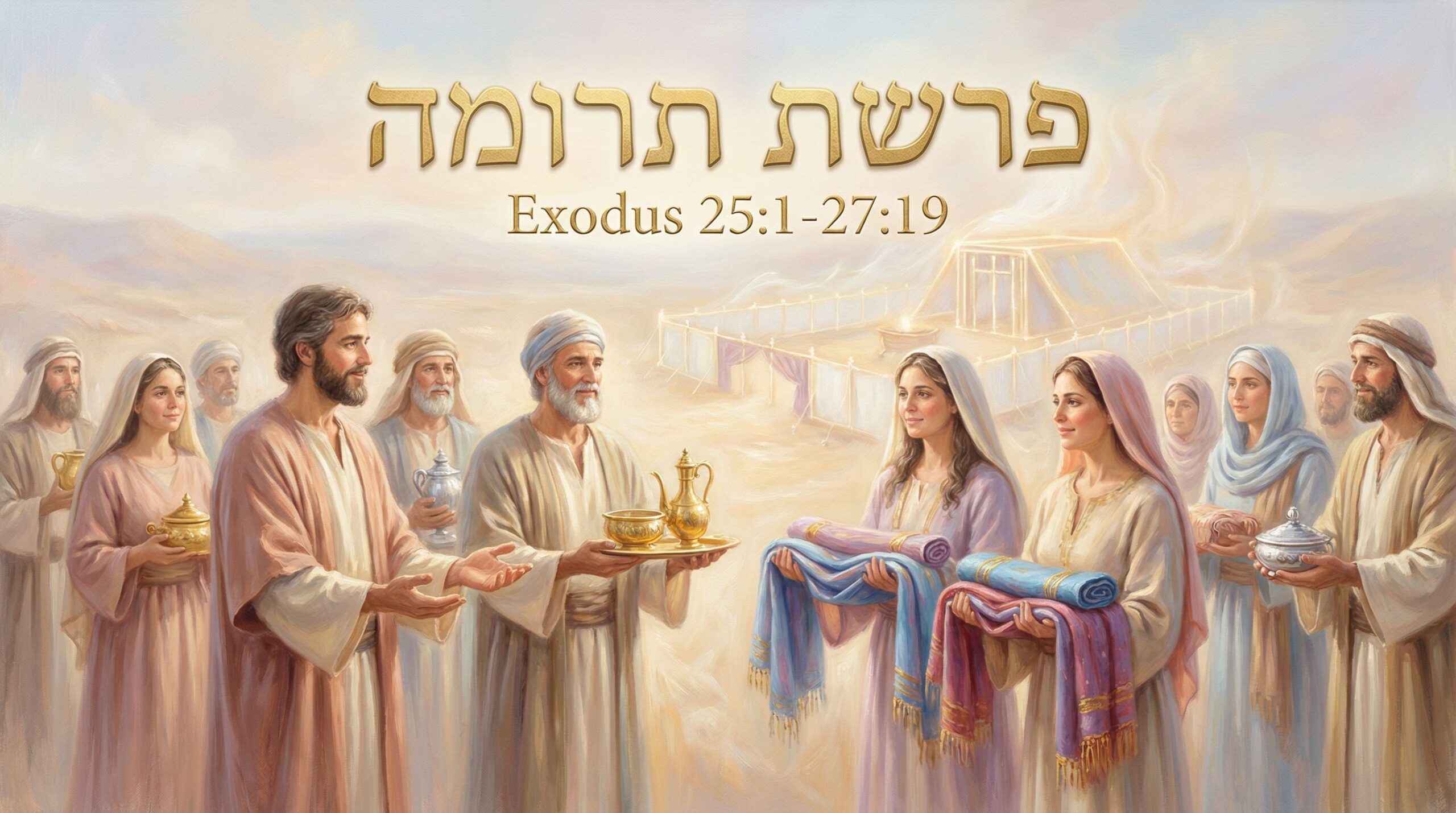
This week’s Torah portion (Exodus 25:1-27:19) opens with one of history’s most successful fundraising campaigns. But unlike modern crowdfunding, this wasn’t about reaching a monetary target. As Sefaria’s text shows us, God tells Moses: “Speak to the children of Israel, that they take for Me an offering; from every man whose heart makes him willing you shall take My offering” (Exodus 25:2).
The Hebrew word “terumah” doesn’t just mean donation, it means elevation. When we give with willing hearts, we dont just support a cause, we elevate both the gift and ourselves. In our age of subscription fatigue and charity overwhelm, Parashat Terumah offers timeless wisdom about meaningful contribution.
The Mishkan: Ancient Israel’s Architectural Marvel
The Tabernacle wasn’t just a tent, it was a precisely engineered marvel. God provides detailed blueprints for every component: the golden Ark of the Covenant, the seven-branched menorah, the showbread table, the incense altar, and the massive outer courtyard. Each measurement matters, every material has meaning.
Chabad’s commentary explains that Rashi sees profound significance in this precision. On Exodus 25:40, the Torah states: “And see that you make them after their pattern, which has been shown you on the mountain.” Rashi teaches that Moses saw a heavenly blueprint, a divine architectural plan that bridged heaven and earth.
The Ramban offers another perspective: the Mishkan served as atonement for the Golden Calf incident. Where the Israelites had created an unauthorized idol, now they would build an authorized dwelling place for God’s presence. The Mishkan became proof that physical objects could serve sacred purposes when created with proper intention.
Consider the materials themselves. Gold represented the highest spiritual aspirations, silver symbolized redemption (used for the half-shekel census), copper grounded everything in earthly reality. Precious stones caught and reflected light, while fine fabrics created boundaries between different levels of holiness. Even the specific woods (acacia) and oils (olive) carried meaning, chosen for their durability and purity.
💡 Did You Know?
The menorah’s design was so complex that Moses couldn’t understand it from verbal instructions alone. According to Midrash, God had to show him a vision of fire shaped like a menorah. Later, Beit Hillel and Beit Shammai would debate its exact construction for generations (Menachot 98b).
Classical Wisdom: What the Commentators Teach Us
The great Jewish commentators saw layers of meaning in every verse. Rashi focuses on the practical, explaining that “terumah” specifically means a voluntary gift, distinct from mandatory taxes or tithes. The Hebrew root suggests lifting up, elevation. When we contribute from willing hearts, we lift both the recipient and ourselves.
Ibn Ezra, the medieval Spanish commentator, emphasizes the mathematical precision. He interprets the exact measurements as reflections of cosmic order. The Mishkan’s proportions mirrored divine harmony, bringing celestial patterns into earthly space. For Ibn Ezra, following the blueprint exactly wasn’t legalistic obsession but cosmic attunement.
Sforno adds a mystical dimension: the physical act of giving transforms the giver. When Israelites donated their Egyptian gold, silver, and gems for the Mishkan, they elevated these materials from symbols of slavery to vessels of freedom. The same gold that once adorned Pharaoh’s temples now housed God’s presence among the liberated people.
The Talmud in Shabbat 92b explores the tension between Mishkan construction and Shabbat observance. Even this holy work had to pause for the weekly day of rest, teaching that sacred time trumps sacred space. This principle resonates today: no matter how meaningful our projects, they shouldn’t consume our entire lives.
MyJewishLearning explains how different Jewish movements interpret these teachings. Orthodox Judaism emphasizes faithful replication of Temple practices in synagogue and home. Conservative Judaism focuses on community responsibility for maintaining sacred spaces. Reform Judaism extracts universal principles about creating holiness anywhere.
Modern Applications: Building Your Personal Mishkan
What does ancient Tabernacle construction mean for contemporary Jews navigating busy lives in small apartments? More than you might expect. The principles of Parashat Terumah translate directly into modern sacred space creation.
First, consider the “willing heart” requirement. God didn’t want reluctant donors, and meaningful sacred space can’t be built through guilt or obligation. Whether you’re designating a prayer corner in your studio apartment or organizing synagogue renovations, authentic enthusiasm matters more than expensive materials.
Second, notice how the Mishkan balanced beauty with function. The golden menorah wasn’t just decorative, it provided light. The showbread table wasn’t merely symbolic, it held real bread. Your personal sacred space should serve practical spiritual needs: a place for quiet reflection, holiday observances, or study.
Third, the parsha emphasizes community effort. No single Israelite could build the entire Mishkan alone. Similarly, contemporary sacred spaces work best when they reflect collective contributions. Consider starting a neighborhood havurah (fellowship group) that rotates hosting duties, or organizing apartment building Shabbat dinners.
Reform Judaism’s perspective emphasizes that sacred space isn’t limited to traditional synagogue settings. Progressive Jews might create outdoor sanctuaries, digital prayer communities, or multi-faith dialogue spaces. The key is intentionality, not conformity to ancient architectural specifications.
The concept of terumah also applies to financial giving. Rather than viewing charitable donations as burdens, Parashat Terumah suggests approaching them as opportunities for spiritual elevation. Consider adopting the traditional practice of giving 10% of income to meaningful causes, but do it joyfully, with the “willing heart” the Torah demands.
Denominational Perspectives: One Torah, Multiple Interpretations
Orthodox Judaism sees Parashat Terumah as literal divine instruction. The Mishkan’s precise measurements provide templates for contemporary synagogue design, Torah scroll preparation, and home ritual objects. Mystical traditions like Kabbalah find cosmic significance in every dimension, connecting Tabernacle architecture to divine emanations and spiritual worlds.
Conservative Judaism balances reverence for tradition with historical context. Conservative scholars note that Tabernacle descriptions were likely compiled centuries after the desert period, reflecting Temple practices rather than exact wilderness reality. This doesn’t diminish the text’s spiritual authority, but it does suggest flexibility in modern applications.
Reform Judaism emphasizes ethical and spiritual principles over ritual details. Reform thinkers ask: What made the Mishkan holy? Not its gold and silver, but the community’s shared commitment to justice and divine service. Modern Reform congregations might prioritize social action spaces over traditional sanctuaries, reflecting this values-based interpretation.
Reconstructionist Judaism would add that Parashat Terumah teaches about civilization-building. The Israelites weren’t just constructing a religious building, they were creating infrastructure for a new society. Contemporary Jewish communities can learn from this comprehensive approach to sacred community development.
Putting This Into Practice
Here’s how to bring this wisdom into your daily life:
If you’re just starting: Designate one corner of your home as sacred space. Add a small bookshelf for Jewish books, a cup for kiddush, and two candlesticks for Shabbat. Don’t worry about expensive materials, focus on intentional use. Spend five minutes there each morning or evening in quiet reflection.
To deepen your practice: Commit to monthly “terumah” giving, donating a percentage of your income to causes that align with your values. Research the recipients carefully, giving with the same willing heart the Torah describes. Also, study the parsha each week, connecting ancient wisdom to current challenges in your life and community.
For serious exploration: Organize a community study group focused on creating contemporary sacred spaces. Visit different synagogues, meditation centers, and religious communities to observe how various groups balance tradition with innovation. Consider taking classes in Jewish mysticism or liturgy to deepen your understanding of sacred space concepts.
The wisdom of Parashat Terumah doesn’t require us to build physical Tabernacles in our backyards. Instead, it invites us to approach space, time, and community with the same intentionality that guided our ancestors in the desert. Whether we’re lighting Shabbat candles in a tiny apartment or planning million-dollar synagogue renovations, the principles remain the same: willing hearts, precise attention, and openness to divine presence.
As we read about ancient Israelites contributing their most precious possessions for a shared vision, we’re challenged to examine our own contributions. What are we building together? How do our homes, communities, and hearts serve as dwelling places for the sacred? These questions don’t have simple answers, but Parashat Terumah assures us that the journey of building and contributing is itself a form of worship.
The Hebrew calendar confirms that this year’s reading falls during Adar I, a month associated with joy and hidden miracles. Perhaps that’s fitting. The Mishkan, like all sacred spaces, reveals hidden possibilities, transforming ordinary materials into vessels for extraordinary encounters.
Frequently Asked Questions
- Q: What does Terumah mean in the Torah?
- A: Terumah means ‘contribution’ or ‘offering,’ specifically referring to voluntary gifts given from a willing heart, not mandatory taxes or obligations.
- Q: Why is the Mishkan important in Judaism?
- A: The Mishkan was the first portable sanctuary where God’s presence dwelled among the Israelites, serving as the prototype for all future Jewish sacred spaces.
- Q: What are the main vessels described in Parashat Terumah?
- A: The Torah describes the Ark of the Covenant, golden menorah, showbread table, incense altar, and detailed courtyard specifications with precise measurements.
- Q: How can I create sacred space in my modern home?
- A: Designate an intentional corner with Jewish books, ritual objects, and meaningful items. Focus on willing heart and regular use rather than expensive materials.
- Q: What is the difference between terumah and regular tzedakah?
- A: Terumah specifically refers to voluntary offerings for sacred purposes, while tzedakah is obligatory charity for social justice and helping those in need.