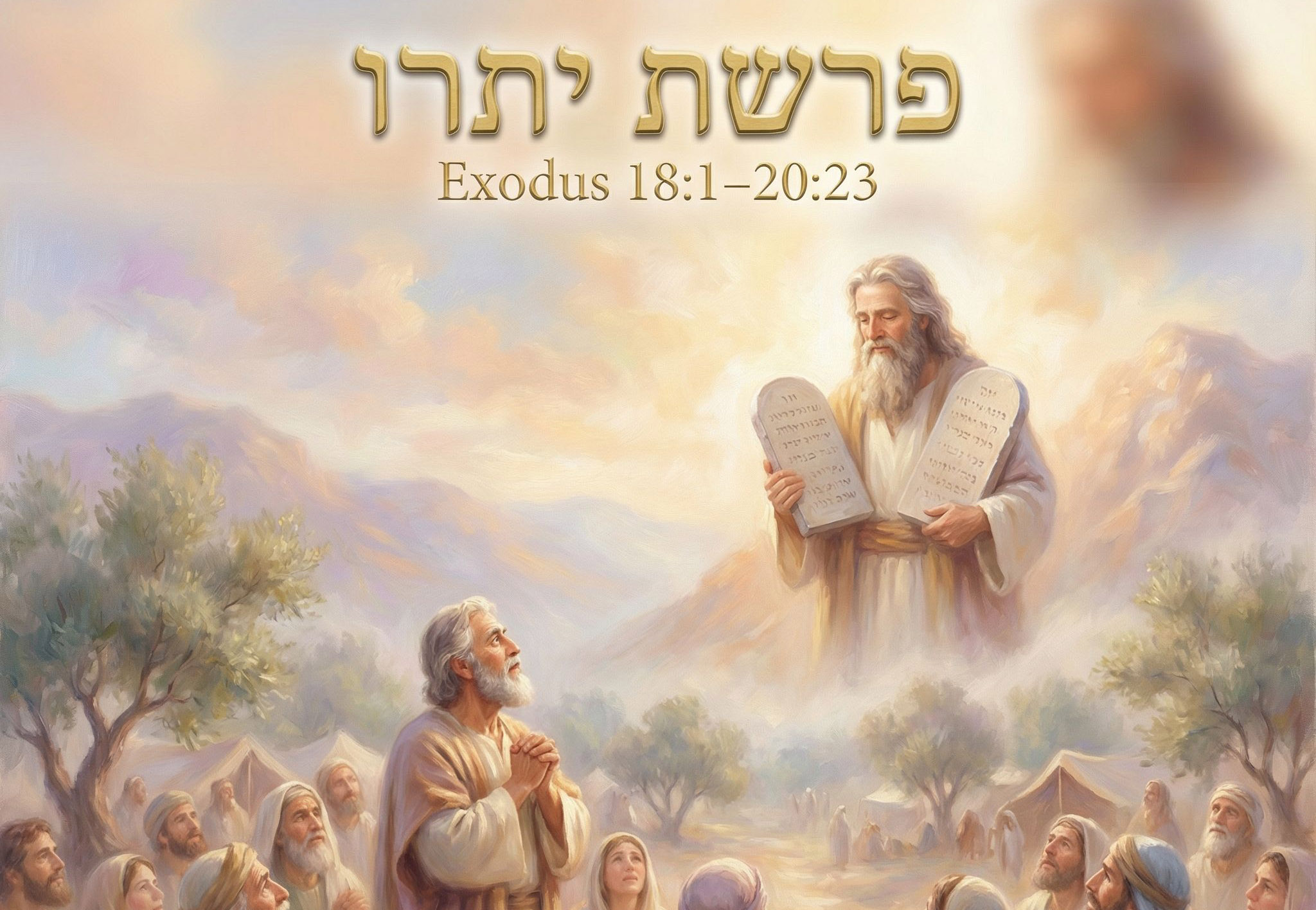
Parashat Yitro: Leadership Lessons from Ancient Sinai
How Moses’ Father-in-Law and the Ten Commandments Revolutionized Both Divine Revelation and Human Management
TL;DR: Parashat Yitro brings together two transformative moments: Jethro’s practical advice on delegation that saves Moses from burnout, and God’s direct revelation of the Ten Commandments at Mount Sinai. This Torah portion teaches us that both human wisdom and divine law are essential for building a just society.
Quick Takeaways
- Smart delegation prevents burnout. Jethro teaches Moses to share leadership responsibilities through a tiered court system.
- Preparation matters for big moments. The Israelites undergo three days of purification before receiving the Ten Commandments.
- Ethics ground all law. The commandments begin with God’s identity as liberator, not just lawgiver.
- Gentile wisdom has value. Yitro is the only non-Israelite whose name titles a Torah portion.
- Thunder and lightning accompany transformation. Divine revelation comes with dramatic natural phenomena that inspire both awe and fear.
- Community governance requires structure. Moses learns that even the most capable leader needs systematic help.
- Spiritual preparation is active work. The Israelites must sanctify themselves before encountering God at Sinai.
Picture this: You’re a manager drowning in meetings, fielding every question from every team member while your inbox explodes with urgent requests. Sound familiar? Now imagine your father-in-law drops by and says, “You’re doing this all wrong. Let me show you a better way.” That’s exactly what happens to Moses in this week’s Torah portion, and the lesson is just as relevant today as it was 3,000 years ago.
Parashat Yitro opens with Moses reunited with his father-in-law Jethro (Yitro in Hebrew), who arrives with Moses’ wife and children. But Jethro doesn’t just come for a family visit. He observes Moses’ exhausting daily routine of judging disputes from morning until evening and offers game-changing advice about leadership and delegation. The portion then shifts to one of the most dramatic moments in Jewish history: the revelation at Mount Sinai and the giving of the Ten Commandments.
This Torah portion, as detailed in Hebcal’s comprehensive guide, covers Exodus 18:1–20:23 and will be read on February 7, 2026.
Jethro’s Management Revolution: Ancient Wisdom for Modern Leaders
The Torah describes Moses’ overwhelming workload: “It came to pass on the next day, that Moses sat to judge the people, and the people stood by Moses from morning until evening” (Exodus 18:13). Anyone who’s been in a leadership position recognizes this scenario immediately. Moses was the classic micromanager, trying to handle everything himself.
Jethro watches this unsustainable pattern and delivers what might be history’s first management consultation. He tells Moses, “The thing that you do is not good. You will surely wear away, both you and this people that is with you, for the matter is too heavy for you; you are not able to perform it yourself alone” (Exodus 18:17-18).
His solution? Create a hierarchical system where capable people handle smaller disputes, while Moses focuses on major cases and teaching God’s laws. MyJewishLearning explains that Jethro’s advice establishes the foundation for Jewish judicial systems that persist today.
Rashi, commenting on this passage, notes that Jethro’s conversion to Judaism was genuine because he praised God after hearing about the miracles, unlike other nations who remained silent. Sforno adds that Jethro’s advice was divinely inspired, teaching that proper delegation preserves leaders for their unique prophetic roles.
The modern workplace desperately needs Jethro’s wisdom. How many talented leaders burn out trying to do everything themselves? How many organizations suffer because their visionaries get bogged down in day-to-day minutiae? Jethro’s model of identifying capable people and empowering them to handle appropriate responsibilities remains the gold standard for sustainable leadership.
Preparing for Transformation: The Three Days Before Sinai
After establishing the judicial system, the Israelites arrive at Mount Sinai, where they’ll receive the most famous legal code in human history. But first comes preparation. God tells Moses: “Go to the people and sanctify them today and tomorrow, and let them wash their garments. And let them be ready for the third day, for on the third day the Lord will come down in the sight of all the people upon Mount Sinai” (Exodus 19:10-11).
This three-day preparation period teaches profound lessons about readiness for significant moments. The Israelites don’t just show up for the revelation; they actively prepare through ritual purification, washing their clothes, and maintaining sexual abstinence. The complete text on Sefaria shows how this preparation creates both physical and spiritual readiness.
Ramban explains that this sanctification period was necessary to purify the people for their encounter with the divine. The three days created a buffer between ordinary life and extraordinary revelation.
In our culture of instant gratification, this ancient wisdom challenges us to slow down before major transitions. Whether it’s a new job, marriage, or spiritual commitment, the Sinai model suggests that meaningful transformation requires intentional preparation. We need time to clear away distractions, focus our intentions, and create space for something new to enter our lives.
💡 Did You Know?
Parashat Yitro is the only Torah portion named after a non-Israelite, highlighting how gentile wisdom contributes to Jewish law. Additionally, the gematria (numerical value) of Yitro’s name equals 616, which traditional sources connect to the 613 commandments plus the three patriarchs, suggesting his integral role in Jewish tradition.
The Ten Commandments: Revolutionary Ethics for Every Age
Then comes the moment that changes everything. “And it came to pass on the third day, when it was morning, that there were thunders and lightnings, and a thick cloud upon the mount, and the voice of a shofar (ram’s horn) exceeding loud” (Exodus 19:16). The divine revelation begins with natural pyrotechnics that would make any Hollywood director jealous.
But the Ten Commandments themselves begin not with prohibitions, but with relationship: “I am the Lord your God, who brought you out of the land of Egypt, out of the house of bondage” (Exodus 20:2). God identifies as liberator before lawgiver, grounding ethics in the experience of freedom rather than arbitrary rules.
The commandments that follow address both our relationship with God and our relationships with each other. The first four focus on divine connection: no other gods, no idols, don’t take God’s name in vain, and remember Shabbat. The final six govern human relationships: honor parents, don’t murder, don’t commit adultery, don’t steal, dont bear false witness, and don’t covet.
Or HaChaim explains that God spoke the Ten Commandments directly to create an eternal bond without intermediaries. This direct communication emphasizes that these aren’t just ancient rules, but timeless principles for ethical living.
Modern ethicists still wrestle with these commandments because they address fundamental human challenges that transcend culture and time. The prohibition against coveting speaks to our consumer culture’s obsession with acquisition. Honoring parents remains relevant as societies grapple with aging populations. The Sabbath commandment offers a powerful antidote to our always-on work culture.
Denominational Perspectives: How Different Jewish Communities Understand Yitro
Orthodox Judaism emphasizes the literal historical accuracy of the Sinai revelation and sees Jethro’s advice as divinely inspired wisdom that creates binding legal precedents. The commandments represent God’s direct word, unchangeable and eternal.
Conservative Judaism highlights the communal preparation at Sinai and appreciates Jethro’s rational governance advice as human wisdom that complements divine law. This movement sees both human and divine elements working together in the Torah’s development.
Reform Judaism focuses on the universal ethical principles embedded in the Ten Commandments, viewing them as moral ideals that have evolved over time. The dramatic revelation at Sinai represents the emergence of ethical monotheism as a transformative force in human civilization.
Chabad’s traditional perspective emphasizes how both Jethro’s practical wisdom and the divine commandments work together to create a just society rooted in both human experience and transcendent values.
These different approaches remind us that sacred texts can speak to us in multiple ways simultaneously. We can appreciate Jethro’s practical management advice while also being inspired by the transcendent moral vision of the Ten Commandments.
Classical Voices: What the Sages Teach About Leadership and Law
The classical commentaries offer rich insights into both Jethro’s advice and the Sinai revelation. Rashi explains that Jethro heard about the splitting of the Red Sea and the war with Amalek, prompting his journey to join the Israelites. His praise of God was unique because other nations remained silent after hearing about the miracles.
The Talmud in Shabbat (87a) discusses the timing of Jethro’s arrival, teaching that he came after hearing about the miraculous events. This emphasizes that genuine conversion comes from recognizing God’s power in historical events.
Ibn Ezra interprets the increasing intensity of the shofar blast at Sinai as designed to heighten the people’s awe and fear. The natural phenomena weren’t just special effects, but pedagogical tools to help the Israelites understand the magnitude of what was happening.
Midrash Shemot Rabbah teaches that Jethro had explored every form of idolatry before recognizing the one true God, making his conversion particularly meaningful. His outsider perspective allowed him to see problems with Moses’ leadership style that those inside the system couldn’t recognize.
These classical voices remind us that both practical wisdom and spiritual insight come from unexpected sources. Jethro’s management advice proves just as valuable as the dramatic revelation that follows. Sometimes the most important lessons come from observers who see our blind spots clearly.
Putting This Into Practice
If you’re just starting: Look for one area where you’re trying to do everything yourself, whether at work, home, or in community involvement. Identify someone trustworthy who could handle some of these responsibilities. Start small with clear guidelines and check-in procedures.
To deepen your practice: Create your own “three-day preparation” ritual before major decisions or life transitions. This might involve journaling, meditation, consulting with trusted advisors, or simply creating space for reflection. Use the Ten Commandments as a weekly ethical check-in, asking yourself how you’re doing in each area.
For serious exploration: Study the complete text of Jethro’s advice and develop your own leadership philosophy based on his principles. Consider how the Ten Commandments might guide modern ethical dilemmas in technology, business, and relationships. Join or create study groups that wrestle with applying ancient wisdom to contemporary challenges.
The thunder and lightning have faded from Mount Sinai, but the lessons of Parashat Yitro echo through every boardroom and family kitchen where leaders struggle with overwhelming responsibilities. Jethro’s management wisdom remains startlingly relevant: sustainable leadership requires delegation, and even the most capable leaders need systematic support.
The Ten Commandments continue challenging us to build societies rooted in both transcendent values and practical ethics. They remind us that true law begins with liberation, not oppression, and that our obligations to God and to each other are inseparably connected.
Whether we’re managing teams, raising families, or simply trying to live ethically in a complex world, the ancient Sinai offers both thunder and tenderness: the dramatic call to transformation and the gentle guidance of those who’ve walked the path before us. Moses learned to share leadership; the Israelites learned to prepare for greatness; we can learn both lessons as we navigate our own wilderness journeys toward the promised lands of our deepest aspirations.
Frequently Asked Questions
- Q: What is Parashat Yitro about?
- A: Parashat Yitro tells the story of Moses’ father-in-law Jethro advising him on delegation and leadership, followed by the dramatic revelation of the Ten Commandments at Mount Sinai.
- Q: Why did Jethro advise Moses on judges?
- A: Jethro saw Moses burning out from trying to judge every dispute himself from morning until evening, and recommended creating a tiered judicial system for sustainability.
- Q: What are the key themes of the Ten Commandments?
- A: The commandments balance our relationship with God (first four) and our relationships with people (final six), grounding ethics in divine liberation rather than arbitrary rules.
- Q: How can Jethro’s leadership advice apply today?
- A: Modern leaders can use Jethro’s delegation model to prevent burnout, identify capable team members, and focus on their unique contributions rather than micromanaging everything.
- Q: What is unique about Parashat Yitro?
- A: It’s the only Torah portion named after a non-Israelite, and it contains the only direct divine speech of the Ten Commandments in the entire Torah.