
Why Gen Z Jews Are Returning to Tradition-Just Not to Synagogue
- Many Gen Z Jews are embracing Jewish ritual, practice, and study while stepping back from formal synagogue membership and denominational labels.
- Practices like Shabbat observance, kashrut, Torah study, and home-based community are emerging as the primary vehicles of Gen Z Jewish identity.
- This trend reflects a search for structure, embodiment, and earned belonging in an era of digital fragmentation and institutional distrust.
- Jewish tradition’s deep emphasis on daily practice makes it unusually well-suited to a generation skeptical of institutions but hungry for meaning.
- Jewish leaders across denominations are rethinking how to meet young Jews where they actually are, rather than waiting for them to arrive at established front doors.
Something is shifting among young Jewish Americans, and it does not fit the standard narrative of religious decline. The common assumption is that younger generations are simply less religious, more secular, more distant from the institutions that shaped their parents and grandparents. On the surface, the data seems to confirm that story: synagogue membership is down, denominational affiliation is weaker, and formal religious identity is less central to how many young Jews describe themselves.
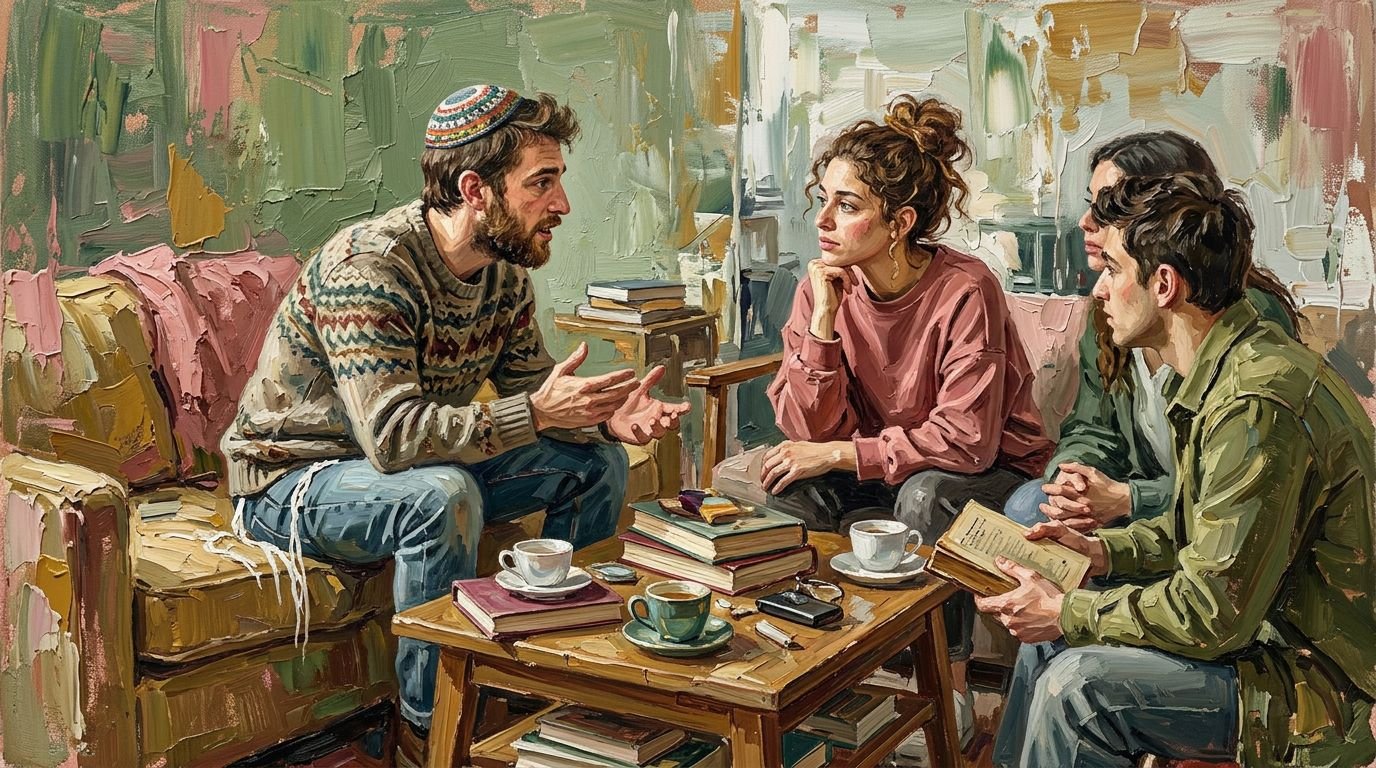
But beneath that surface, something more complicated is happening. Gen Z Jews, born roughly between 1997 and 2012, are increasingly drawn to Jewish practice – to Shabbat candles, to deliberate food choices, to weekly Torah study in someone’s apartment, to small havurot that meet in living rooms rather than sanctuaries. They are curious about prayer. They are reading Talmud.
They are asking what it means to live inside a tradition, not just alongside it.
This is not simply a return to the synagogue. It may be a return to something older: the portable, practice-centered Judaism that has sustained our people across every era of upheaval and change. Understanding what is driving this shift, and what it asks of our communities, is one of the defining challenges of Jewish life right now.
Why Tradition Feels More Compelling Than Institution
The distinction many young Jews draw is not between “religious” and “secular.” It is between practice and institution. For a generation that came of age watching institutions fail – financial systems, social trust, public health infrastructure – the appeal of a tradition that operates at a smaller, more personal scale is genuinely understandable.
Judaism has always grasped this. The Talmud in tractate Avot (2:4) teaches, “Do not trust in yourself until the day of your death” – a reminder that the work of Jewish living is never finished, never bureaucratized, never safely handed off to a committee. Jewish obligation is personal. It belongs to each of us, in our own kitchens and living rooms and communities.
There is also something specifically compelling about a tradition that makes claims on time rather than only on affiliation. When a young Jew lights Shabbat candles on Friday evening, they are not merely joining an organization. They are enacting a covenant with a community of memory that spans continents and centuries. That is a different kind of belonging than synagogue membership, and for many young people it feels more substantive and more honest.
Resources like Sefaria have made the texts themselves more accessible than at any earlier point in Jewish history, allowing anyone with a smartphone to engage primary sources in Hebrew, Aramaic, and English translation. For a generation that values directness and authenticity, going straight to the text feels more grounded than receiving tradition secondhand through an institution. The tradition’s intellectual richness is no longer gated behind a seminary degree or a synagogue library card.
Ritual as Identity: What Gen Z Is Actually Seeking
The young Jews turning toward practice consistently describe a few recurring themes when they try to articulate what draws them: structure, embodiment, continuity, and what one might call earned belonging. These are not vague spiritual longings. They are specific responses to specific conditions of contemporary life.
Structure matters deeply to a generation raised on infinite digital choice. The constant pressure to curate one’s identity, relationships, and information environment is exhausting in ways that young people are beginning to name openly. Jewish ritual offers a counter-pattern: obligations that arrive on a fixed schedule, practices that require the body as well as the mind, and a rhythm of the week that does not bend to algorithmic suggestion.
The Torah portion in Deuteronomy 6 frames the transmission of practice in powerful terms. The Shema, Judaism’s central declaration of faith, is immediately followed by the command to speak these words “when you sit in your house and when you walk by the way, when you lie down and when you rise up.” The rabbis understood this to mean that Jewish practice should run through the texture of daily life itself, not be reserved for designated religious occasions or institutional settings.
Embodiment is equally important. Kashrut requires attention to what enters the body three times a day. Shabbat requires physical rest, the lighting of candles, and the distinction between sacred and ordinary time. Tzitzit are worn on the body as a reminder of commandment.
These are not merely symbolic gestures. They are practices that train attention, cultivate intentionality, and create what the tradition calls kedushah – holiness – in ordinary moments.
For Gen Z, navigating a world of constant digital mediation, the pull of practices that require the physical, the embodied, and the present is a rational response to the specific conditions of their lives. It is not nostalgia. It is adaptation.
Shabbat, Kashrut, and Prayer Outside Synagogue Walls
The three pillars of traditional Jewish practice that appear most consistently in conversations with young observant or newly observant Jews are Shabbat, kashrut, and prayer. What stands out is how often these practices are described as portable, personal, and home-centered rather than synagogue-dependent.
Shabbat may be the most significant. The Talmud in tractate Shabbat (10b) records that God gave Israel the Shabbat as a precious gift – a matanah tovah, a genuinely good gift. But that gift does not require a synagogue building to receive. A table, candles, wine or grape juice, challah, and willing companions are sufficient.
Young Jews are discovering that hosting a Shabbat dinner for friends, or simply observing it alone in a small apartment, can be a genuine encounter with sacred time in a way that attending a formal service sometimes is not.
My Jewish Learning documents the breadth of Shabbat observance traditions across denominations, showing that there are many authentic ways to mark the day. This pluralism matters to young Jews who may not feel at home in any single denominational community but want their practice to be genuinely rooted in tradition rather than invented from scratch.
Kashrut can be observed entirely outside synagogue life as well. For some young Jews, keeping kosher is less about strict halakhic compliance in every detail and more about intentional food practice – choosing to make Jewish values visible at the dinner table, to ask what they eat and why.
Others follow kashrut rigorously, finding in its discipline a daily structure that feels meaningful and connective. Chabad.org offers detailed guides to kashrut observance for Jews at every level of practice, and its accessibility has made it a surprising reference point for young Jews exploring observance across the denominational spectrum.
Prayer presents a more layered picture. Many young Jews find the formal synagogue liturgy difficult to access – whether because of Hebrew fluency, unfamiliarity with the prayer structure, or simply a feeling that the davening in their local synagogue moves too quickly or too formally for real engagement. But this does not mean they are not praying. Small groups gather for havurah-style services in homes and community spaces.
Online resources and guided apps offer structured tefillah for learners. Many young Jews develop personal prayer practices that draw on traditional texts while adapting form to their circumstances.
The Talmud in tractate Berakhot (6a) teaches that prayer requires kavanah – intentionality of the heart. The rabbis did not say it requires a sanctuary.
Why Synagogue Membership Feels Less Central to Young Jews
Honesty about the practical barriers matters here. Synagogue membership often requires significant financial cost, a denominational affiliation that may not fit, a liturgical style that can feel foreign, and a demographic culture that skews considerably older. For a 24-year-old carrying student debt and working in the gig economy, an annual synagogue membership fee can be genuinely prohibitive. The “pay to pray” structure of High Holiday ticketing has been a persistent source of alienation for young Jews who might otherwise want to participate.
There is also a mismatch of scale. Many young Jews are looking for intimate community – ten or twenty people who genuinely know each other, where someone notices when you are absent. Large institutional synagogues often struggle to provide that experience, even with thoughtful small-group programming layered on top.
This is not, it should be said, a problem unique to synagogues. Churches, civic organizations, and other membership institutions are facing the same structural challenges. The decline of institutional affiliation is a broad social phenomenon, and it would be a mistake to read it as a specifically Jewish failure.
What is specifically Jewish is the tradition’s own resources for responding. Jewish life has always known how to create community at the micro-scale. The Talmud tractate Eruvin deals extensively with the eruv – a legal boundary that allows neighbors to share a common space and a common set of responsibilities on Shabbat. The eruv is not a building.
It is a practice that creates community through shared commitment and mutual acknowledgment. That model of community-as-practice rather than community-as-institution carries real wisdom for this moment.
Reform Judaism has invested in developing new entry points for young Jews who feel distant from traditional synagogue structures. The Jewish Theological Seminary has similarly documented and supported emerging forms of Jewish community formation that operate outside conventional institutional boundaries. Across denominational lines, Jewish institutions are working out how to reach young Jews where they are rather than waiting for them to appear at an established door.
Community, Meaning, and Obligation in a Post-Pandemic Era
The pandemic years clarified something that was already true: young Jews wanted Jewish community far more than they wanted Jewish infrastructure. When synagogues closed, what people mourned was connection, shared prayer, and the physical presence of familiar faces. What many discovered they did not miss was the institution itself.
The post-pandemic moment has accelerated a trend toward smaller, more intentional communities. Havurot – informal Jewish fellowship groups organized around study, prayer, and shared celebration – have seen renewed interest. Independent minyanim, prayer groups operating outside any official synagogue structure, have multiplied in urban areas. Study groups organized through social media, Jewish young adult networks, and informal connections are drawing participants who would never have joined a synagogue.
Research from Brandeis University‘s Cohen Center for Modern Jewish Studies has consistently shown that young Jews value Jewish connection, identity, and continuity even as they step back from formal institutional structures. The demand for Jewish meaning has not evaporated. The channel through which it flows has shifted.
The tradition itself anticipated this. Pirkei Avot (1:2) teaches that the world stands on three things: Torah, avodah (worship), and gemilut chasadim (acts of loving-kindness). Notice what is not on that foundational list: synagogue membership, denominational affiliation, or formal institutional structure. The tradition grounds Jewish life in practice and relationship.
That teaching is newly legible to a generation renegotiating where Jewish life happens and what it requires.
The post-pandemic turn toward obligation is also worth naming directly. Some young Jews, particularly those drawn toward more traditional practice, describe the appeal of halakha – Jewish law – in terms that might surprise those who assume young people want only flexibility and freedom. What they describe wanting is structure, accountability, and a community with shared expectations. A tradition that says “here is what we do on Friday night, and here is how we do it, and here is who we do it with” can feel less like restriction and more like a form of genuine care.
Being held by something turns out to be a different experience than being left to choose everything yourself.
What This Shift Means for Jewish Leaders and Writers
For rabbis, educators, and Jewish communal leaders, this moment carries both a real challenge and a genuine opportunity. The challenge is that young Jews are not coming through the front doors of our institutions in the numbers once expected. The opportunity is that many of them are seriously, substantively engaged with Jewish practice, text, and community – arriving through different doors.
The implication is not to abandon institutions, which remain critical anchors of communal resources, lifecycle support, and continuity. The implication is to take seriously the idea that Jewish life can be lived fully in many kinds of space, and that a 23-year-old who keeps Shabbat in an apartment with four friends and studies Talmud on a Tuesday night has a substantive Jewish practice, full stop – regardless of whether she holds a membership card anywhere.
For writers and thinkers, this shift invites a return to a question as old as the tradition itself: what is the minimum structure required for Jewish life to be transmitted and sustained? The Talmud records genuine controversies about prayer quorums, about the conditions under which obligations can be fulfilled, about what constitutes a valid Jewish community. These are not antiquarian questions. They are live ones, and we are living through a new iteration of them right now.
We might also recognize that this generation is asking Jewish tradition to do something it has always done when asked sincerely: carry people through difficult times. Economic uncertainty, ecological anxiety, political polarization, and the particular loneliness of digital life form the backdrop of Gen Z’s Jewish searching. The tradition has navigated exile, dispersal, persecution, and radical change before. It has resources for this moment too.
Our work – as writers, teachers, and community members – is to help young Jews find them, wherever they are standing.
- Gen Z’s relationship to Jewish tradition is best understood as practice-centered rather than institution-centered – many young Jews are more engaged with ritual than with formal affiliation.
- Shabbat, kashrut, Torah study, and informal havurot are the primary vehicles through which many young Jews are building Jewish lives today.
- The tradition’s own emphasis on daily practice and small-scale community gives Judaism unusual resources for this cultural moment of institutional distrust.
- Synagogue membership is declining not because young Jews reject Judaism, but often because cost, cultural distance, and scale make formal synagogue life feel inaccessible or ill-fitting.
- Post-pandemic Jewish life has accelerated the growth of independent minyanim, havurot, and informal study groups as genuine alternatives to institutional membership.
- Jewish leaders across denominations are rethinking how to reach young Jews where they are, drawing on the tradition’s own portable, practice-based model of community.
- The tradition’s own foundational texts – from Pirkei Avot’s grounding of Jewish life in Torah, worship, and loving-kindness to the Talmud’s flexible understanding of community – offer real guidance for this moment of reconfiguration.
- Q: Are Gen Z Jews becoming more religious, or just more traditional?
- The distinction matters more than it might seem. “Religious” in the conventional sense often implies belief, theology, and formal worship. “Traditional” points toward practice, rhythm, and cultural continuity. Many Gen Z Jews drawn toward kashrut, Shabbat, or Torah study would not describe themselves as more religious in a theological sense. They might describe themselves as more intentional about practice, more curious about what the tradition actually asks of them, and more interested in living inside Jewish time rather than simply identifying with it from the outside. The two things are not mutually exclusive, but they are genuinely different, and many young Jews are choosing the second even when uncertain about the first.
- Q: Why are some young Jews drawn to tradition but not synagogue?
- Several factors converge. Cost is real: synagogue membership fees, High Holiday tickets, and lifecycle event expenses create genuine barriers for young people with limited income. Scale is also a factor, since many young Jews want intimate community where they are truly known, and large institutional synagogues can be difficult to enter as a newcomer or outsider. There is also a cultural dimension: the liturgical style, music, and social dynamics of many established synagogues reflect the preferences of an older generation. None of this means young Jews are rejecting Jewish community. They are often actively building it – in apartments, study groups, and havurot that feel more immediate and legible to their actual lives.
- Q: Does returning to tradition mean a move toward Orthodoxy?
- Not necessarily, though some young Jews are indeed exploring Orthodox or traditional halakhic frameworks, and that phenomenon is real and worth taking seriously. The broader trend is less about denominational shift and more about renewed interest in the substance of Jewish practice, whatever form it takes within a given community or family. A Reform Jew who begins lighting Shabbat candles and observing more of the holiday cycle is returning to tradition without moving toward Orthodoxy. A Conservative Jew who joins a serious weekly Torah study group is deepening engagement with the tradition without changing affiliation. The search, broadly, is for depth and intentionality, and it is happening across the full denominational range.
- Q: What role does pandemic-era life play in this shift?
- The pandemic compressed and clarified trends that were already developing before 2020. It forced Jewish life out of institutional settings and into homes, and for many people that reorientation proved lasting. It also heightened the felt need for structure, community, and meaning that many young Jews are now seeking through Jewish practice. At the same time, it disrupted the standard entry points to Jewish community – Birthright trips, campus Hillels, lifecycle celebrations – in ways that pushed some young Jews to find their own pathways into Jewish life. The post-pandemic moment is one in which the Jewish world is still working out what those new pathways look like at scale, and the conversation is genuinely open.
The story we sometimes tell ourselves about Jewish continuity assumes it runs through institutions, buildings, and membership rolls. But the longer history of our people suggests something different. Jewish life has survived – and often flourished – precisely because its most essential practices are portable, personal, and built into the texture of ordinary days. Gen Z is not abandoning that inheritance.
Many young Jews are, in their own way, reaching back toward it: to the Shabbat table, to the study partnership, to the covenant that does not require a parking lot or an annual pledge form. Our task, as a community of writers, teachers, and leaders, is to recognize what is happening, to take it seriously, and to be genuinely present in the spaces where a new generation is finding its way home.