Parashat Ki Tisa: From Golden Calf to Divine Mercy
How This Week’s Torah Portion Transforms Our Understanding of Failure, Forgiveness, and Finding Our Way Back to What Matters Most
TL;DR: Parashat Ki Tisa tells the story of the Golden Calf disaster and God’s incredible response of mercy. This Torah portion teaches us that even our worst mistakes can become opportunities for deeper connection and understanding, both with the divine and with ourselves.
Quick Takeaways
- Equal census. Every Israelite gives the same half-shekel, teaching that all souls have equal value regardless of wealth.
- Golden Calf crisis. While Moses is on Mount Sinai, the people create an idol, leading to the breaking of the first tablets.
- Divine mercy revealed. God shows Moses the 13 Attributes of Mercy, foundational to Jewish understanding of forgiveness.
- Second chances matter. Moses carves new tablets, symbolizing that we can always begin again after failure.
- Leadership under pressure. Aaron’s complex role shows how good people can make poor choices in difficult circumstances.
- Modern golden calves. Today’s idols might be social media, materialism, or anything that distracts from authentic values.
- Practical repentance. The parsha offers a roadmap for acknowledging mistakes and rebuilding trust.
We’ve all been there. That moment when we realize we’ve messed up so badly that we wonder if there’s any way back. Maybe it’s a relationship we’ve damaged, a promise we’ve broken, or a value we’ve compromised. In our hyperconnected world, these failures feel even more devastating because they’re often public, permanent, and impossible to escape.
This week’s Torah portion, Parashat Ki Tisa, speaks directly to this human experience of failure and recovery. But it doesn’t just offer comfort, it provides a practical framework for transformation that has guided Jewish communities for thousands of years. The story begins with a census and ends with radiant forgiveness, taking us through one of the most dramatic episodes in Jewish history.
The Story Unfolds: From Census to Crisis
Ki Tisa opens with God instructing Moses about taking a census of the Israelites. But this isn’t just any headcount. Each person, rich or poor, must contribute the same half-shekel (Exodus 30:12). As Chabad.org explains, this equal contribution teaches us that every soul has the same infinite value before God.
The Torah then details the creation of the anointing oil for the Tabernacle and emphasizes the importance of Shabbat observance. Everything seems to be proceeding according to divine plan. Moses is on Mount Sinai receiving the tablets, the people below are waiting, and the covenant between God and Israel appears solid.
But then disaster strikes. When Moses delays his return, the people panic. “This man Moses, who brought us from the land of Egypt, we do not know what has become of him” (Exodus 32:1). In their anxiety and uncertainty, they pressure Aaron to create something tangible, something they can see and touch. The result? A golden calf, declared with the words: “This is your god, O Israel, who brought you out of the land of Egypt!” (Exodus 32:4).
Rashi’s commentary on this verse reveals Aaron’s complex motivations. According to traditional interpretation, Aaron feared that refusing the people’s demands might lead to violence. He hoped to delay the project until Moses returned. Sometimes even our best intentions can lead to catastrophic outcomes, a lesson that resonates deeply in our age of difficult leadership decisions.
When Moses Breaks: The Tablets and Our Hearts
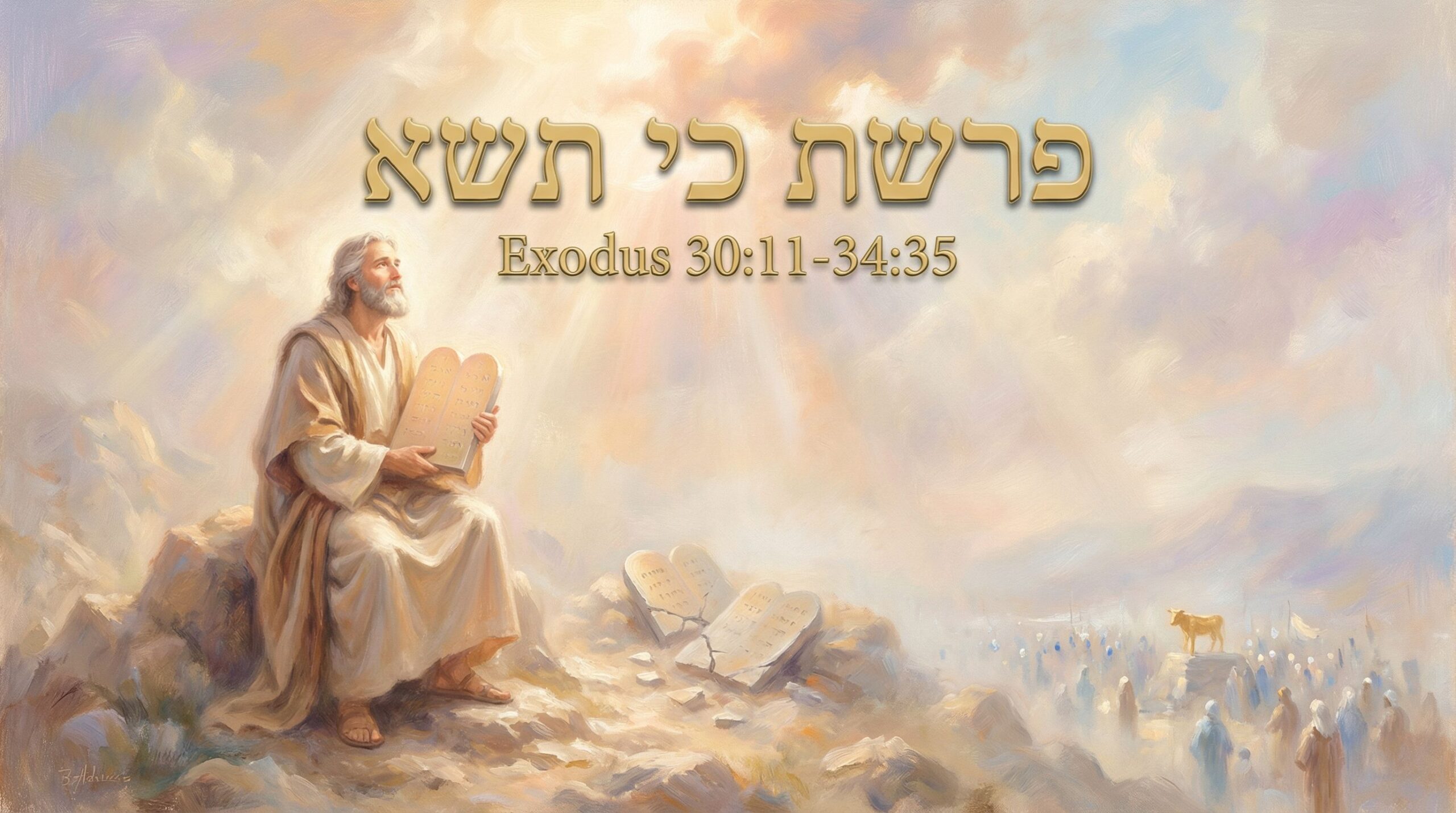
Moses’ reaction upon seeing the golden calf is immediate and visceral. The text tells us he “became enraged; and he hurled the tablets from his hands and shattered them at the foot of the mountain” (Exodus 32:19). This isn’t just anger, it’s heartbreak. The tablets, described as “the work of God” with writing that was “God’s writing” (Exodus 32:16), lie in pieces.
Orthodox tradition teaches that Moses broke the tablets deliberately, reasoning that if the people had violated the covenant, they shouldn’t possess its physical symbol. Conservative and Reform perspectives often emphasize the human emotion in this moment, seeing Moses as a leader overwhelmed by the gap between divine expectation and human reality.
The Talmud in Shabbat 87a offers a fascinating detail: the letters themselves flew off the tablets before they shattered, as if the divine words couldn’t bear to be associated with the scene below. This image captures something profound about how our worst moments can feel like everything sacred has abandoned us.
But here’s what’s remarkable: God doesn’t abandon the covenant. This crisis, instead, becomes the catalyst for revealing something even more precious than the original tablets.
💡 Did You Know?
Parashat Ki Tisa is read on Shabbat Parah, when we also read a special maftir about the red heifer ritual for Passover purification. This connection between the golden calf story and purification rituals isn’t coincidental, it emphasizes themes of cleansing and renewal that run throughout the parsha.
The 13 Attributes: A Master Class in Mercy
After the immediate crisis passes, Moses makes an extraordinary request. He asks to see God’s glory (Exodus 33:18). God’s response becomes one of the most important passages in all of Jewish liturgy: the revelation of the 13 Attributes of Mercy.
“The Lord! the Lord! a God compassionate and gracious, slow to anger, abounding in kindness and faithfulness, extending kindness to the thousandth generation, forgiving iniquity, transgression, and sin” (Exodus 34:6-7). According to MyJewishLearning, these attributes form the theological foundation for Jewish concepts of repentance and forgiveness.
The Talmud in Rosh Hashanah 17b teaches that whenever Israel sins, they should recite this formula and they will be forgiven. But this isn’t magic, it’s psychology and spirituality working together. By focusing on divine mercy rather than divine judgment, we create space for genuine teshuvah (repentance) to occur.
Each attribute offers practical guidance. “Slow to anger” suggests we should pause before reacting to others’ mistakes. “Abounding in kindness” reminds us that generosity of spirit should be our default mode. These aren’t just theological concepts but a blueprint for building healthier relationships and communities.
Modern Jewish movements interpret these attributes differently but find common ground in their emphasis on human potential for growth. Reform Judaism particularly emphasizes the universal applicability of these mercy principles, while Orthodox tradition focuses on their specific role in the Jewish covenant relationship.
Modern Golden Calves: What Are We Really Worshipping?
The golden calf story isn’t really about ancient idol worship, it’s about the human tendency to create false sources of security and meaning. Today’s golden calves might be our smartphones, our bank accounts, our social media metrics, or our professional achievements. Anything that we turn to for ultimate meaning and security instead of authentic values and relationships.
The Hebrew word for idol, “avodah zarah,” literally means “strange service.” When we think about it this way, we can ask ourselves: what strange services are we performing? What are we sacrificing our time, energy, and authentic selves to serve?
Social media offers a particularly relevant parallel. Like the Israelites who wanted something visible and immediate instead of waiting for Moses, we often crave instant validation and visible metrics of worth. We check our phones compulsively, seeking the dopamine hit of likes and comments, creating our own kind of golden calf that demands constant attention and worship.
Reform Judaism’s perspective on Ki Tisa emphasizes that ethical monotheism isn’t just about believing in one God, but about organizing our lives around one coherent set of values rather than fragmenting ourselves among competing loyalties.
The half-shekel census at the beginning of the parsha offers an antidote to modern inequality and status obsession. Everyone gives the same amount, regardless of wealth. This principle challenges our culture’s emphasis on wealth as a measure of worth and suggests that true community building requires equal participation from all members.
The Path Back: Lessons in Repair and Renewal
The most hopeful part of Ki Tisa isn’t the crisis itself but what comes after. Moses doesn’t just intercede for the people, he carves new tablets to replace the broken ones. The second set isn’t described as inferior to the first, in some traditions, they’re considered even more precious because they represent the possibility of return and renewal.
This process offers a practical model for anyone dealing with failure or betrayal. First comes acknowledgment, Moses doesn’t minimize or excuse the sin. Then comes advocacy, he argues for the people’s worth despite their mistakes. Finally comes action, the concrete work of rebuilding what was broken.
The Talmud in Bava Batra 14b teaches that both the broken pieces of the first tablets and the complete second tablets were kept together in the Ark of the Covenant. This detail is profound: we don’t discard our broken pieces or pretend they never happened. Instead, we carry them alongside our renewed commitments as reminders of our capacity for both failure and recovery.
For individuals struggling with addiction, broken relationships, or professional failures, this model suggests that recovery isn’t about becoming someone new but about integrating all parts of our story into a more complete whole. The broken tablets have their own sanctity.
Putting This Into Practice
If you’re just starting: Take time this week to identify one “golden calf” in your life, something you turn to for comfort or validation that might be distracting you from deeper values. Don’t judge yourself harshly, just notice the pattern with curiosity and compassion.
To deepen your practice: Memorize one or two of the 13 Attributes of Mercy and recite them when you’re frustrated with someone (including yourself). Practice extending the same patience and kindness that you hope to receive. Consider giving equally to charity this month regardless of your financial situation, honoring the half-shekel principle.
For serious exploration: Study the complete text of the 13 Attributes and incorporate them into your daily meditation or prayer practice. When you face a major failure or disappointment, use Moses’ model: acknowledge what went wrong, advocate for what’s still possible, and take concrete action toward repair. Consider how you might carry both your “broken tablets” and your renewed commitments together.
The story of Ki Tisa reminds us that our worst moments don’t have to be our final moments. The Israelites who danced around the golden calf are the same people who later built the Tabernacle and received the Torah. The Moses who broke the tablets in rage is the same Moses who glowed with divine light after receiving the second set.
This week, as we read about failure and forgiveness, broken tablets and divine mercy, we’re invited to see our own struggles differently. Maybe the things we’re most ashamed of can become doorways to deeper understanding. Maybe our capacity for mess is matched only by our capacity for repair. And maybe that’s exactly how it’s supposed to be.
The golden calf is gone, but the memory remains. The first tablets are shattered, but the second ones endure. And we, like the Israelites in the wilderness, continue the long journey toward becoming who we’re meant to be, carrying all our pieces, broken and whole, sacred and ordinary, toward a destination that’s always just beyond the horizon but never out of reach.
Frequently Asked Questions
- Q: What is Parashat Ki Tisa about?
- A: Ki Tisa tells the story of the Golden Calf incident, Moses breaking the tablets, and God revealing the 13 Attributes of Mercy, culminating in forgiveness and new tablets.
- Q: Why did the Israelites build the Golden Calf?
- A: When Moses delayed his return from Mount Sinai, the people panicked and demanded a tangible god they could see, leading Aaron to create the golden calf.
- Q: What is the significance of the half-shekel in Ki Tisa?
- A: The half-shekel census required equal contributions from rich and poor alike, teaching that all souls have equal infinite value before God.
- Q: What are the 13 Attributes of Mercy?
- A: God’s revelation to Moses of divine characteristics emphasizing compassion, patience, kindness, and forgiveness that became foundational to Jewish theology and prayer.
- Q: How can I apply Ki Tisa lessons today?
- A: Identify modern ‘golden calves’ like materialism or social media, practice the mercy attributes in relationships, and embrace second chances after failures.