What to do when you’re alone on Shabbat: 7 meaningful rituals
Quick Takeaways
- You can do every Shabbat ritual by yourself. Candle lighting, Kiddush, and blessings over bread don’t require a family or minyan.
- Alone and lonely aren’t the same thing. A solo Shabbat can be deeply restful and spiritually rich.
- Start simple. Even lighting one candle and saying one blessing creates sacred time.
- Cook for yourself like you matter. A beautiful meal for one honors both Shabbat and yourself.
- Community is always an option. Synagogues, Chabad houses, and organizations like OneTable can connect you with others.
- Shabbat adapts to your life. There’s no single right way to observe – what matters is making it meaningful for you.
The Challenge of Shabbat Dinner for One
Friday evening arrives. The sun is setting. And you’re standing in your kitchen, alone, wondering if Shabbat (the Jewish Sabbath) is even meant for people like you – people without a bustling family table, without children to bless, without a partner to share the wine.
If this sounds familiar, you’re not alone in feeling alone. Many Jewish adults – single, divorced, widowed, or simply living far from family – struggle with how to observe solo Shabbat in a tradition that seems built around communal tables. The images we carry of Friday night are powerful: generations gathered, songs rising, platters being passed. When your reality looks different, it’s easy to feel like you’re doing it wrong or that Shabbat isn’t really for you.
But here’s what Jewish tradition actually teaches: every single ritual associated with Shabbat dinner can be done by one person. As My Jewish Learning explains, “All of the blessings that go along with Shabbat, from lighting the candles, to saying Kiddush, Hamotzi, and Birkat Hamazon, can be done on your own.” You don’t need a minyan. You don’t need a family. You need only yourself and the willingness to create something sacred.
Why Shabbat Matters Even More When You’re Alone
Rabbi Abraham Joshua Heschel, one of the most influential Jewish thinkers of the twentieth century, called Shabbat “a sanctuary in time.” He wrote: “The meaning of the Sabbath is to celebrate time rather than space. Six days a week we live under the tyranny of things of space; on the Sabbath we try to become attuned to holiness in time.”
This idea is especially powerful for someone living alone. You don’t need a beautiful house or a dining room full of guests to enter this sanctuary. The sanctuary exists in time itself – and time is something you have, no matter your living situation.
There’s actually something valuable about experiencing Shabbat in solitude. Without the noise of conversation and the pressure to host, you can hear yourself think. You can rest in a way that’s harder to access when you’re managing other people’s needs. The Hebrew word for the rest of Shabbat is menucha, which means something deeper than just not working – it suggests tranquility, peace, a settled soul. Sometimes that kind of peace is easier to find when you’re not performing for anyone else.
The Talmud records a teaching (Taanit 23a) that says “either companionship or death,” acknowledging how important connection is to human wellbeing. But it also recognizes that there are different kinds of connection. Connection to yourself, to tradition, to the rhythm of sacred time – these also sustain us.
A Step-by-Step Guide to Solo Shabbat Dinner
Here’s how to create a meaningful Friday night experience when it’s just you:
Before Shabbat Begins
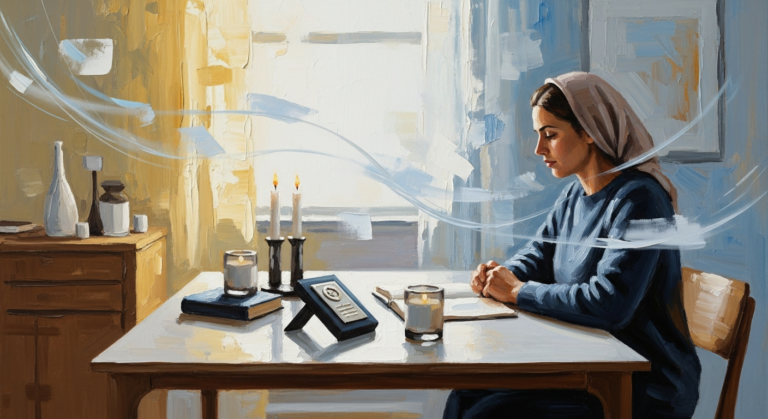
Prepare your space. Clean up enough that your home feels restful. Set your table – yes, even for one person. Use a real plate, a real glass, maybe a tablecloth. This isn’t about impressing anyone. It’s about signaling to yourself that this time is different.
Prepare your food. You don’t need to cook a seven-course meal, but do make something you’ll enjoy. A simple roast chicken, a salad, some good bread – whatever feels like a treat. The point is to honor Shabbat and yourself with food that feels special. Leftovers can become tomorrow’s lunch.
Get your supplies ready. You’ll need candles (single women traditionally light one candle; men living alone also light), wine or grape juice, and challah or any bread. If you don’t have challah, regular bread works fine.
Welcoming Shabbat
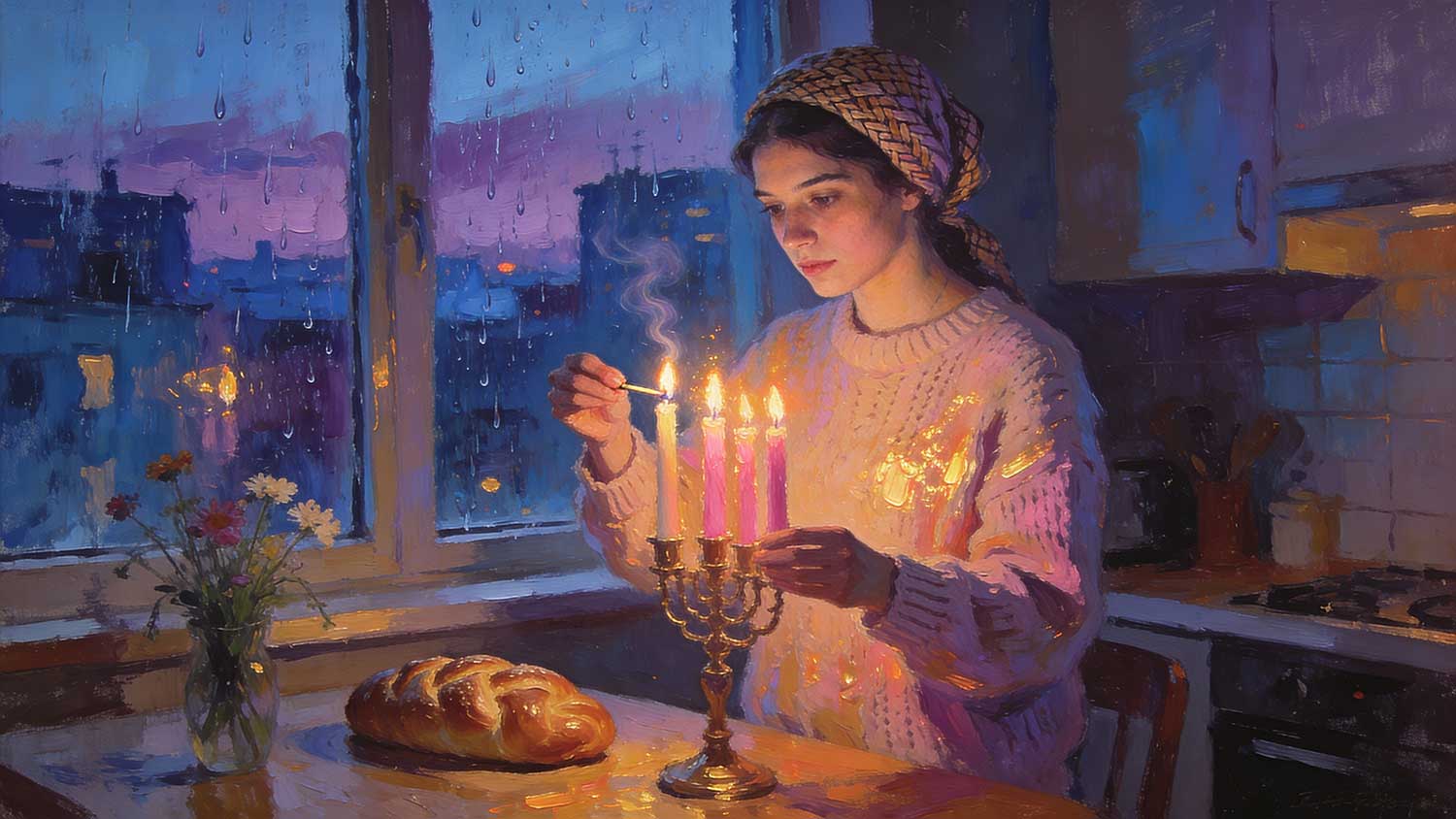
Light candles. The tradition is to light 18 minutes before sunset. After lighting, cover your eyes and recite the blessing: “Baruch atah Adonai, Eloheinu melech ha’olam, asher kid’shanu b’mitzvotav v’tzivanu l’hadlik ner shel Shabbat.” (Blessed are You, Lord our God, Ruler of the universe, who has sanctified us with commandments and commanded us to light Shabbat candles.) Then uncover your eyes and look at the candles. Take a breath. Shabbat has begun.
Say Kiddush. Hold your cup of wine or grape juice and recite the Kiddush, the prayer that sanctifies the day. You can find the full text at Chabad.org. It’s perfectly acceptable to say Kiddush in English if you don’t read Hebrew.
Wash hands and bless the bread. Wash your hands ritually (pouring water over each hand) and say the blessing for handwashing. Then uncover your challah and say the Hamotzi: “Baruch atah Adonai, Eloheinu melech ha’olam, hamotzi lechem min ha’aretz.” (Blessed are You, Lord our God, Ruler of the universe, who brings forth bread from the earth.)
💡 Did You Know?
The custom of covering challah during Kiddush comes from a beautiful teaching about sensitivity. Just as the manna in the desert was covered by dew above and below, we cover the bread so it won’t be “embarrassed” that the wine blessing comes first. If Jewish tradition extends this kindness to bread, imagine how much more it values kindness toward people – including yourself.
Making Your Solo Shabbat Feel Special
The difference between a regular Friday night and Shabbat isn’t just the blessings – it’s the atmosphere you create. Here are some ways to make your evening feel distinct:
Disconnect intentionally. Put your phone away, or at least silence it. Different Jewish communities have different standards about technology on Shabbat. Some people observe strict prohibitions; others simply try to reduce screen time. Whatever your practice, creating some separation from the digital world helps Shabbat feel different from every other night.
Read something meaningful. This might be the weekly Torah portion (called the parsha), a book about Jewish ideas, poetry, or anything that feeds your soul. Sefaria offers free access to Jewish texts in Hebrew and English.
Sing, if you want to. Traditional Shabbat songs called zemirot are often sung at the table. Singing alone might feel awkward at first, but there’s something powerful about it. If singing isn’t your thing, put on some peaceful music instead.
Take a real break. Sleep in on Saturday. Go for a walk. Sit and do nothing. The word Shabbat comes from the Hebrew root meaning “to cease.” Give yourself permission to stop.
When Loneliness Hits
Let’s be honest: sometimes a solo Shabbat feels peaceful, and sometimes it just feels lonely. Both experiences are valid. Jewish tradition doesn’t pretend that being alone is always wonderful. The Torah’s very first “not good” appears in Genesis 2:18: “It is not good for man to be alone.”
If loneliness is a regular struggle, Shabbat can actually be part of the solution. Organizations like OneTable connect young Jewish adults with Shabbat dinner opportunities. Many Chabad houses welcome anyone for Friday night meals – you don’t need to be observant or even Jewish to attend. Synagogues often have hospitality committees that match guests with host families.
You might also consider hosting. Inviting even one other person over changes the dynamic completely. It doesn’t have to be elaborate. Soup, bread, wine, and good conversation make a Shabbat dinner.
But on weeks when you are alone – by choice or circumstance – know that your Shabbat still counts. Your candles still shine. Your blessings still rise. The tradition holds you even when no other person is there to do so.
Putting This Into Practice
Here’s how to start building your solo Shabbat practice:
If you’re just starting: Commit to lighting candles and saying the blessing this Friday. That’s it. Don’t worry about the full dinner or all the prayers. One candle, one blessing, one moment of marking the transition into Shabbat. See how it feels.
To deepen your practice: Add Kiddush and Hamotzi to your routine. Prepare a meal you actually look forward to eating. Set your phone to “do not disturb” for the evening. Try reading a few paragraphs of the weekly Torah portion during or after dinner.
For serious exploration: Learn the full Friday night liturgy and practice saying it at your own pace. Experiment with more traditional observance – perhaps avoiding work, cooking, or technology. Find a community to join for occasional Shabbat meals, whether through a synagogue, Chabad, or an organization like OneTable. Consider inviting others into your home to share what you’ve created.
Remember: Jewish tradition values any step toward observance. You don’t have to do everything perfectly. You don’t have to do everything at all. Start where you are and grow from there.
The Gift of Sacred Solitude
There’s a teaching that Shabbat is a foretaste of the world to come – a glimpse of what complete peace might feel like. For many people, that glimpse comes most clearly not in the chaos of a crowded table but in quiet moments of reflection and rest.
Living alone doesn’t mean living without Shabbat. It means discovering what Shabbat can become when you’re not performing for anyone else. It means learning to treat yourself as someone worth cooking for, worth blessing, worth giving rest to.
The Sabbath, Heschel wrote, “is a palace in time which we build.” You can build that palace anywhere. You can build it alone. And when you do, you’re not doing something lesser than the families gathered around their tables. You’re doing the same sacred work they’re doing: stopping, breathing, remembering that life is more than what we produce and acquire.
This Friday, light your candle. Bless your wine. Break your bread. Let Shabbat hold you, even when no one else is there. The tradition is big enough for your table, exactly as it is.
Shabbat shalom.
Frequently Asked Questions
- Q – Can I say Kiddush and other Shabbat blessings by myself?
- A – Yes. All Shabbat blessings – candle lighting, Kiddush over wine, Hamotzi over bread, and Birkat Hamazon after the meal – can be recited by one person. You do not need a minyan or family present. These rituals are personal obligations that each Jew can fulfill individually.
- Q – How many Shabbat candles should a single person light?
- A – Traditional practice varies. Single women typically light one candle, while married women light two or more. Men living alone also light candles. Some communities encourage everyone to light two candles regardless of marital status. The minimum requirement is one candle that will last until dark.
- Q – Where can I find Shabbat dinner if I don’t want to eat alone?
- A – Many options exist. Chabad houses worldwide welcome guests for Friday night meals. Organizations like OneTable connect young adults with Shabbat experiences. Local synagogues often have hospitality programs matching guests with host families. You can also host your own dinner and invite friends or neighbors.
- Q – Do I need to cook an elaborate meal for Shabbat dinner alone?
- A – No. What matters is making the meal feel special, not complicated. A simple roast chicken, salad, and bread works beautifully. Some people prepare components on Thursday to reduce Friday stress. The goal is honoring Shabbat with intention, not exhausting yourself with elaborate preparations.
- Q – Is it still considered Shabbat observance if I do it alone without a community?
- A – Absolutely. While community enhances Shabbat, solo observance is fully valid and meaningful. The commandment to remember and observe Shabbat applies to each individual. Many aspects of Shabbat – rest, reflection, disconnecting from work – can be experienced deeply in solitude. Your observance counts.