
How to Build a Jewish Practice from Scratch at 35
- 35 is not a late start in Jewish life; it is a mature entry with exactly the qualities the tradition values – life experience, genuine urgency, and the freedom to choose practices that actually fit your days.
- Begin with one or two repeatable, scalable rituals – Shabbat, a mealtime blessing, or a weekly learning session – before layering on more observances.
- Orthodox, Conservative, Reform, and Reconstructionist traditions all welcome adult beginners, though each frames the journey differently: through halakhic structure, covenantal response, intentional choice, or creative reimagining.
- Community and mentorship matter enormously; finding one rabbi, study partner, or local group will carry you further than any solo effort.
- Jewish tradition models practice-first growth: the Sinai vow was “naaseh v’nishma” – we will do, and then we will understand.
There is a moment many of us reach somewhere in our thirties when the spiritual shortcuts of earlier life stop working. The busy-ness that once filled every hour begins to feel hollow. The friendships and careers we built with such effort don’t answer the older, quieter questions: Who am I? What are my obligations?
What will I pass on? For Jews who grew up minimally observant, for those who married into Jewish life, and for anyone standing at the edge of a tradition they sense belongs to them but have never fully claimed, 35 is not too late. It is, in many ways, exactly the right moment. Judaism offers tested structures for turning life experience into resilient, embodied spiritual practice.
This article is a practical guide for building that life from scratch – not through guilt or obligation-anxiety, but through the wisdom that real practice is built one consistent step at a time.
Why 35 Is a Powerful Time to Start Jewish Practice
The patriarch Abraham received God’s first call – “Lech Lecha,” go forth – at the age of 75 (Genesis 12:1-4). The rabbis read that late beginning not as a limitation but as a statement about when a person is spiritually ready to travel. At 35, we are neither Abraham’s age nor are we teenagers handed a bar mitzvah script we didn’t write. We are people who have lived enough to know what we want rest from, what we want to build, and what we want to mean to the people around us.
Classical Jewish thought does not favor the precocious beginner over the sincere late-comer. Pirkei Avot 4:1 teaches: “Who is wise? One who learns from every person.” The text does not ask when the learning began. What it asks is whether the learner’s posture is genuinely open.
At 35, most of us have been humbled enough by life to show up that way.
There is also a legal-philosophical reason to feel encouraged rather than behind. The Talmud in Makkot 23b-24a records that Rabbi Simlai counted 613 commandments in the Torah – and then the tractate traces how later prophets distilled those commandments down to their moral essence, until Habakkuk summarized the entire Torah in a single principle: “The righteous person lives by their faithfulness” (Habakkuk 2:4). The point is not that the individual commandments don’t matter.
The point is that Jewish life is organized around a center of faithfulness, and you can locate that center from wherever you are standing right now.
Research supports what tradition suggests. Scholars working with the Brandeis University program on contemporary Jewish practice have found that adult returners and late-bloomers often show higher rates of sustained engagement than those who received obligatory childhood religious education and then drifted. Chosen practice tends to stick.
Choosing Your First Core Rituals: Shabbat, Blessings, and Learning
Every experienced Jewish educator will tell you the same thing when you ask where to begin: do not try to do everything at once. A practice overwhelmed by its own ambition will not survive contact with a real Tuesday.
The three most recommended entry-point practices, across denominations, are Shabbat, daily or mealtime blessings, and regular Torah study. Each has a quality that makes it ideal for beginners: it is repeatable, it has clear structure, and it scales from minimal to elaborate depending on where you are in any given week.
Shabbat. The fourth commandment (Exodus 20:8) says simply: “Remember the Sabbath day to sanctify it.” What does sanctifying Friday night look like from scratch?
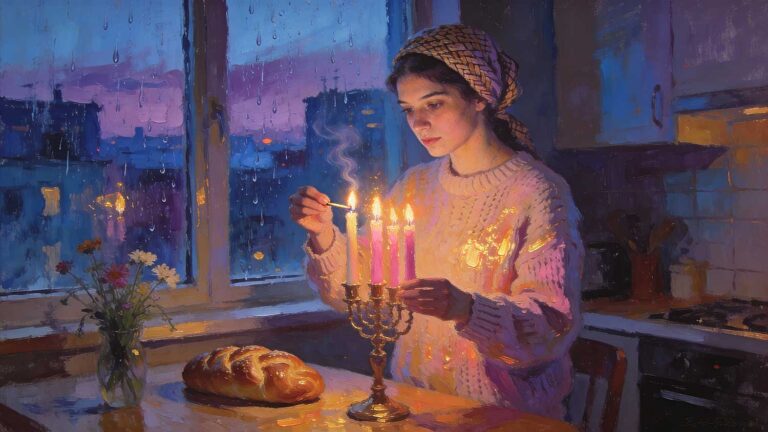
Two candles, a cup of wine or grape juice for Kiddush, two challah loaves covered with a cloth, and the willingness to let the week stop. My Jewish Learning’s guide to starting Shabbat observance and Chabad’s introduction to keeping Shabbat both offer step-by-step scripts for a first Friday night.
The ritual can be as spare as ten minutes or as elaborate as a multi-course dinner – start on the spare end and grow.
Blessings. The Talmud (Berakhot 35a) teaches that enjoying this world without a blessing is like stealing from God. That’s a bracing image, but its practical meaning is this: Jewish tradition has given us a way to interrupt automatic consumption and replace it with intentional gratitude. Learning the blessing before bread (HaMotzi) and a short form of Birkat HaMazon after meals creates two daily bookmarks of attention.
The Sefaria Jewish texts library has every blessing in Hebrew with transliteration and translation, free to access, which means Hebrew fluency is not required to begin.
Learning. Torah study is itself a mitzvah, not a prerequisite for other mitzvot. Even fifteen minutes a day of reading a parsha commentary, exploring a Talmud passage, or working through a contemporary Jewish thinker counts. A weekly Torah portion cycle, followed by millions of Jews across denominations each Shabbat, is one of the best organizing structures available to a beginner. It connects you immediately to a worldwide community reading the same text on the same day, regardless of what city or movement you belong to.
Designing a Sustainable Daily and Weekly Jewish Rhythm
The Torah portion of Vayakhel-Pekudei (Exodus 35-40) describes the construction of the Mishkan – the portable sanctuary the Israelites built in the wilderness. What stands out about that project is its granularity. Every craftsperson, every material, every measurement is catalogued. The rabbis read this as a message about how sacred things are built: through specific, recurring labor, not through occasional acts of inspiration.
A Jewish life is a Mishkan you construct in exactly that way.
A sustainable rhythm has both daily and weekly layers. The daily layer might be as simple as Modeh Ani (the morning gratitude prayer said upon waking), a mealtime blessing, and fifteen minutes of study.
That is roughly twenty minutes in total – less than most of us spend scrolling before we finish our first cup of coffee. The Reform movement’s resources on making Jewish ritual a habit emphasize exactly this: start small, make it specific, and tie it to behaviors you already do reliably. “After I make coffee, I say Modeh Ani. After dinner, I say HaMotzi.”
The weekly layer is anchored by Shabbat, with one additional element: a weekly Torah study session, either solo or with a chavruta (study partner). Many synagogues offer Saturday morning Torah discussions, weekly email divrei Torah, or online study groups that require nothing more than a willingness to show up.
The Reconstructionist framework offers a helpful map for anyone who finds halakhic structure daunting. It identifies seven essential Jewish practices: stopping (Shabbat), giving (tzedakah), interpreting (study), loving (gemilut chasadim), repairing (tikkun olam), awakening (prayer or meditation), and connecting (community and covenant). Think of these not as a checklist but as a menu.
In year one, you might choose two or three to focus on, knowing the others will be there when the time is right.
Finding Community, Mentors, and Denominational Fit
Judaism has never been a solo project. The Talmud (Berakhot 8a) advises that one should live near a house of study – and the practical reason behind that teaching is straightforward. Proximity to community creates accountability, shared vocabulary, and the kind of accidental learning that happens when you overhear someone more experienced answer a question you hadn’t thought to ask.
At 35, finding the right community often means visiting several before committing. Orthodox, Conservative, Reform, and Reconstructionist synagogues are organized around different assumptions about the authority of Jewish law, the role of Hebrew liturgy, and the nature of revelation. Each has something genuine to offer. The denominational question matters less than whether you feel you can ask honest questions in that room and whether the community is genuinely interested in welcoming newcomers rather than simply performing welcome.
A rabbi or mentor relationship is, for most successful adult beginners, the single most important accelerant. A good mentor does not just transmit content – they model what it looks like to live a question rather than to have resolved all the answers. They can also help you calibrate pace: when you’re moving too fast and burning out, or when you’ve plateaued and are ready to add a new layer of practice. Many rabbis are available for a brief, no-commitment conversation with people exploring the tradition.
You do not need to wait until you feel “ready enough” to reach out. Readiness, in this context, is something you build through contact, not in preparation for it.
Study partners (chavruta) serve a related function. Traditional Jewish learning is explicitly dialogical – two people wrestling with a text together, pushing each other’s assumptions, arriving at understanding through argument. Even a weekly twenty-minute phone call with someone else who is beginning their practice creates real accountability and keeps the learning alive between formal sessions.
Reimagining Ritual: Making Ancient Practices Your Own
One of the gifts of coming to Jewish practice as an adult is that you can be intentional about it in a way that childhood religious education rarely allows. You can ask, at every step: what is this ritual actually for? What does it do to me when I do it consistently? What would I lose if I stopped?
The portion of Lech Lecha (Genesis 12) tells us that when Abraham set out on his journey, “he went as God had spoken to him.” He did not have a map. He had a direction and a covenant. Adult Jewish practice works the same way – you choose a direction and accept that the meaning of the journey will become clear as you walk it, not before.
Reform Judaism has been particularly explicit about intentionality. Its theology of informed autonomy invites practitioners to approach ritual as a thoughtful choice: you observe Shabbat because the practice of weekly rest and sanctification does something real in your life, not because external authority compels you. That intentionality is not a lesser form of observance. For many adults, it is the only form that will survive long enough to develop depth.
Orthodox and Conservative perspectives rightly point out that the meaning of many rituals is not fully apparent until you have practiced them long enough to notice what they do to your relationship with time, with gratitude, and with community. The halakhic framework provides structure that protects a practice against the drift of individual preference and overwhelmingly busy schedules. Both truths are worth holding together: choose deliberately, and then trust the structure enough to practice even when the meaning isn’t immediately obvious.
Practically, “making it your own” can mean setting the Shabbat table with objects that carry family meaning. It can mean pairing a daily blessing with a moment of genuine attention to the food or the morning in front of you. It can mean saying a Hebrew prayer alongside your own translation. Judaism has always developed this way – each generation adapting forms while transmitting substance across the generations.
When You Feel Overwhelmed: Pacing, Patience, and Growth
You will, at some point in this process, feel like a fraud. Or like you are too far behind to catch up. Or like you did everything right for six weeks and then Shabbat fell apart three times in a row because life intervened. This is not a sign that you are failing.
It is a sign that you are in the middle of something real.
Pirkei Avot 2:4 teaches: “Do not be sure of yourself until the day of your death.” The rabbis did not mean that as a discouragement. They meant it as a release from the pressure of premature certainty. A Jewish life is not a project you finish; it is a direction you keep returning to after every detour.
The rabbinic concept of teshuva – typically translated as “repentance” but more precisely meaning “return” – applies directly here. When you have been away from your practice for a week or a month, you do not start over from zero. You return. The same door that was open before is open now.
The Talmud (Yoma 86b) teaches that through genuine return, even intentional failures can be reoriented into forward momentum. That is a radical teaching about the reversibility of absence, and it is meant for people in exactly your situation.
The practical implication: keep your entry-level practice small enough that it survives a difficult week. If Shabbat dinner with candles and Kiddush is your practice, that Shabbat dinner takes roughly twenty minutes. A week in which you had a sick child, a work deadline, and a family conflict still contains twenty minutes on Friday evening. Design for the hard weeks, not just the easy ones.
When you are ready to add more depth, add a single element and give it at least a month before evaluating whether to keep it.
Jewish educators often recommend an annual review of your practice – timed, perhaps, to Rosh Hashana, when the tradition already invites honest self-assessment. Ask yourself: which practices are genuinely feeding my life? Which feel empty or performed? What do I want to add in the coming year?
That rhythm of intentional assessment and adjustment is itself a form of spiritual discipline, not a sign that the practice isn’t working.
- 35 is not a late start – it is a mature entry with the life experience, genuine urgency, and freedom of choice that the tradition values in a learner.
- Begin with one or two repeatable, scalable practices (Shabbat, a mealtime blessing, a weekly study session) and build slowly rather than trying to do everything in year one.
- The ancient Sinai principle of “naaseh v’nishma” – doing before fully understanding – is the honest description of how lasting religious practice develops; commit to consistency and the meaning follows.
- Every major denomination offers a legitimate path in; denominational fit matters less than finding a community where you can ask honest questions and a mentor who models living with the questions rather than past them.
- Use the Reconstructionist map of seven essential domains (Shabbat, tzedakah, study, loving-kindness, repair, prayer, community) as a menu rather than a checklist – choose two or three to focus on in year one.
- Design your practice for your hard weeks, not just your easy ones; a sustainable entry-level practice is one that survives a difficult Tuesday as well as a peaceful Friday.
- The concept of teshuva (return) means the door is always open, regardless of how long you have been away – absence is reversible, and every return counts.
- Q: I didn’t grow up observant. Where do I actually start if I want a Jewish practice now, at 35?
- Start with Shabbat. It is the most structurally complete of the Jewish practices – it has a clear beginning (candle-lighting on Friday), a middle (dinner, rest, study or reflection), and an end (Havdalah on Saturday night) – and it recurs every single week. Fifty-two opportunities a year to build the habit. Pair it with a mealtime blessing as your second practice. Those two, done consistently, will give you more of the felt experience of Jewish life than any amount of reading about it. Resources like the Sefaria Jewish texts library and My Jewish Learning’s guide to starting Shabbat can give you the basic scripts for a first Friday night.
- Q: Do I need to know Hebrew or join a synagogue before starting Jewish rituals at home?
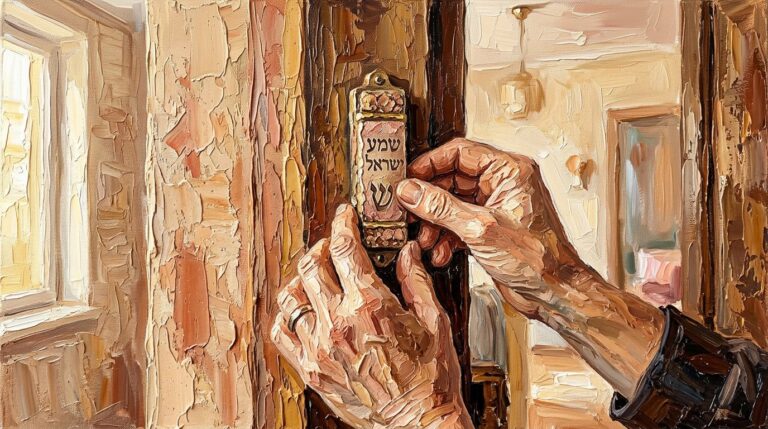
- No to both. Hebrew enriches Jewish practice, but transliteration – the Hebrew text rendered in English letters – is available for every prayer and blessing, and most siddurim (prayer books) include facing-page translations. You can build a full Shabbat practice at home in English for months or years before engaging seriously with the Hebrew. Joining a synagogue deepens and sustains practice, but the home has always been a primary site of Jewish life. The rabbis called the home a “mikdash me’at” – a small sanctuary – and Shabbat, mezuzot, and mealtime blessings are all home-based practices. Community is not a prerequisite for beginning; it is what you grow toward.
- Q: How much observance is “enough”? I’m worried I’ll be judged by more religious Jews.
- This anxiety is among the most common among adult beginners, and the honest answer is that the fear is partly warranted and mostly overblown. In some communities, newcomers encounter implicit gatekeeping. In most communities that actively work with beginners, you will find genuine respect for any sincere effort. The Talmud in Makkot 23b-24a traces how the prophets distilled the entire Torah to its essence, ending with Habakkuk’s “the righteous live by their faithfulness.” Your faithfulness to a small, honest practice outranks an anxious performance of comprehensive observance. Any rabbi or community worth your time will tell you exactly that.
- Q: How can I build a practice that feels spiritually honest if I’m not sure what I believe about God?
- Judaism is unusual among world religions in that practice has historically preceded and often generated belief, rather than the reverse. “Naaseh v’nishma” – we will do and then we will understand – is the tradition’s own answer to this question. Many deeply practicing Jews hold theological views that range from classical theism to Jewish naturalism to something they describe as “I’m not sure but I keep showing up.” What they share is commitment to the practice. Lighting Shabbat candles, saying blessings, studying texts, and engaging in tzedakah and chesed carry meaning independent of any particular theological position. Begin with the practices that feel most honest. The questions of belief will evolve alongside the doing rather than needing to be resolved before it.
- Q: Is it better to focus on learning first or on doing rituals first when starting Jewish life as an adult?
- Do both at once, but keep each commitment small. The great failure mode of “I’ll learn first and then practice” is that the learning never terminates – there is always more to know, and the rituals never begin. The failure mode of “I’ll just practice without understanding” is that the practice eventually runs out of internal fuel and becomes mechanical. Fifteen minutes of learning per week – one parsha commentary, one Talmud passage with translation – paired with one or two simple ritual practices gives each side something to feed. The practice gives your learning a living context; the learning gives your practice depth and resilience. Neither is the prerequisite for the other.
Starting a Jewish practice at 35 is, in the end, a choice to enter a conversation that has been going on for thousands of years and that will continue long after us. We bring to that conversation the particular questions of our particular lives – about rest, about obligation, about what it means to be part of something larger than our own ambitions and anxieties. Judaism does not resolve those questions. It gives us structures in which to hold them wisely, over time, together.
The first Shabbat candles you light will not feel like much. The fiftieth will feel like something you can barely remember not having. That is how it works. Light the candles.