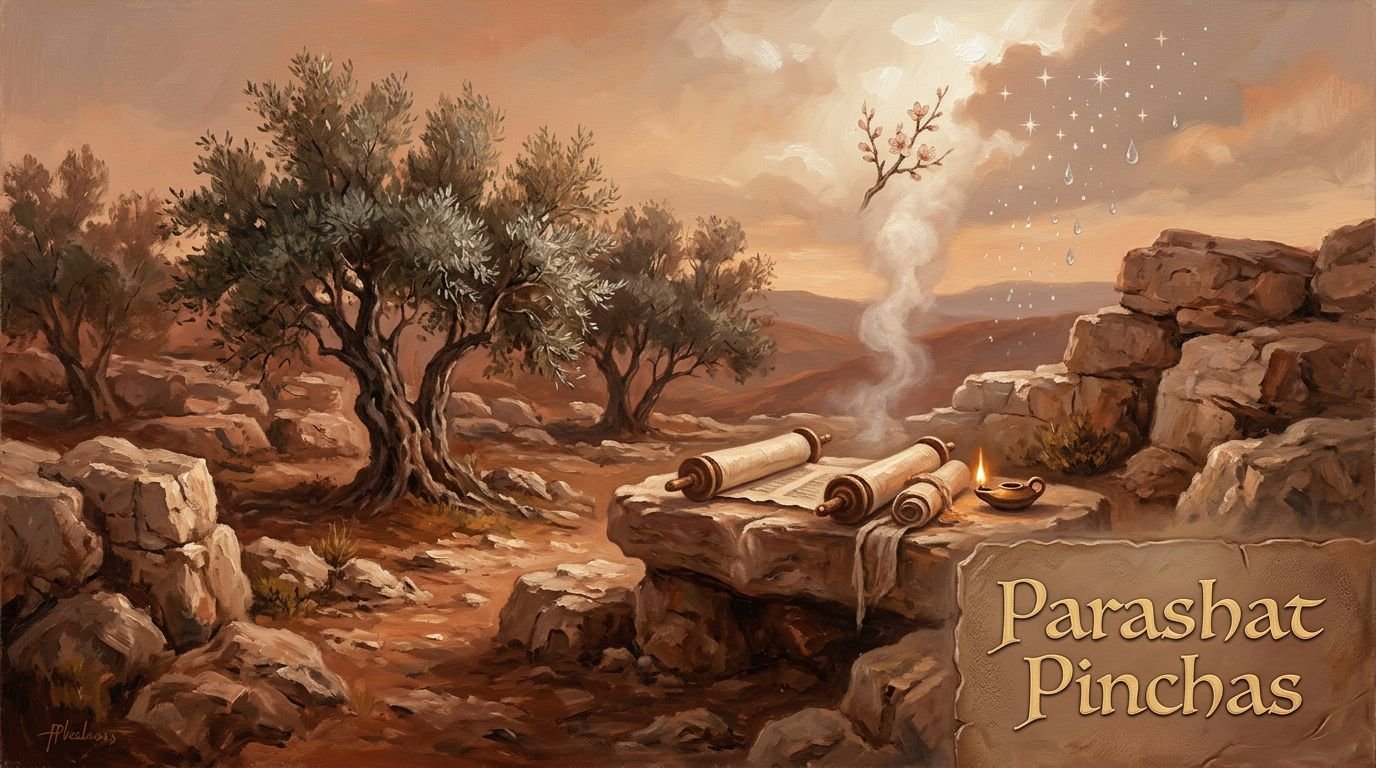
Parashat Pinchas: Zealotry, Justice, and the Covenant of Peace
When Zeal Must Become Peace: Parashat Pinchas and the Covenant That Holds Us Together
- Pinchas receives a “covenant of peace” after halting a devastating plague through a violent act, prompting enduring questions about religious passion and its legitimate limits.
- A second census of the new wilderness generation maps who will receive the Land, framing the covenant as a promise renewed across time and across generations.
- The five daughters of Tzelophechad publicly challenge the inheritance law, win their case before God, and permanently expand the Torah’s legal framework.
- Moses commissions Joshua as his successor in a transparent public ceremony, modeling the selfless leadership that communities require at moments of generational transition.
- A detailed calendar of communal offerings closes the parasha, anchoring Israel’s covenant relationship with God in the rhythm of sacred time.
Pinchas’ Zealotry and the Covenant of Peace
The act of Pinchas is not subtle. In the preceding portion, an Israelite named Zimri publicly escorted a Midianite woman, Kozbi, into the Israelite camp in conspicuous defiance during a moment of national crisis. Pinchas took a spear and killed both of them, halting a plague that had claimed twenty-four thousand lives. God’s response is a “covenant of shalom – peace” and an eternal priesthood (Numbers 25:12-13). Rashi, drawing on the Talmud, notes a scribal detail that opens the entire interpretive question: the letter vav in the word shalom is written with a break in the Torah scroll. This is one of only a handful of such anomalies in the entire Torah text. Many authorities read the broken letter as a sign that Pinchas’ peace is fragile, purchased at tremendous cost, requiring divine repair to sustain. This is not a simple endorsement of religious violence; it is the transformation of a violent moment into something that must be actively protected and cultivated. The Ramban (Nachmanides) argues that Pinchas’ act was spiritually dangerous even as it was legally defensible. It falls into a narrow and nearly unrepeatable rabbinic category: in cases of acute, public desecration of God’s name before the community, a zealot who acts immediately and entirely from pure motives may be held blameless. Ramban stresses that Pinchas succeeded not because religious passion is inherently praiseworthy, but because his inner state was completely free of personal anger or political calculation. The moment such an act becomes routine, or the motivation becomes mixed, it loses its sanctity entirely. The Or HaChaim reads the “covenant of peace” through a mystical lens. He suggests that taking a life, even in defense of God’s honor, engages forces in the soul that can damage even righteous individuals if left unaddressed. God grants Pinchas this covenant not merely as a reward but as an act of spiritual repair, a promise that his soul will be held whole after what he was called upon to do. The covenant is itself a form of healing. Rabbi Jonathan Sacks, in his Covenant and Conversation on Parshat Pinchas, argues that the Torah encodes a warning here. Pinchas is affirmed, but his act is not to be imitated. The covenant of peace re-routes his religious passion toward the permanent structures of priestly service, where zeal is channeled into disciplined, communal worship. The lesson is not “be like Pinchas in his act.” The lesson is “be transformed as Pinchas was transformed.”
Did You Know? The Hebrew word for peace in the covenant God grants Pinchas is written in the Torah scroll with a “broken vav” – a letter whose form is interrupted by a deliberate scribal gap. This is among the rarest anomalies in the entire Torah text, appearing only a handful of times across the Five Books. Many authorities read it as a visual statement that true peace, especially peace purchased through violence, requires active spiritual repair and cannot be taken for granted.
The Second Census and Apportioning the Land
Following the drama of Pinchas, the Torah pivots to a second national census – a careful count of the new generation that has grown up in the wilderness. The census is also the mechanism for apportioning the Land of Israel proportionally: larger tribes will receive larger portions, smaller tribes smaller ones, with the exact boundaries determined by lot. Ibn Ezra observes that the combination of proportional allocation and a lottery element is itself a theological statement. Human planning sets the broad parameters; divine providence fills in the particulars. The Ramban reads this census as an act of covenant renewal. The generation that left Egypt has died in the wilderness, with only Caleb and Joshua surviving. This new count is the Torah’s signal that God’s promises to the patriarchs now pass to a fresh community. The same promises, the same land, the same covenant – but carried by a generation that has not repeated the failures of its parents. The census is an act of communal hope encoded in figures. Chabad.org’s overview of Parshat Pinchas offers helpful context on how these tribal portions and census figures connect to the broader structure of the parasha and to its classical commentaries.The Daughters of Tzelophechad: Halakhic Change from the Margins
If the census tells us who belongs to the covenant community and what they will receive, the story of the daughters of Tzelophechad asks what happens when the law, as currently written, excludes someone who belongs entirely. Their father died in the wilderness without male heirs. Under the inheritance laws as they stood, his portion would not be allocated – his name would simply disappear from the land distribution. His five daughters – Machlah, Noa, Choglah, Milkah, and Tirtzah – approached Moses, the priest Elazar, the chieftains, and the entire community at the entrance to the Tent of Meeting. Their argument was legally precise and morally clear: their father died for his own sin, not in Korach’s rebellion, and his name should not disappear from among his family. “Give us a holding among our father’s kinsmen” (Numbers 27:4). Moses brought the case before God. God said: “The daughters of Tzelophechad speak rightly” (Numbers 27:7). Rashi notes that their choice to stand before the full public assembly was deliberate. They brought their case into the open without private petition, making it a matter of communal record. He also observes that their love for the Land of Israel was itself a form of piety – while men of their generation sometimes longed to return to Egypt, these women were insisting on their place in Israel. The Kli Yakar reflects on their method. He reads the daughters’ public appeal as a model for how legitimate legal challenges should be made: not by circumventing the institution, not through private lobbying, but by standing before the community and making the argument on its merits. The Torah validates both the substance of their claim and the integrity of their approach. The Schechter Institute’s essay on Parashat Pinchas frames the daughters’ courage as paradigmatic: voices from the margins, properly and publicly channeled, can change law. The Reform reading at ReformJudaism.org extends this to ask which communities today remain excluded from their rightful inheritance, and what institutions might respond as this one did. What unites Orthodox, Conservative, and Reform readings of this story is recognition that halakhah (Jewish law) here did not bend from external pressure; it completed itself from within, through its own processes of public deliberation and divine response. Moses asked. God answered. The law grew.
Did You Know? The names of Tzelophechad’s five daughters appear twice in the Torah – once when they make their appeal and once when the inheritance is actually granted (Numbers 27 and Numbers 36). The rabbis read this repetition as a mark of exceptional honor: the Torah preserves every name and every detail across two separate accounts as testimony to the esteem in which their courage and their legal reasoning were held.
Moses, Joshua, and Models of Covenant Leadership
Immediately after God validates the daughters’ claim, Moses asks God to appoint a successor. The juxtaposition is striking. Having just witnessed what it looks like to advocate for those who have no prior claim to be heard, Moses turns to his own unfinished responsibility. He will die before the people enter the Land. Who will shepherd them? Sforno reads Moses’ request as a model of genuinely selfless leadership. Moses does not ask for his sons to inherit his role. He does not advance anyone from his family. He asks God to choose someone “who shall go out before them and come in before them” (Numbers 27:17) – a leader defined entirely by what the people need, not by what the leader has built or by whom he wishes to honor. Sforno sees in this phrasing a quiet rebuke to leaders who confuse their role with their identity and cannot separate what they do from who they are. God chooses Joshua, a man described as one “in whom there is spirit” (Numbers 27:18). Moses is instructed to lay his hands on Joshua before Elazar the priest and the entire community. The public investiture is not ceremonial decoration. Sforno emphasizes that leadership legitimacy in Israel requires communal witness – it is not enough to be privately designated; the community must see the transition and acknowledge it. The Or HaChaim adds that Moses’ laying of hands transfers something real, not merely symbolic. The quality of leadership Moses carried flows, at least in part, into Joshua through this act. Succession in the covenant tradition is a spiritual inheritance and not only an institutional appointment. The scene also models the courage it takes for a great leader to actively build up a successor rather than leaving the transition to happen around him. MyJewishLearning’s overview of Parashat Pinchas situates Moses and Joshua within the longer arc of Israelite leadership, helping readers see how this succession scene shaped later rabbinic and communal models of ordination. Communities navigating generational transitions in synagogue leadership, rabbinic succession, or lay institutional life are working from the same coordinates: seek guidance beyond oneself, look for someone of spirit, make the transition visible, and let the outgoing leader honor the incoming one before the whole community.Korbanot and the Sanctification of Time in Parashat Pinchas
The parasha closes with a detailed listing of korbanot (communal sacrificial offerings): the daily offering, the additional Shabbat offering, offerings for the new month, and the full sequence of festival offerings from Passover through Sukkot. After the human dramas that have preceded this section, the shift to precise liturgical prescription can feel like a change of key. The commentators read it as the resolution the entire parasha has been building toward. Ibn Ezra notes that the offerings are listed with mathematical precision – so many animals, so much fine flour, so much oil and wine for each occasion. This precision reflects the essentially communal character of public worship. In ancient Israel, these offerings were a shared national responsibility, funded from collective resources, performed by priests on behalf of all Israel. No individual could opt out of either the cost or the benefit. The offerings were the covenant made visible and made regular. The rhythm of the offerings – daily, weekly, monthly, annually – creates a liturgical structure for communal life. Each unit of sacred time has its own acknowledgment that this day, this week, this season, belongs to God. When the Temple was destroyed, the rabbinic tradition preserved this structure almost exactly by replacing animal offerings with prayer. The morning, additional, and afternoon prayer services that frame Jewish communal prayer today correspond directly to the daily and additional offerings enumerated in this parasha. The sacred calendar of Parashat Pinchas became, and in a real sense remains, the calendar of Jewish prayer across the centuries. There is also a thread connecting the offerings to the opening of the parasha. Pinchas’ act was an expression of religious passion in defense of the covenant. The offerings are also expressions of religious passion – but channeled, regularized, repeatable, and communal. The arc of the entire portion moves from the single, unrepeatable, violent act of one individual’s zeal to the endless, ordered, collective acts of public worship. That movement is the “covenant of peace” enacted in the full life of the community.
Key Takeaways from Parashat Pinchas
- Religious passion requires a covenantal container. Pinchas’ zeal is affirmed but immediately redirected into the structured, peaceful service of the priesthood – not offered as a replicable model for individual religious action.
- The legal tradition contains its own mechanisms for growth. The daughters of Tzelophechad did not bypass the law; they worked through it publicly, and the law expanded in response to a legitimate moral claim made with integrity.
- Voices from the margins that advocate clearly, in public, and on the merits of their case can catalyze structural change without undermining the institution they address.
- Selfless leadership means defining the role by the community’s needs, not the leader’s legacy. Moses’ request for someone who will “go out before them and come in before them” sets a standard still recognizable in every generation.
- Public commissioning creates legitimate authority. Joshua’s investiture before the entire community is not symbolic – it is the source of the community’s trust in him and the foundation of his own confidence.
- Sacred time, structured through communal offerings or their prayer equivalents, is the rhythmic covenant that holds a people together across generations of change.
- The parasha as a whole traces an arc from the individual act of zealotry to the communal institution of worship – the path along which religious energy must travel if it is to build a people rather than consume them.
-
class=”st-faq”>
- Q: How can the Torah praise Pinchas’ violent act yet reward him with a ‘covenant of peace’?
- The commentators are unanimous that the praise and the peace are not in contradiction, but they are equally unanimous that they are in genuine tension. Rashi, Ramban, and the Or HaChaim each emphasize that Pinchas’ act was valid only within a specific, narrow, and nearly unrepeatable set of circumstances, and that the “covenant of peace” is God’s way of closing off that category and redirecting Pinchas toward a life of priestly service. The praise is for the pure intention and the concrete outcome – the plague stopped. The reward is not more zealotry; it is a commitment to peace as a permanent vocation and a spiritual repair for the violence required to reach it. As Rabbi Sacks observed, Pinchas is commended for what he did once and then guided toward what he must do forever.
- Q: Why is the story of the daughters of Tzelophechad considered so significant in Jewish law and thought?
- Because it demonstrates that the legal system possesses the capacity to respond to genuine moral claims even when the existing rules do not yet address them. Five women excluded by a legal gap brought their case before the entire community, and God explicitly validated both their argument and their approach. The ruling they won – that daughters inherit when there are no sons – became a permanent part of the Torah’s legal framework, not a one-time exception. This matters not as an anomaly but as evidence of how the system is designed: with humility, with public deliberation, and with an openness to completing itself when confronted with a claim it has not yet answered.
- Q: What does Moses’ appointment of Joshua teach about Jewish models of leadership?
- Several things simultaneously. First, that authentic leadership means defining the role entirely by what the people need: Moses asks for someone who will “go out before them and come in before them,” with no reference to family connection or personal continuity. Second, that transitions require public witness to generate legitimate authority – Joshua is invested before the entire community, not appointed through a private communication. Third, following the Or HaChaim, that real leadership carries a spiritual quality that can be transmitted and cultivated, not merely assigned by title. The scene also models the particular courage it takes for a great leader to actively build up a successor rather than leaving the transition to happen around him.
- Q: Why does Parashat Pinchas include both census data and a detailed list of offerings? How are they connected?
- Both serve the same underlying project: building a stable, covenant-centered community prepared to inhabit and sanctify the Land. The census answers “who are we and what is each part of our community owed in space?” The offerings answer “how do we organize our relationship with God across time?” Land without worship produces mere nationalism. Worship without land produces a spirituality permanently defined by exile. Together, the census and the offerings frame the two axes – space and time – within which a covenant people is meant to live. Parashat Pinchas holds both together as two dimensions of a single vision.
- Q: Is there a broader message about women’s roles in Judaism found in Parashat Pinchas?
- The story of the daughters of Tzelophechad has resonated across the denominational spectrum precisely because it is the Torah’s own most explicit account of women successfully using legal reasoning, public advocacy, and moral argument to change a halakhic outcome. God’s declaration that they “speak rightly” is a formulation of complete vindication found nowhere else in quite this form. Orthodox readers see it as evidence that the legal tradition’s own processes can address women’s concerns from within; Conservative readers point to it as a model for ongoing legal evolution; Reform readers use it as a call for full equality across Jewish life. What unites these readings is the recognition that these five women changed the law, and that the Torah records this as something right and good.