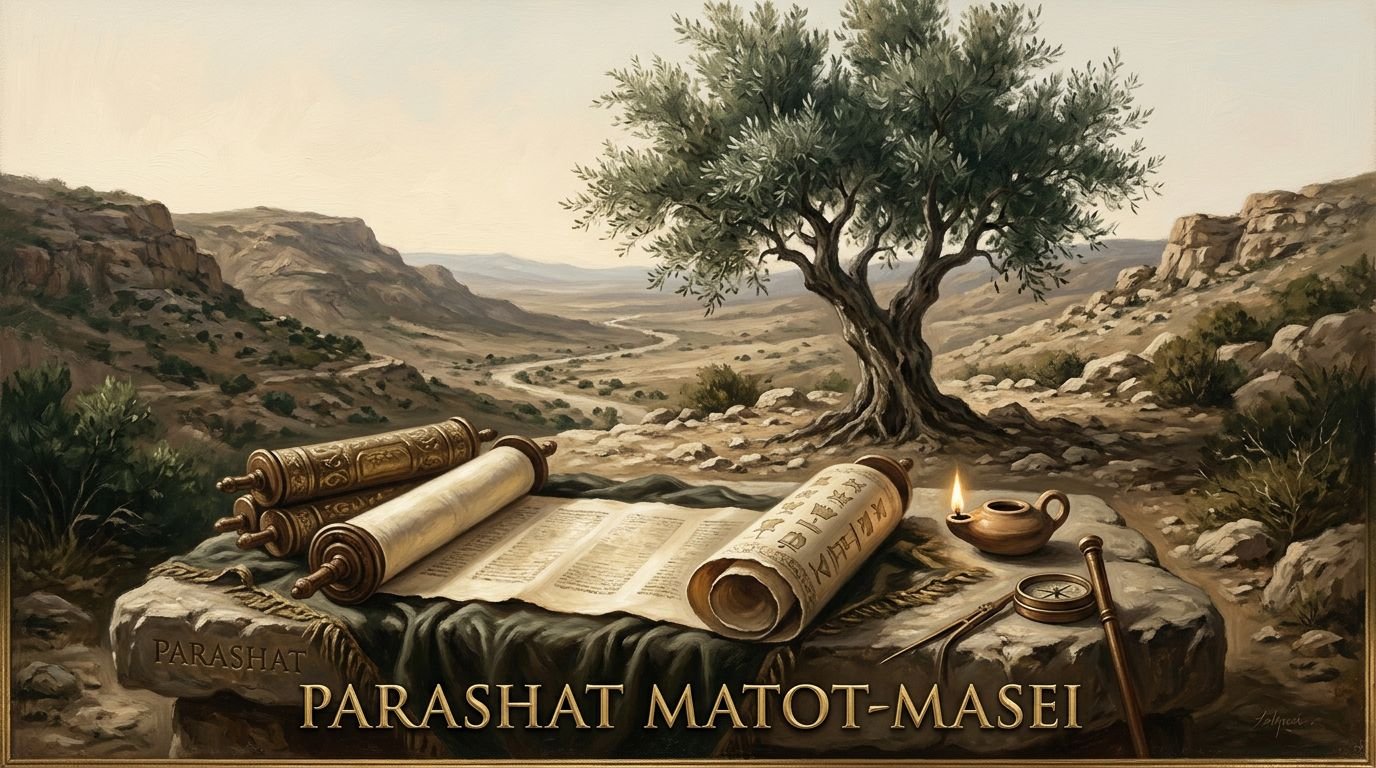
Parashat Matot-Masei: Vows, Wandering, and the Moral Architecture of Arrival
Words That Bind, Roads That Lead: Parashat Matot-Masei at the Threshold of the Land
- Parashat Matot-Masei closes Sefer Bamidbar with laws of vows, a divinely commanded war, territorial negotiations, a full catalogue of wilderness stations, and foundational legislation on justice and inheritance.
- The laws of vows (nederim) insist that spoken words create binding obligations, and that communal leaders carry a particular responsibility for the language their communities make and keep.
- The tribes of Reuven and Gad negotiate to settle east of the Jordan, raising questions about personal interest versus covenantal duty that every generation must answer for itself.
- The forty-two wilderness journeys are preserved not as historical footnote but as spiritual itinerary, teaching that every stop and detour in our collective life belongs to a larger purposeful path.
- Cities of refuge (arei miklat) and the case of the daughters of Tzelofchad model a Torah committed to distinguishing intent from outcome and to expanding justice in response to new moral questions.
The Power of Vows: Speech, Responsibility, and Communal Leadership
Matot opens with a striking address: Moshe teaches the laws of vows not to the entire assembly but specifically to the heads of the tribes (Numbers 30:2). This choice of audience is deliberate. Rashi (Rabbi Shlomo Yitzchaki, 11th century, France) notes that honoring the elders by teaching them first reflects a hierarchy of covenantal responsibility. Leadership does not merely receive the law; it models and guards it. The heads of tribes are also empowered, in specified circumstances, to release vows made by members of their households – making them not passive recipients of law but its active custodians. The word neder, a vow that dedicates an action or object to a sacred purpose, is the paradigmatic binding utterance of the parasha. Ibn Ezra (12th century, Spain) distinguishes carefully between a neder and a shevuah (oath), which invokes the divine name to affirm or forbid a future act. Both forms of speech share a common principle: words spoken aloud with formal intention create an obligation as real as any physical act. Sforno (Rabbi Ovadiah Sforno, 15th-16th century, Italy) draws an ethical lesson from this opening. Vows, he argues, serve a function of self-discipline. When a person speaks a commitment aloud, she constructs not just an obligation but a self – she gives her future choices a shape. Speech, in this view, is not merely descriptive; it is constitutive. The person who makes a vow is a different person afterward. This reading carries weight in our own moment. We inhabit a culture of throwaway language: half-kept promises, terms-of-service agreements clicked through without reading, declarations abandoned before the week is out. The Torah’s insistence that words bind reality offers a serious counterweight. A community whose leaders model careful, weighty speech becomes a community that understands the relationship between language and integrity as something other than metaphor.
Did You Know? The Talmud devotes an entire tractate – Masechet Nedarim – to the laws of vows, working through hundreds of cases to determine precisely when a verbal commitment is binding and when circumstances allow for its release. The tradition’s meticulous attention to speech reflects a conviction that language is the primary medium through which human beings participate in the creative act that brought the world into being – and that misusing it therefore carries genuine moral weight.
Holy War and Moral Limits: The Campaign Against Midian
Few passages in the Torah generate more sustained moral discomfort for contemporary readers than the command to wage war against Midian (Numbers 31). The episode recounts a campaign of comprehensive destruction, a meticulous distribution of spoils, and a purification ritual for warriors returning from battle. No dimension of the campaign is left outside a legal and moral framework, and that framing is itself significant. The Or HaChaim (Rabbi Chaim ibn Attar, 18th century, Morocco and Israel) reads the campaign as a spiritually charged confrontation. Midian had deployed the most dangerous weapon available against Israel: not an army in the field but seduction into idolatry and immorality at Peor. The assault was not on Israel’s bodies but on its covenantal identity. In this reading, the gravity of the response reflects the gravity of the original attack. Ramban (Nachmanides, 13th century, Spain) addresses the troubling details directly. He argues that the purification rituals applied to returning warriors serve a moral-educative function: even a divinely sanctioned war leaves a residue that must be processed, not celebrated. Soldiers do not return from killing unchanged. The Torah’s insistence on a seven-day purification period outside the camp is a recognition that violence carries spiritual weight, and that the community must consciously reintegrate its fighters rather than simply praising their victories. Conservative and Reform readers have engaged this text with candor. Some interpreters situate the Midian narrative within the realities of ancient tribal conflict rather than presenting it as a timeless model. Others, drawing on the prophetic tradition, argue that the Torah’s ethical center of gravity shifts over time toward texts like “Seek peace and pursue it” (Psalms 34:15). These different approaches do not dissolve every tension in the passage – nor should they. The willingness to sit with that tension is itself a form of serious, honest engagement with Torah.
Did You Know? The purification of metal utensils captured in the Midian campaign (Numbers 31:22-23) forms one of the biblical foundations for the practice of kashering vessels – rendering them ritually fit through immersion and sometimes fire or boiling. This ancient law continues to shape the daily practice of observant Jewish households worldwide. For context on purity concepts in the biblical world, see the Biblical Archaeology Society’s exploration of purification rituals in the Hebrew Bible.
Reuben, Gad, and Half of Menashe: Negotiating Desire and Duty
The request of the tribes of Reuven and Gad to settle east of the Jordan, in the rich grazing lands of Gilead, provokes one of the Torah’s most psychologically acute dialogues. Moshe’s initial response is sharp: “Shall your brothers go to war while you sit here?” (Numbers 32:6). He compares them to the spies whose failure of nerve condemned a generation to die in the wilderness. The accusation is serious. This is not a minor disagreement about geography; it is a question about whether covenantal obligation can be negotiated away in exchange for material advantage. Rashi reads Moshe’s alarm as proportionate to the danger. Discouragement is contagious. If two and a half tribes withdraw from the shared project of conquest, the hearts of the remaining tribes may weaken before the campaign begins. The Kli Yakar (Rabbi Shlomo Ephraim Luntschitz, 16th-17th century, Prague) presses deeper, noting that the tribes of Reuven and Gad mention their cattle before they mention their children (Numbers 32:16). He reads this inversion as a sign of misplaced priorities – property before family, economic calculation before covenant. What follows, however, is genuine negotiation, and it ends in genuine agreement. Reuven and Gad commit to serve as the military vanguard – the most exposed position in the army – until every tribe has received its inheritance in Canaan. Only then will they return east of the Jordan. Moshe accepts this arrangement. The parasha models what we might call covenantal flexibility: sub-groups have legitimate needs that do not always align with the collective plan, and those needs can be honored – but through explicit, binding commitment, not vague goodwill. The question the tribes of Reuven and Gad faced – what do I owe to the larger project when my private interests pull another way? – is one that every generation answers in its own register. The parasha’s answer is neither shame nor permission. It is obligation, accepted freely and publicly.Forty-Two Journeys: Mapping the Spiritual Wilderness
The opening chapters of Masei list all forty-two stations of Israel’s journey from Egypt to the plains of Moav. The list is meticulous and, to the casual reader, repetitive: “They journeyed from X and camped at Y.” For the classical commentators, this catalogue is neither appendix nor filler. It is theology. Ramban argues that the list preserves an irreplaceable witness to the miracle of the wilderness period. A people sustained for forty years in an uninhabitable terrain cannot afford to forget the specific geography of that experience. Every named stop is a place where they were fed, sheltered, and guided. The catalogue is an extended act of gratitude and a historical claim: this happened, here, to us. The Or HaChaim offers a more mystical reading. Each of the forty-two journeys corresponds to an inner movement of the soul as it travels from the narrowness of Mitzrayim – the Hebrew word for Egypt, cognate with the root for “narrow” or “constricted” – toward the expansiveness of the Land. The physical itinerary is simultaneously a spiritual itinerary. We do not merely cross geography; we cross states of consciousness. Sforno suggests that the purpose of recording the journeys is fundamentally educational: future generations who know exactly where their ancestors stood are better equipped to understand the full scope of what was endured and what was given. Memory is not nostalgia. It is orientation. A community that knows where it has been is better equipped to understand where it must go. For reflection on how these journeys illuminate Jewish communal identity, see the Academy for Jewish Religion’s d’var Torah on Matot-Masei . The forty-two stations also model something we rarely admit: the path from constriction to freedom is neither straight nor swift. The people camp, break camp, travel, and camp again. Some stops are named without explanation. Some are sites of conflict and failure – the itinerary includes both Sinai and the incident of Baal Peor. A map of freedom that runs through failure is not a flawed map. It is an honest one.Borders, Levitical Cities, and Cities of Refuge: Space as Moral Architecture
Masei’s second movement establishes the borders of the Land of Israel, designates forty-eight cities for the Levites dispersed throughout the tribal territories, and creates six arei miklat – cities of refuge – where a person who has caused a death accidentally may flee to await communal adjudication, sheltered from the immediate anger of the victim’s family. Together these provisions treat space itself as a moral category. Where something happens, and where a person may go, is never spiritually neutral. The legal distinction the Torah draws is precise: intentional killing with premeditation, a deadly weapon, and prior enmity is murder and subject to capital punishment. Accidental killing – without hostility, without a lethal weapon, without malice – is manslaughter, and the person responsible must dwell in a city of refuge until the death of the High Priest, when a kind of communal amnesty takes effect. Ramban reads this arrangement as a profound theological statement. The Torah cares about the interior state of the actor, not merely the external fact of the death. Human beings are not machines that produce outcomes. They are moral agents whose intentions shape the character of their acts. Sforno treats the cities of refuge as a moral-educative institution. The Levites who inhabit these cities are Israel’s teachers. The accidental killer who lives among them receives the best available formation in careful, responsible living – an awareness of the fragility of life that the circumstances of the death had made devastatingly concrete. The time in the city is not merely protective custody; it is an invitation to become a different kind of person. For a broader philosophical perspective on how legal systems have grappled with intention and culpability, see the Stanford Encyclopedia of Philosophy’s entry on criminal law and moral responsibility . The forty-eight Levitical cities dispersed throughout all the tribal territories serve a related function. By scattering Israel’s spiritual teachers across the Land, the Torah ensures that no region is far from learning, from law, and from the reflective moral life that Levitical presence is meant to cultivate. The geography of the Land is, in this reading, a pedagogical design.The Daughters of Tzelofchad and Inheritance: Gender, Tribe, and Justice
Parashat Matot-Masei closes by revisiting a ruling from an earlier portion. The daughters of Tzelofchad had won the right to inherit their father’s portion (Numbers 27). Now the heads of the clan of Menashe raise a practical concern: if these women marry into other tribes, their inherited land will leave Menashe’s territory. Moshe, again consulting the divine, rules that the daughters may inherit – but they must marry within the tribe of Menashe to preserve the integrity of ancestral land. Orthodox readers generally see in this resolution a model of Torah’s precise legal architecture. The daughters’ individual inheritance rights are real and legally protected; the tribe’s communal claim to its ancestral portion is also real and protected. The ruling balances both through a bounded, specific requirement – neither set of rights cancels the other. Conservative interpreters often highlight something else: this ruling represents legal evolution within the Torah itself. The same text that expanded women’s inheritance rights now refines the terms of those rights in response to a new question. This suggests that Jewish law is always in dialogue with changing circumstances, reasoning toward justice through argument and precedent rather than through mechanical application of fixed rules. Reform readings typically foreground the daughters’ original claim as the moral center of the story, seeing the marriage restriction as a time-bound accommodation to a patrilineal land system whose underlying principle of equity belongs to every generation, even if the specific rule need not. All of these readings share a recognition that the daughters of Tzelofchad acted with legal courage and moral imagination. They brought an unprecedented case, argued it on grounds of familial dignity and equity, and won. The Torah’s willingness to revisit and refine that ruling models a legal culture that is neither frozen nor arbitrary, but principled and responsive. For historical context on women’s legal standing in the ancient Near Eastern world, see Britannica’s overview of women’s social and legal roles in antiquity .- Human speech carries covenantal weight: vows and oaths create real obligations, and communal leaders bear a particular responsibility for cultivating a culture of honest, careful language in their communities.
- Even divinely commanded action must be accompanied by moral accountability – the purification rituals of the Midian campaign model a community that does not treat violence as spiritually neutral, even when warranted.
- The negotiation between Moshe and the tribes of Reuven and Gad shows that communal covenant can accommodate individual difference, but only through explicit, binding commitment rather than vague intention.
- The forty-two wilderness journeys are not a historical footnote; they are a spiritual map, teaching that every stop, detour, and delay in our collective life can be received as a stage on a larger, purposeful path.
- Cities of refuge model a justice system that cares about intent as well as outcome, treats the accidental killer with dignity, and creates genuine space for moral change rather than simple punishment.
- The daughters of Tzelofchad demonstrate that legal precedent can and must expand in response to equity and fairness, and that Torah itself models a culture of principled, ongoing legal reasoning.
- Matot-Masei teaches that arrival requires moral preparation: the quality of community we build on the journey determines the quality of community we bring into the Land.
- Q: Why does the Torah begin Parashat Matot with vows, and why are the laws taught specifically to the heads of the tribes?
- The placement of the vow laws at the opening of Matot signals that covenantal speech is the foundation on which communal life rests. By addressing the heads of the tribes first, the Torah assigns them a dual responsibility: to model careful, binding speech themselves, and to oversee the vow obligations of those under their leadership. Rashi understood this as a form of honor extended to the elders; Sforno read it as a moral charge. Leaders who speak carelessly invite communities to do the same. The laws of vows are therefore not merely a technical legal category – they are a statement about the relationship between language, authority, and communal integrity. A community led by people who take their words seriously has a foundation for every other form of covenantal commitment.
- Q: How can a divinely commanded war of vengeance against Midian be reconciled with Jewish ethics of peace and compassion?
- This is one of the genuinely difficult questions of the parasha, and different commentators and different Jewish movements have engaged it from different angles. The Or HaChaim situates the war within the gravity of Midian’s assault on Israel’s spiritual and moral identity through seduction – a form of attack the Torah treats as existentially dangerous. Ramban emphasizes that the purification rituals following the campaign acknowledge that warfare always carries moral weight, even when sanctioned by divine command. Conservative and Reform interpreters have pressed further, arguing that this narrative must be read alongside the prophetic tradition’s emphasis on peace, and that the Torah as a whole does not present the Midian campaign as a template to replicate but as a historically embedded response to a specific covenantal crisis. Sitting with the discomfort of the text – rather than resolving it too quickly in either direction – is itself a form of serious engagement with Torah.
- Q: What is the significance of the request by Reuven, Gad, and half of Menashe to live outside the land proper?
- The significance operates on both a personal and a communal level. Personally, the tribes of Reuven and Gad were drawn by the rich pastureland of Gilead – legitimate economic interests the Torah does not dismiss as trivial. Communally, their initial request raised the specter of the spies’ failure: a withdrawal from the shared project that could undermine the resolve of the entire nation. What the parasha ultimately models is that personal interest and communal duty need not be irreconcilable, but that resolving them requires explicit, binding commitment rather than sentiment. The tribes’ agreement to fight as the vanguard transforms a potentially divisive request into a model of covenantal negotiation. The Kli Yakar’s observation that they mentioned their cattle before their children remains a pointed warning about the ordering of our priorities – what we put first reveals what we actually value.
- Q: Why does the Torah list all forty-two journeys in Masei, and what relevance do they have once the travels are over?
- Ramban argues that the list preserves a witness to the sustained miracle of the wilderness – a people sustained for forty years in uninhabitable terrain, station by station. Sforno emphasizes the educational purpose: future generations who know exactly where their ancestors stood are better equipped to understand the full scope of what was given and endured. The Or HaChaim reads the journeys as a map of inner spiritual movements, each station corresponding to a stage in the soul’s transit from constriction toward freedom. Taken together, these readings suggest that the list matters not in spite of the fact that the journeys are over, but because of it. The map of how we got here orients us in where we stand and what we carry forward. Communities without memory of their wandering tend to forget what their arrival cost.
- Q: How do the cities of refuge reflect the Torah’s view of justice and human fallibility?
- The cities of refuge reflect a legal philosophy that takes both the fact of death and the interiority of the actor with full moral seriousness. The Torah’s precise distinction between intentional murder and accidental manslaughter requires investigating not just what happened but what the person intended, what weapon was used, and whether prior enmity existed – a genuinely demanding inquiry into the inner life of the responsible party. By providing a protected space for the accidental killer, the Torah acknowledges human fallibility without collapsing it into malice. Sforno’s reading of the Levitical cities as educational environments suggests that the time in a city of refuge is meant to be formative as well as protective. The death of the High Priest that ends the period of exile may also carry symbolic resonance: a transition in communal leadership signals the possibility of renewal, both for the community and for the individual who caused a death without intending to.