
Why Bad Things Happen to Good People: What Judaism Really Says
Jewish Teachings on the Challenges Faced by Good Individuals
It is one of the oldest questions in human history, and it hits hardest in our most vulnerable moments: why do good people suffer? When a devoted parent receives a devastating diagnosis, when a generous and kind person loses everything, when tragedy strikes someone who has done nothing to deserve it – the question stops feeling philosophical. It feels personal. It feels urgent.
Jewish suffering as a concept sits at the very heart of Jewish theology, explored across thousands of years of tradition, exile, loss, and renewal. Judaism doesn’t pretend this question has a clean resolution. It doesn’t offer a tidy answer wrapped in comfort. Instead, it does something far more honest: it wrestles with the question openly, preserves multiple competing answers, and invites every generation to join the conversation.
What follows draws on Torah, Talmud, medieval philosophy, and contemporary Jewish thinkers to walk through what Jewish tradition actually teaches. Not a single definitive answer – but a rich, sometimes uncomfortable, always serious engagement with one of the most profound challenges to faith.
Quick Takeaways
- Judaism preserves many answers, not just one. The tradition holds multiple competing explanations for suffering in productive tension rather than forcing a single conclusion.
- Asking “why” is deeply Jewish. From Abraham to Moses to Job, questioning God is not a sign of weak faith – it is a sign of serious engagement with it.
- The Talmud offers a surprising concept: suffering as love. What the rabbis called yissurim shel ahavah (afflictions of love) suggests that not all suffering is punishment.
- The Book of Job rejects easy answers. God himself rebukes Job’s friends for claiming they know why Job suffers – a powerful warning against pat explanations.
- Rabbi Soloveitchik shifted the question entirely. The right response to suffering, he argued, is not to ask “why?” but “what do I do now?”
- Human action matters enormously. Jewish tradition places significant weight on our responsibility to fight suffering wherever it exists – not wait for a divine explanation.
- Different Jewish movements approach this differently. Orthodox, Conservative, Reform, and other streams each bring distinct theological perspectives to the table.
The Question Judaism Refuses to Dismiss
Judaism’s engagement with suffering begins with something that might surprise newcomers to Jewish thought: God doesn’t punish people for asking hard questions. In fact, the tradition celebrates it.
Abraham, regarded as the first Jew, stood before God and demanded justice: “Should the Judge of the whole world not act fairly?” (Genesis 18:25). Moses, the greatest prophet in Jewish tradition, cried out: “Why have You treated this people badly?” (Exodus 5:22). The prophet Jeremiah wrote an entire book of laments – what we now call Lamentations – mourning the destruction of Jerusalem with raw, unfiltered grief. These are not the words of people who accepted suffering quietly. They are the words of people who took both their faith and their pain seriously enough to confront the tension between them.
The Hebrew word tzaddik (a righteous person) appears again and again in discussions of suffering precisely because the problem of the righteous sufferer is not a modern invention. The rabbis of the Talmud wrestled with what they called tzaddik v’ra lo, rasha v’tov lo – “the righteous one to whom bad things happen, and the wicked one to whom good things happen” (Berakhot 7a). They didn’t pretend the problem wasn’t real. They catalogued it, debated it, and left much of it unresolved – because that honesty was itself a form of theological integrity.
So if you’ve come to this question feeling confused, angry, or even betrayed by God, Judaism’s first message is this: you are in very good company. The tradition not only permits this kind of wrestling – it practically requires it.
What the Torah and Talmud Actually Teach About Suffering
The oldest answer in the Jewish textual tradition is also the most direct. Much of the Torah – particularly Leviticus and Deuteronomy – operates within what scholars call the retributivist framework: obey God’s laws and receive blessing; abandon them and suffer the consequences. The Torah states this plainly: “If you follow my statutes and observe my commandments… I will grant peace in the land” (Leviticus 26:3,6). The reverse consequences fill the pages that follow.
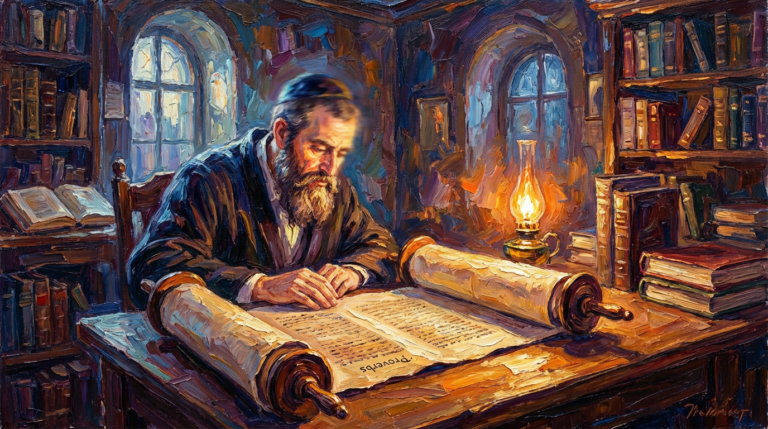
This framework made sense as a communal covenant. The promises and warnings were largely addressed to the people of Israel as a collective – a nation entering into a relationship with God that carried real stakes. But even within the Torah itself, cracks appear in this neat arrangement. The Book of Job stands as the tradition’s most powerful challenge to simple retributivism. Job is described by the text itself as “blameless and upright” (Job 1:1), and yet loses his children, his health, and his wealth in rapid succession. His friends arrive and offer the retributivist explanation: Job must have sinned. Job insists he has not. And at the end of the book, God rebukes the friends – not Job – saying they have “not spoken the truth about Me as my servant Job has” (Job 42:7). The man who protested his innocence and argued with God is vindicated. The men who defended God with easy theological answers are corrected.
That is a remarkable thing for any sacred text to do. The Book of Job essentially says: be careful about claiming you know why someone suffers. You probably don’t.
The Talmud later introduces a concept that adds yet another layer. In tractate Berakhot (5a), the rabbis discuss what they call yissurim shel ahavah – “afflictions of love.” The idea is striking: some suffering is not punishment at all, but an expression of God’s closeness to a person. The passage draws on Proverbs 3:12 – “For whom the Lord loves, He rebukes, as a father the son he delights in.” The rabbis debated the limits of this idea vigorously, and it was never meant to explain away all suffering. But it opened a door to understanding pain that did not require assigning blame.
💡 Did You Know?
The Book of Job is one of the only books in the entire Hebrew Bible where God directly criticizes characters for giving theologically incorrect answers – specifically the friends who insist Job must have sinned to deserve his suffering. Rabbinic tradition takes this as a serious warning: claiming to know why someone suffers is not a sign of faith. It can actually be a religious error.
Maimonides and the Medieval Philosophers: A Different Kind of Answer
By the medieval period, Jewish philosophers were wrestling with this question in a new intellectual environment, shaped by Greek philosophy and the demand for logical consistency. Maimonides (Rabbi Moshe ben Maimon, 1138-1204), known by his acronym Rambam, is the towering figure of this era. Writing in his monumental work The Guide for the Perplexed, Maimonides approached the problem of evil with characteristic rigor.
His first point was about free will. Much of the evil in the world, Maimonides argued, comes from human beings making harmful choices. God created humans with the capacity for moral freedom, and that freedom is not a flaw – it is what makes human action meaningful in the first place. A world without free will would be a world without genuine goodness, because goodness chosen is categorically different from goodness programmed.
But free will doesn’t explain natural disasters, disease, or the death of children. For these, Rambam offered a second argument: much of what we call “evil” is actually a privation – the absence of something good – rather than an active force that God created. Illness is the absence of health. Darkness is the absence of light. On this view, God is not the author of evil so much as the one who created a world where finitude and physical limitation are built in. Suffering that arises from our physical nature is not a punishment; it is part of what it means to be a material, mortal creature.
Rambam was also deeply influenced by the idea that our limited human perspective cannot fully grasp the divine plan. He did not use this as an intellectual escape hatch – he genuinely believed that philosophical humility was the appropriate stance before questions that exceed human comprehension. Not “we can’t understand God’s ways” as a conversation-ender, but as a serious epistemological claim: our vantage point is simply too narrow.
The Ramban (Rabbi Moshe ben Nachman, also known as Nachmanides, 1194-1270) took a somewhat different view. He leaned more heavily on the idea that true reward and punishment play out not in this world but in the World to Come, Olam Ha-Ba. From this perspective, the injustices we see in this life are real – but they are not the final accounting. The righteous person who suffers in this world is not being cheated; they are being prepared for a deeper form of flourishing that this world cannot fully contain.
The 20th Century: When Theodicy Became Unbearable
No event forced a rethinking of Jewish theology about suffering more than the Holocaust. The murder of six million Jews – including one-and-a-half million children – by the Nazis between 1941 and 1945 confronted every existing Jewish framework with a challenge of almost incomprehensible scale. Traditional retributivist answers felt not just inadequate but morally monstrous when applied to the Shoah. The idea that six million people were killed because of collective sin struck many Jewish thinkers, and most modern Jews, as theologically indefensible.
Different Jewish movements responded in very different ways. Some Orthodox thinkers doubled down on retributivism, attributing the catastrophe to religious failures or the abandonment of Torah. Most contemporary Orthodox authorities, it should be noted, reject this approach as both cruel and presumptuous. Liberal Jewish theologians moved in the opposite direction – some embracing the idea that God is “hidden” (hester panim, the “hiding of God’s face,” a concept drawn from Deuteronomy 31:18), or that God’s power is more limited than classical theology acknowledged. Rabbi Harold Kushner, a Conservative rabbi, wrote what became one of the most widely read Jewish books of the 20th century, arguing in When Bad Things Happen to Good People that God is perfectly good but not all-powerful – that God “hates suffering but cannot eliminate it.” Kushner’s view is not accepted by traditional Jewish theology, but it resonated deeply with millions of people who found classical answers cold comfort.
Rabbi Joseph B. Soloveitchik, one of the most influential Orthodox thinkers of the 20th century, charted a different course entirely. Rather than trying to explain why suffering happens – which he regarded as ultimately unanswerable – Soloveitchik shifted the entire question. The right Jewish response to suffering, he argued, is not metaphysical but ethical. The Halakha (Jewish law) does not ask us to understand our pain; it asks us to respond to it. “The sufferer commits a grave sin,” he wrote, “if he allows his troubles to go to waste and remain without meaning or purpose.” In other words: meaning is not found in suffering. It is created through what we do with it.
This was not a dismissal of the question. It was a reframing that has deep roots in Jewish practice – in the tradition of responding to tragedy with action, community, prayer, and renewed commitment to ethical life.
What Rabbi Kushner and Chabad Both Got Right
Here’s what’s interesting about two seemingly opposite Jewish responses to this question: they actually converge in one critical place.
Rabbi Kushner argued that we should stop looking for answers and start formulating responses. As Chabad’s Rabbi Aron Moss writes, perhaps the deepest reason to resist a satisfying answer to this question is that an answer would allow us to make peace with suffering – and that would be a spiritual catastrophe. If we could fully explain why a child suffers, we could tolerate it. We could move on. The burning question is what keeps us engaged, outraged, and motivated to act.
“Keep asking the question,” Rabbi Moss writes, “but stop looking for answers. Start formulating a response.” This aligns almost perfectly with Soloveitchik’s framework, despite the very different theological starting points of these two thinkers.
Judaism’s diversity is one of its great strengths on questions like this. Orthodox, Conservative, Reform, Reconstructionist, and Renewal streams each bring something distinct to the table. Reform Judaism has generally been most comfortable with theological uncertainty and most willing to reinterpret classical concepts of divine power. Orthodox Judaism holds more firmly to traditional frameworks while acknowledging their limits. Conservative Judaism often seeks a middle path, preserving classical sources while engaging honestly with modern challenges. What all of them share is the conviction that the question must be asked – and that asking it, loudly, honestly, and without easy resolution, is itself a Jewish act.
Putting This Into Practice
Jewish tradition is not only a set of ideas. It is a way of living – and that includes living through pain. Here is how different aspects of this tradition can be brought into real life:
If you are just starting to engage with this question: Give yourself permission to be angry, confused, or grieving. The entire tradition of Jewish lament – from the Psalms to the Book of Lamentations – validates these feelings as spiritually legitimate. You do not have to resolve the theology before you are allowed to feel the pain. Read Psalm 22, which opens with “My God, my God, why have you forsaken me?” – and notice that it is in the Bible not as a mistake, but as a model.
To deepen your engagement: Study the Book of Job directly, ideally with a commentary. The Sefaria platform offers the full text with classical commentaries side by side, all free. Pay close attention to what God says at the end – it is not what most people expect. Then read Rabbi Harold Kushner’s When Bad Things Happen to Good People alongside a traditional response to it, so you can hold the tension between perspectives.
For practical community engagement: Jewish responses to suffering are not only theological – they are communal and embodied. Bikur holim (the mitzvah, or religious obligation, of visiting the sick) and nichum avelim (comforting mourners) are specific commandments rooted in the belief that human presence and action are the appropriate responses to suffering. When someone you know is going through a hard time, showing up – literally – is not just kindness. In Jewish tradition, it is a religious obligation.
For serious exploration: Read Rabbi Joseph Soloveitchik’s essay “Kol Dodi Dofek” (available in translation) for his theology of suffering and response, and explore the Talmudic passage Berakhot 5a with a study partner. The classical debate about yissurim shel ahavah is dense but extraordinarily rewarding. A good rabbi or study group can help navigate the original sources.
The Ongoing Conversation
Judaism does not give you an answer to why bad things happen to good people because – honestly – no tradition can do that with integrity. What it gives you instead is something more durable: a framework for living with the question. It gives you Abraham’s audacity, Job’s honesty, the Talmud’s refusal to settle too quickly, Maimonides’s philosophical rigor, and Soloveitchik’s insistence that meaning is made, not found.
The great Rabbi Akiva, whose own life ended in martyrdom under Roman persecution, is recorded in the Talmud as teaching that “all that the Merciful One does, He does for good” (Berakhot 60b). This was not naive optimism from a man unfamiliar with suffering. It was a hard-won, deeply personal theological conviction forged through loss and grief. You do not have to share it. But knowing it exists – that someone who endured that much still held onto that belief – is itself a kind of resource.
The question of why the righteous suffer will not be resolved in this article, or in any article, or likely in any human lifetime. But Judaism’s greatest gift on this subject may be the permission it grants – to keep asking, to keep wrestling, to refuse easy comfort, and to channel the energy of that refusal into making the world more just. That, the tradition suggests, is exactly what we are here to do.
Frequently Asked Questions
- Q – Does Judaism believe God causes suffering as punishment?
- A – Jewish tradition includes a retributivist view linking suffering to sin, but also strongly challenges it. The Book of Job, Talmudic concepts like afflictions of love, and modern thinkers like Rabbi Soloveitchik all argue that suffering cannot be reduced to punishment alone. Most contemporary Jewish movements reject blanket retributivist explanations.
- Q – What does the Book of Job say about why good people suffer?
- A – Job concludes that easy explanations for suffering are wrong. God rebukes Job’s friends for claiming to know why Job suffered, while vindicating Job for honestly protesting his innocence. The book’s message is that human beings cannot fully comprehend divine justice, and that presuming to explain someone else’s suffering is a theological error.
- Q – Do Reform and Orthodox Jews differ on why bad things happen to good people?
- A – Yes, significantly. Orthodox Judaism generally maintains traditional frameworks, including divine providence and reward-and-punishment, while acknowledging their limits. Reform Judaism is more comfortable with theological openness and reinterpreting divine power. Conservative Judaism tends to hold both in tension, preserving classical sources while engaging honestly with modern challenges.
- Q – What is the Jewish concept of afflictions of love?
- A – The Talmud (Berakhot 5a) introduces yissurim shel ahavah, meaning “afflictions of love” – the idea that some suffering is not punishment but an expression of God’s closeness to a person. Drawing on Proverbs 3:12, the rabbis suggested that certain hardships reflect divine care rather than divine anger, though the concept was debated and is not applied universally.
- Q – How does Judaism say we should respond when bad things happen?
- A – Rabbi Soloveitchik argued the right Jewish question is not “why?” but “what do I do now?” Judaism emphasizes responding through action: comforting mourners, visiting the sick, pursuing justice, and creating meaning from pain. The tradition validates grief and anger while directing their energy outward toward repair rather than inward toward endless unanswerable questioning.