Parashat Nasso: Blessing, Vows, and Sacred Community
Why the Longest Torah Portion Contains Judaism’s Most Beloved Blessing
TL;DR: Parashat Nasso is the longest Torah portion, spanning 176 verses. It contains the Priestly Blessing (the oldest known biblical text), the controversial Sotah ritual, the Nazirite vow, and the twelve tribal offerings. Its central themes – blessing, trust, commitment, and individual dignity – remain deeply relevant to modern Jewish life.
When was the last time someone blessed you – not in passing, not as a polite formality, but with genuine intention and care? In a world where many people feel unseen and undervalued, the idea of receiving a sacred blessing can feel almost radical. Yet that is precisely what Parashat Nasso offers us: a Torah portion that stretches across 176 verses and explores the deep human need for blessing, trust, commitment, and belonging.
This week’s parsha (Torah portion) is the longest in the entire Torah cycle, containing 8,632 Hebrew letters and 2,264 words. At its heart stands the Priestly Blessing – a three-part benediction that has echoed through Jewish life for nearly three thousand years. As the Sefaria: Numbers 4:21-7:89 (full Nasso text) explains, the portion covers Levitical duties, restitution laws, the Sotah ritual, the Nazirite vow, and the offerings of twelve tribal leaders.
Quick Takeaways
- “Nasso” means “lift up.” The portion opens with God commanding Moses to “lift up the heads” of the Levite families, suggesting that counting and dignity go hand in hand.
- The Priestly Blessing is ancient. Silver amulets bearing its words were discovered at Ketef Hinnom near Jerusalem, dating to the 7th century BCE – making it one of the oldest biblical texts ever found.
- The Sotah ritual raises difficult questions. This ceremony for a woman suspected of infidelity has troubled readers for centuries, and different Jewish movements offer very different approaches to understanding it.
- A Nazirite brings a sin offering. Paradoxically, someone who vows extra holiness must also bring an atonement sacrifice, suggesting that denying life’s pleasures is not entirely praiseworthy.
- Twelve identical offerings, repeated twelve times. The Torah could have summarized them in a single passage but instead repeats each individually, honoring unique contribution.
- Peace in marriage holds extraordinary weight. The Talmud teaches that God erased the divine name written in water for the sake of shalom bayit (domestic peace).
- Confession and restitution come first. Before any ritual, the Torah demands that a person who wrongs another must confess and make full repayment.
The Meaning Behind the Name: Lifting Up
The Hebrew word “Nasso” carries a dual meaning that sets the tone for everything that follows. On one hand, it means “to count” or “to take a census.” On the other hand, it means “to lift up” or “to carry.” Rashi, the great medieval commentator, notes that the phrase “nasso et rosh” (lift up the head) of the Levite families implies not merely counting but elevating each person’s dignity.
Sforno, the 16th-century Italian commentator, takes this further. He reads “Nasso” as a call to spiritual elevation – that each individual has a unique relationship with God deserving recognition. This is a powerful opening for a portion exploring personal vows, communal offerings, and the words by which the divine Presence is invoked.
Why does the Torah begin a census with the language of lifting up? Perhaps because numbers alone can flatten human beings into statistics. The Torah insists that every count must also be an act of honor. Every person counted is a person whose head should be raised.
Restitution and the Courage of Confession
Before Parashat Nasso arrives at its most famous passage, it addresses a foundational ethical principle. Numbers 5:6-7 establishes that when a person wrongs another, the path to repair begins with confession (vidui) and full restitution. The wrongdoer must admit the sin, add one-fifth to the amount owed, and return it to the person harmed.
What stands out here is the order: confession comes before repayment. The Talmud (Tractate Yoma 86b) teaches that true teshuvah (repentance) requires verbalizing the wrong, not just fixing it silently. Different Jewish traditions emphasize different aspects – Orthodox commentators focus on halakhic (legal) requirements, while Reform and Conservative thinkers draw out ethical implications. Either way, the Torah makes clear that you cannot skip honest reckoning.
💡 Did You Know?
The Priestly Blessing (Birkat Kohanim) was found inscribed on tiny silver scrolls at the archaeological site of Ketef Hinnom, just outside Jerusalem. These amulets date to approximately the 7th century BCE – centuries before the Dead Sea Scrolls – making them the oldest known biblical text. The discovery confirmed that these specific words were considered sacred and protective long before the Torah reached its final form.
The Sotah Ritual: Trust, Suspicion, and the Limits of Certainty
Perhaps no section of Parashat Nasso generates more discussion than the Sotah ritual in Numbers 5:11-31. When a husband suspects his wife of infidelity but has no witnesses, he may bring her before the priest. The ceremony involves holy water, dust from the Tabernacle floor, and an oath on a scroll dissolved into the water.
The Talmud (Tractate Sotah 28a) offers a remarkable qualification: if the husband himself had engaged in illicit relationships, the bitter waters would not affect his wife. This introduces a principle of reciprocity that complicates any simple reading of the ritual. The ceremony is not a one-sided instrument of male power; it contains an internal check against hypocrisy.
Bamidbar Rabbah 10:5 draws a striking conclusion: this entire passage demonstrates the extreme importance of peace between husband and wife. So much so that God permitted the divine Name – written on the scroll – to be erased in water for the sake of shalom bayit (marital peace).
Modern readers understandably struggle with this text. The My Jewish Learning overview of Parashat Nasso notes that Reform and Conservative movements focus on the ethical dimensions rather than the ritual details. Some scholars see it as a text that protected women from harsher responses in the ancient world. Others read it as a patriarchal practice that should be studied but not valorized. The honest approach is to sit with the discomfort and let the text challenge us.
The Nazirite Vow: When Extra Holiness Requires Atonement
Numbers 6:1-21 describes the Nazirite vow – a voluntary commitment involving abstention from wine and grape products, avoiding contact with the dead, and letting hair grow uncut. The default duration was 30 days, as the Talmud notes in Tractate Nazir 5a. At its conclusion, the Nazirite brings offerings including a sin offering.
This is one of the most counterintuitive details in the parsha. Why would someone who chose extra holiness need a sin offering? Ramban (Nachmanides) provides a deeply human answer: the Nazirite denied himself permissible pleasures. Judaism does not ask us to withdraw from the world’s gifts but to sanctify them. Enjoying wine, celebrating life, and participating fully in human experience are not obstacles to holiness but vehicles for it.
The vow represents admirable discipline, yet it hints at an imbalance. As Rabbi Jonathan Sacks wrote, Judaism’s genius lies not in renouncing the world but in finding the sacred within it.
The Priestly Blessing: Three Lines That Changed Jewish Life
At the center of Parashat Nasso stands one of the most beloved passages in all of Jewish scripture. Numbers 6:24-26 contains the Birkat Kohanim, the Priestly Blessing:
“May the Lord bless you and protect you. May the Lord cause His face to shine upon you and be gracious unto you. May the Lord lift His face toward you and grant you peace.”
Rashi makes a critical observation: the priests do not bless with their own power. They serve as conduits for a blessing from God. The formula is not “we bless you” but “may the Lord bless you.” Blessing is not a human commodity dispensed by religious authorities – it flows from the divine source through those willing to serve as vessels.
The three-part structure has invited centuries of interpretation. The first line concerns material blessing and protection. The second speaks of divine grace. The third, culminating in “shalom” (peace), is understood as the highest blessing – because without peace, every other gift is incomplete. Or HaChaim, the 18th-century kabbalist, connects these three lines to three dimensions: the physical, the intellectual, and the soul’s deepest yearning.
Twelve Leaders, Twelve Offerings: Honoring Individual Contribution
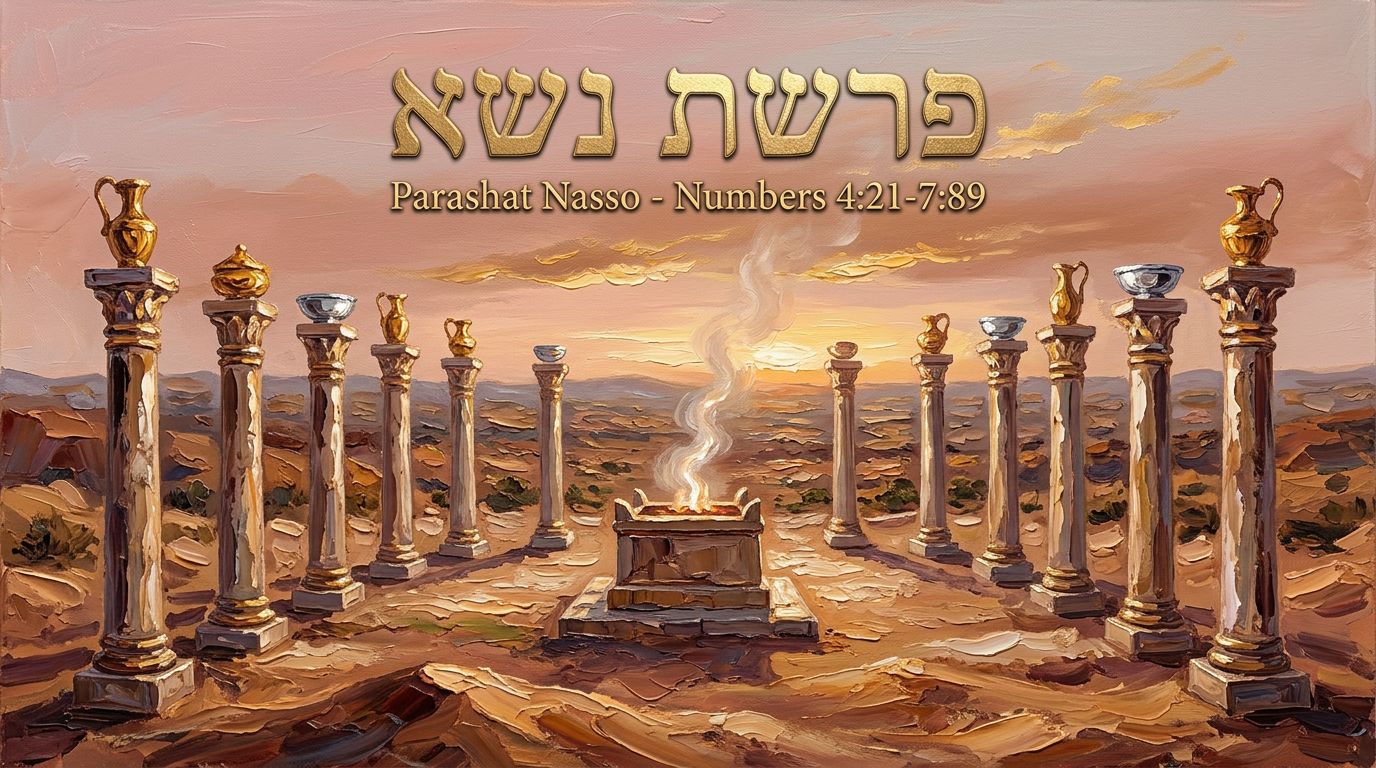
Numbers 7 is remarkable for a structural reason easy to miss. Over 89 verses, the Torah describes the offerings brought by each of the twelve tribal leaders at the dedication of the Tabernacle (the portable sanctuary). Every offering is identical: one silver dish, one silver basin, one golden spoon full of incense, and animal sacrifices.
Why repeat the same offering twelve times? The Midrash Tanchuma suggests a profound answer. Even though the gifts were identical in form, each leader’s offering was unique in intention and significance. Each tribe brought its particular heart, its particular relationship with God. To collapse them into a single entry would erase that individuality.
The twelve offerings also illustrate a model many Jewish communities still aspire to: equality of dignity did not require uniformity of identity. Each was recorded on its own day, with its own tribal name, celebrating distinctiveness within unity.
Putting This Into Practice
Beginner: Bless Your Children
One of the most accessible applications of this week’s parsha is the custom of blessing your children on Friday evening before Shabbat (the Sabbath). Parents traditionally place their hands on their children’s heads and recite the Priestly Blessing, followed by a wish for them to be like Ephraim and Manasseh. You do not need to be a priest or a rabbi. You need only be a parent, grandparent, or caring adult willing to speak blessing over a child.
Intermediate: Practice Honest Reckoning
Take the Torah’s teaching on confession and restitution seriously. Think of a relationship where you have caused harm or left something unresolved. Reach out to that person. Name what happened. Ask what repair might look like. This is the practical work of teshuvah (repentance) – it does not have to wait until the High Holidays.
Advanced: Make and Honor a Commitment
Inspired by the Nazirite vow, consider making a deliberate spiritual commitment for a defined period – perhaps 30 days. It might involve a practice of study, a dietary discipline, a commitment to daily prayer, or a pledge to speak only words of kindness. The key is specificity and a defined timeframe. At the end, reflect: what did this commitment teach me about discipline, pleasure, and gratitude?
Frequently Asked Questions
- What does the name “Nasso” mean?
- “Nasso” comes from the Hebrew root nun-samech-aleph and means “to lift up” or “to carry.” In context, it refers to lifting up the heads of the Levite families for counting, but commentators like Sforno understand it as a call to spiritual elevation.
- Why is Parashat Nasso the longest Torah portion?
- At 176 verses and 2,264 Hebrew words, Nasso is the longest parsha in the annual Torah reading cycle. The primary reason is Numbers 7, which repeats the identical offering of each of the twelve tribal leaders individually rather than summarizing them. This literary choice, as the Midrash Tanchuma explains, honors the unique significance of each leader’s contribution.
- What is the Priestly Blessing (Birkat Kohanim)?
- The Priestly Blessing is a three-part benediction found in Numbers 6:24-26. It is recited by Kohanim (descendants of the priestly class) in synagogue services and by parents blessing their children on Friday nights. Its words were found on silver amulets from the 7th century BCE, making it one of the oldest biblical texts in existence.
- What is the Sotah ritual?
- The Sotah ritual, described in Numbers 5:11-31, was a ceremony for a woman suspected of infidelity when there were no witnesses. It involved holy water, an oath, and a test. The Talmud (Sotah 47b) records that Rabban Yochanan ben Zakkai abolished the practice in the first century CE, arguing that the social conditions that once justified it no longer existed.
- What is a Nazirite vow?
- A Nazirite vow (Numbers 6:1-21) was a voluntary commitment to heightened holiness, involving abstention from wine and grape products, avoiding contact with the dead, and leaving hair uncut. The default duration was 30 days. At its conclusion, the Nazirite brought a sin offering because, as Ramban explained, denying permissible pleasures is not the Jewish ideal – sanctifying them is.
Conclusion: The Blessing We Carry Forward
Parashat Nasso is long, but its length is part of the message. Every verse about the Levites, every repeated tribal offering, and every word of the Priestly Blessing is there because the Torah refuses to rush past what matters. It names every leader. It insists that each person’s contribution be recorded individually.
In our own lives, we often feel pressure to move quickly, to summarize, to compress. This portion invites us to slow down. To lift up our heads and notice who stands beside us. To confess what needs confessing. To make commitments we intend to keep. And above all, to bless one another as channels for something far greater than ourselves.
As you enter this Shabbat, may you carry the words of the Birkat Kohanim with you: May the Lord bless you and protect you. May the Lord cause His face to shine upon you and be gracious unto you. May the Lord lift His face toward you and grant you peace. Shabbat shalom.