Parashat Eikev: Memory, Humility, and the Dangers of Prosperity
When Enough Is Never Enough: Parashat Eikev and the Spiritual Risks of Prosperity
- Moses opens Eikev with a conditional promise: covenant fidelity brings divine blessing, but prosperity itself becomes the most dangerous test the people have not yet faced.
- The portion warns that abundance is more spiritually perilous than scarcity, because comfort tends to produce forgetfulness about the source of what we have received.
- Moses reviews Israel’s wilderness failures not to shame but to ground the covenant in divine mercy rather than national merit or righteousness.
- The second paragraph of the Shema, embedded in this portion, frames covenant life as a generational obligation that pervades every dimension of daily existence.
- Classical commentators from Rashi to Or HaChaim read Eikev as a sustained meditation on dependence, gratitude, and what honest memory requires of a covenanted people.
Parashat Eikev, the fifth portion of Deuteronomy, centers on a danger that arrives not in crisis but in comfort, not in scarcity but in abundance.
Moses addresses a generation that has never seen the vineyards and walled cities of Canaan, and yet warns them about what those vineyards and cities will do to the human soul. The Hebrew word eikev (heel, or consequence) that opens the portion was read by the rabbis as a hint: even the commandments we treat lightly, those we let slide under our heel, deserve the same careful observance as those we celebrate with full ceremony. Covenant life does not allow us to choose which obligations receive our full attention.
Eikev is a parasha for communities that have arrived. Moses speaks to those who have built institutions, achieved security, and now face the subtler test of what to do with success. His answer is searching, and it demands more of us than any moment of crisis ever did.
How Eikev Links Covenant Obedience to Divine Blessing
Moses opens Parashat Eikev with a direct covenantal promise: if Israel observes God’s commandments, God will keep the oath sworn to the patriarchs, love the people, bless the fruit of the land, and protect them from disease and defeat. The formula is clear, almost contractual, yet the classical commentators refuse to let it rest at that surface reading.
Rashi, following the plain sense of the text, explains that the reward promised in Eikev covers the whole range of human welfare, from fertility of the land to the defeat of enemies. Rashi reads Moses as setting out a cause-and-effect reality that the people could verify through their own wilderness experience. Blessing and obedience are genuinely linked, not merely metaphorically.
The Ramban pushes deeper, situating Eikev within the concerns of Jewish philosophical thought about divine providence in history. For Ramban, Israel’s success in the land will not be the product of military skill or demographic strength; it will be the product of divine promise kept on condition of covenant loyalty. The nation that forgets this premise has not merely grown ungrateful: it has misunderstood the very basis of its own existence.
Ibn Ezra, always attentive to language, notes that the word eikev introduces not a simple “if” but a conditional with real weight behind it: the consequence follows the cause as inevitably as a heel follows a step. Sforno adds that the goal of this obedience is not mere survival but the creation of a society that has genuinely internalized what it means to be covenanted to God. The reward is less a payment than an outcome, a people formed by its own faithfulness.
Moses’ Warning Against Pride and Self-Sufficiency in Prosperity
One of the most striking passages in Eikev is Moses’ direct rebuke of a pride Israel has not yet committed. “Beware,” Moses says, “lest your heart grow haughty and you forget the Lord your God.” He names the specific temptation: the houses you build, the herds you accumulate, the silver and gold that multiply, and you say in your heart, “My power and the strength of my hand made me this wealth.”
The Or HaChaim reads this passage as a spiritual psychology as much as a legal warning. Or HaChaim argues that abundance produces a quiet, almost imperceptible shift in the soul’s orientation: what was received as gift gradually comes to feel like entitlement, and what was given by God gradually comes to feel self-generated. The warning is not about corruption or open wickedness but about something subtler and more dangerous, the normalization of forgetting.
Moses’ antidote is equally specific: “You shall remember the Lord your God, for it is He who gives you the power to make wealth.” The act of remembering is not sentimental nostalgia; it is a structural commitment to reading success correctly. Gratitude here is not optional piety but accurate perception. The person who sees only his own effort has made a factual error, not merely a spiritual one.
For scholars of Deuteronomy, this passage fits a broader pattern in the book: Israel’s life is consistently framed as dependent on divine initiative. Covenantal obedience is, in this reading, less about earning reward than about staying genuinely oriented toward the source of life in the land. The danger Moses identifies is that prosperity makes that orientation feel unnecessary.
Did You Know? The word eikev shares its root with the name of the patriarch Jacob, Yaakov, because he was born grasping Esau’s heel (Genesis 25:26). Midrashic tradition linked this to our portion: just as Jacob held fast and would not let go, so Israel is called to hold fast to the whole of covenant life, including the commandments we might otherwise let slip unnoticed beneath our feet.
Why Moses Reviews Israel’s Wilderness Failures
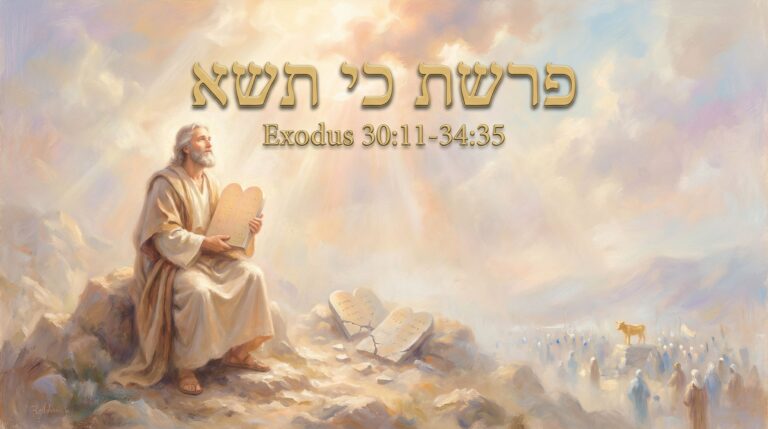
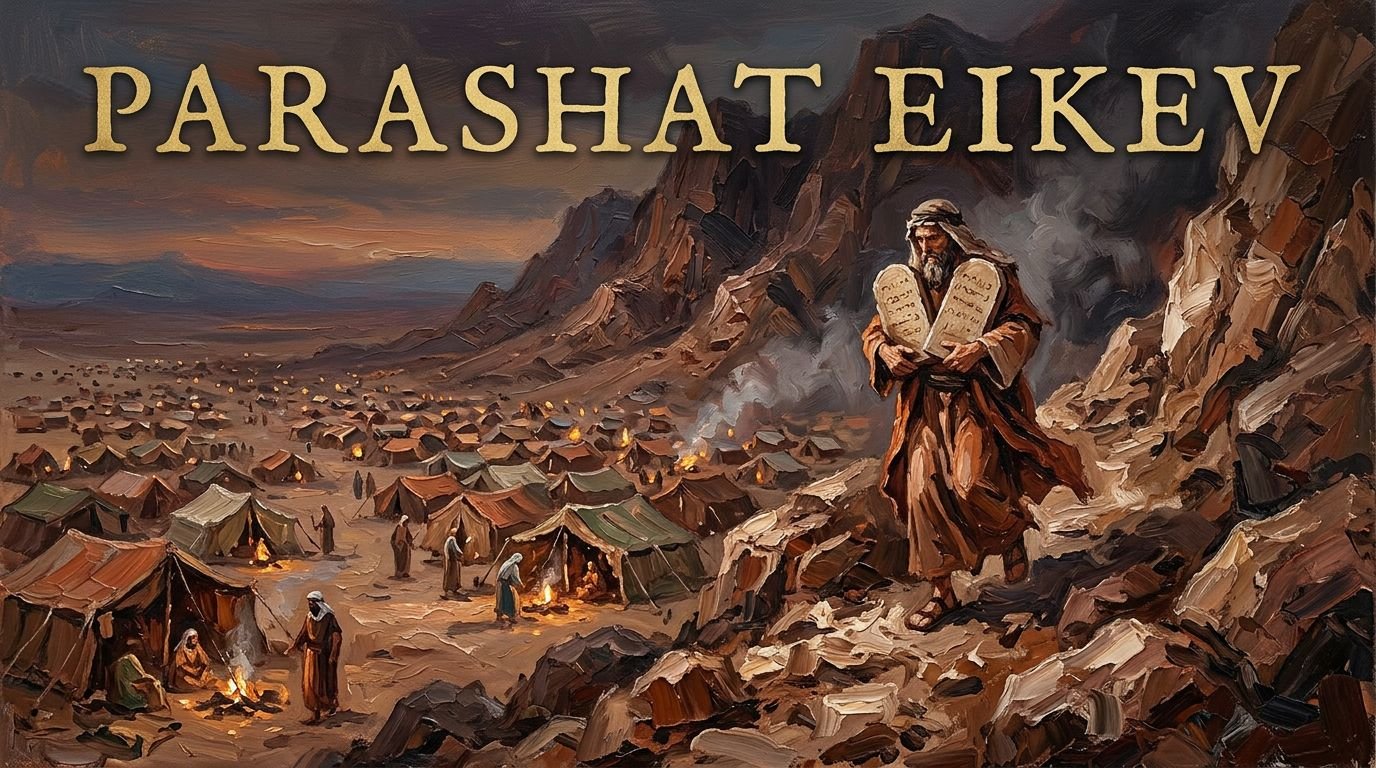
Moses reviews Israel’s wilderness failures in Eikev not to shame the new generation but to teach it to read history correctly. He catalogs the Golden Calf, Korah’s rebellion, the spies, Taberah, Massah, and the other crises of the desert years, and the catalog is long and deliberate.
Rashi is careful to note that Moses frames these memories as evidence of mercy: God forgave each transgression, and it is that forgiveness, not Israel’s righteousness, that undergirds the covenant. When Moses states plainly, “It is not because of your righteousness that you are crossing to possess this land,” he makes a theological claim that cuts against every form of national self-congratulation.
The Conservative reading of this material focuses on covenantal memory: a community that honestly remembers its failures is better equipped to take responsibility for its ongoing obligations. Recalling the Golden Calf is not self-flagellation; it is the maintenance of a realistic self-understanding that makes genuine moral growth possible and prevents the hardening that comes from believing one’s tradition has always been impeccable.
The Orthodox tradition emphasizes that Moses’ recitation of failure points directly to the necessity of ongoing commandment observance. The wilderness generation failed not because it was evil by nature but because it lacked the structures of covenant discipline. Humility, sustained by honest memory, is the foundation on which covenant life is built, and that foundation must be established before prosperity tests it.
The Second Paragraph of the Shema: Covenant Life as Generational Obligation
The second paragraph of the Shema (Deuteronomy 11:13-21), recited twice daily in Jewish prayer, is embedded within Parashat Eikev. It promises that wholehearted love and service of God will bring rain in its season and agricultural abundance, and warns with equal directness that turning away to serve other gods will close the heavens and bring ruin.
Rashi reads the second paragraph of the Shema as a continuation of the conditional logic that runs through the whole parasha. The same cause-and-effect structure now applies to the rhythms of weather and agriculture that determined survival in the ancient Near East. The people are not asked to believe in an abstract covenant; they are asked to live within a covenantal ecology where every dimension of life falls within their relationship with God.
The Reform reading of this passage acknowledges the tension between its literal reward-and-punishment framework and modern sensibilities about how the world works. Many Reform interpreters understand the rain metaphor as pointing to a broader spiritual truth: communities aligned with their deepest values tend to flourish, while those that abandon those values tend to deteriorate. The emphasis falls on the moral and communal dimensions of covenant life.
Sforno notes that the second paragraph of the Shema concludes with the instruction to teach these words to children, to speak of them at home and on the road, morning and evening. Covenant life is not a private spiritual practice; it is a generational project. The obligation to transmit what we have received is itself an act of faithfulness, and it transforms even the most ordinary moments of domestic life into occasions of covenant renewal.
Fear, Love, and Care for the Stranger: Eikev’s Complete Covenant Ethics
Moses compresses a vast demand into a single verse in chapter ten: what does God ask of you but to fear the Lord, to walk in His ways, to love Him, and to serve Him with all your heart and soul? The Talmud observes, not without irony, that this “only” is no small thing.
The classical tradition holds that yirah (awe or reverence) and love are not competing orientations but complementary ones: reverence produces the restraint and attentiveness without which love can become sentimental, while love motivates the pursuit of what God’s ways actually require.
Moses brings this together with a command that has unsettled readers across the centuries: “Circumcise the foreskin of your heart.” Or HaChaim reads this as pointing to the inner life that must undergird all external observance. A community that performs the forms of covenant without the corresponding inner orientation has missed the most essential request. The law is not only a set of prescribed actions; it is a discipline intended to reshape what we actually want and how we actually see ourselves in relation to others.
The parasha then returns to a practical consequence of loving God: care for the stranger, the orphan, and the widow. Moses grounds this command in Israel’s own history of vulnerability: “You shall love the stranger, for you were strangers in the land of Egypt.” The memory of oppression is not only a source of humility; it is the direct foundation for ethical obligation. Those who remember their own dependence are opened, almost structurally, to the claims of others who have received very little.
The figure of Moses as lawgiver and moral teacher is unambiguous on this point: the covenant does not permit the comfortable to assume their comfort is simply deserved. The philosophical study of memory and moral formation reinforces what the Torah insists upon: that how we remember our own story shapes what we are willing to do for others, and that a community which has revised its past into a tale of unbroken merit has lost one of its most important moral resources.
- Covenant obedience in Eikev is not about earning reward but about maintaining an accurate understanding of where blessing originates and what it requires of those who receive it.
- Moses’ warning against pride is addressed to a nation that has not yet sinned through success, because the time to build humility is before prosperity arrives, not after.
- The wilderness failures Moses recalls are evidence of divine mercy rather than national worthiness: the covenant persists not because Israel deserved it but because God remained faithful through repeated failure.
- The second paragraph of the Shema frames covenant life as a generational obligation: both receiving the tradition and transmitting it are acts of faithfulness, not merely the preservation of inherited custom.
- Reverence and love are not competing orientations toward God but complementary ones: awe produces discipline and attentiveness, while love motivates the positive pursuit of what covenant life requires.
- Care for the vulnerable is not an add-on to covenant ethics but a direct consequence of honest memory: those who remember their own dependence are opened to the claims of others who depend on very little.
- Prosperity is spiritually risky not because wealth is wrong but because abundance tends to normalize the feeling that what has been given was actually earned by our own strength.
- Q: What is the main message of Parashat Eikev?
- Eikev carries several interlocking messages, but the central one is this: covenant life requires accurate perception. Israel must understand that its blessing, its land, and its continued existence are gifts rather than achievements. Moses’ warnings against pride, his recitation of wilderness failures, and his call to wholehearted love and service all point in the same direction: a community that misreads the source of its success is in greater spiritual danger than one that is openly struggling.
- Q: Why does Moses repeat Israel’s failures in the wilderness?
- The recitation of failure serves a constructive purpose. Moses is not shaming a new generation for sins it did not commit; he is teaching it to read history correctly. The Golden Calf, the spies, and the other wilderness rebellions all demonstrate that Israel’s survival through those crises depended on divine mercy rather than national virtue. That knowledge is meant to produce humility and trust rather than guilt. As Rashi reads the passage, the point is precisely that God forgave, and that forgiveness is the ground on which Israel now stands.
- Q: What is the significance of the second paragraph of the Shema in this parasha?
- The second paragraph of the Shema, recited twice daily in Jewish prayer, originates in Eikev. It extends the declaration of God’s unity into a covenantal program: wholehearted love and service bring blessing, while turning away brings its consequences. Sforno and other commentators read it as the liturgical crystallization of the parasha’s central teaching, that covenant life must pervade every dimension of daily existence, from seasonal rhythms to the education of the next generation. The fact that we recite it morning and evening is itself a practice of the memory Moses demands.
- Q: How does Eikev connect gratitude with power and success?
- The Or HaChaim offers the sharpest diagnosis: abundance gradually shifts the soul’s orientation from receptivity to entitlement. When we are dependent, we are naturally aware of what we do not control. When we are prosperous, that awareness fades, and what was received as gift begins to feel earned. Moses’ antidote is not poverty but memory: “You shall remember the Lord your God, for it is He who gives you the power to make wealth.” Gratitude, in this framework, is not sentiment but accurate perception.
- Q: Is the parasha mainly about reward and punishment?
- The reward-and-punishment language in Eikev is real and should not be explained away. However, the classical commentators consistently read it within a larger framework about relationship and moral formation rather than a simple transactional system. Ramban’s theology of providence, Sforno’s emphasis on the society the commandments are meant to produce, and the Reform tradition’s focus on communal ethics all suggest that the conditional structure of the parasha is less about payment for services rendered and more about the natural consequences of how a covenanted community orients its collective life. The blessings are less a reward than an outcome, and the consequences of forgetfulness are less a punishment than a result.
Parashat Eikev asks what grows more urgent the more settled we become: what do we owe to the source of our blessing, and what do we owe to those who have not shared in it? Moses does not leave this as a personal spiritual question. He frames it as a national and covenantal one, woven into daily prayer, seasonal agriculture, and the education of children. Memory is the practice that holds the answer together.
When we remember honestly, not to celebrate our achievements but to locate them within a story larger than ourselves, we find that gratitude and justice are not separate obligations. They are two expressions of the same honest perception, and that perception is what the covenant calls us to sustain, generation after generation.