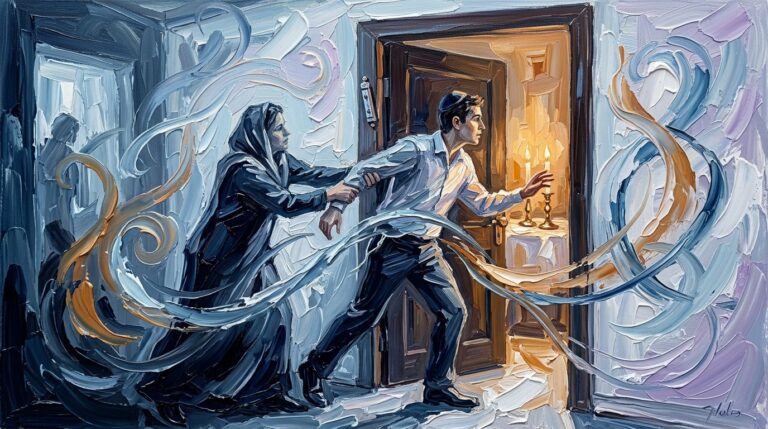

Why Jews Argue So Much (And Why It’s Not a Bug)
- The Jewish culture of argument is rooted in ancient biblical texts and was deliberately structured into Rabbinic tradition through the Talmud’s preservation of minority and rejected opinions alongside final rulings.
- The concept of machloket l’shem shamayim – controversy for the sake of Heaven – sets a moral standard that distinguishes sacred disagreement from ego-driven conflict.
- Orthodox, Conservative, Reform, and Reconstructionist communities all inherit this culture of structured debate, though they channel it through different frameworks and priorities.
- The Talmud attributes the destruction of the Second Temple to baseless hatred, not to argument itself – a reminder that how we disagree matters as much as whether we do.
- The architecture of Jewish debate – shared textual grounding, honest representation of opposing views, and accepted communal outcomes – offers tested tools for a polarized age.
The old joke goes: two Jews, three opinions. But what if that is not a punchline? What if it is closer to a theological statement – a compressed summary of how Jewish civilization has understood the relationship between human minds and divine truth for more than two thousand years?
The Jewish culture of argument is not an accident of temperament, a product of diaspora anxiety, or an unfortunate side effect of too much time poring over dense texts. It is, in some very deep sense, the curriculum. The Talmud is not a law code. It is a record of disagreements.
The Mishnah reports disputes without resolving them. The Gemara layers more disputes on top of those. Commentators from across centuries and continents argue with each other and with the texts themselves. Students entering a beit midrash – a house of study – are not taught to receive answers.
They are taught to ask better questions, to press hard against every claim, and to hold the discomfort of uncertainty long enough to reach something truer than a quick consensus.
We argue so much, it turns out, because we believe truth is serious enough to be worth fighting for.
From Abraham to the Talmud: How Disagreement Became a Jewish Spiritual Practice
The habit starts early – with Abraham himself. In Genesis 18, when God announces plans to destroy Sodom and Gomorrah, Abraham does not lower his eyes and comply. He bargains. He pushes back.
“Will you really sweep away the innocent with the guilty?” he asks, pressing until God agrees to spare the city if fifty righteous people can be found, then forty-five, then forty, then thirty, then twenty, then ten. The negotiation is striking not because Abraham wins – Sodom is destroyed anyway – but because God entertains the challenge at all. The argument itself seems to be the point.
Jacob’s wrestling match in Parashat Vayishlach (Genesis 32) carries the same logic. He struggles through the night with a mysterious divine figure and refuses to release his grip until he receives a blessing. The encounter leaves him permanently marked – limping for the rest of his life – but it also gives him a new name: Yisrael, “one who struggles with God.” The Jewish people are not named for a particular doctrine or a single prophet’s unquestioned vision. They are named for a wrestling match.
We come by our argumentative streak honestly.
What the Rabbis then did with this inheritance is extraordinary. Rather than resolve the disputes that accumulated over centuries of legal and theological discussion, they preserved them. The Mishnah, compiled around 200 CE, is filled with conflicts recorded in the formula “Rabbi X says… but Rabbi Y says…” – and both positions are left standing.
The Babylonian Talmud, redacted over several centuries, adds layer upon layer: arguments about the arguments, hypothetical scenarios pressed to logical extremes, minority opinions that were rejected in practice but retained in the textual record for all future generations to study.
The reason the losing opinions are kept is significant. They are preserved so that a future court or scholar might find cause to revisit them. The minority view is not waste; it is testimony. Tractate Sanhedrin teaches that when a court reaches a verdict, even those who dissented must then act with the majority for the sake of communal life – but their dissent is not erased.
No honest account of what Israel wrestled with can afford to throw away the record of what was seriously considered, argued at length, and ultimately set aside. In this sense, the Talmud is not merely a legal document. It is a library of serious intellectual effort that refused to pretend the process was simpler than it was.
Machloket L’shem Shamayim: When Arguing Counts as Sacred Work
The most important phrase in the Jewish theology of argument appears in Pirkei Avot 5:17 – Arguments for the Sake of Heaven: machloket l’shem shamayim, “controversy for the sake of Heaven.” The passage offers two contrasting examples. The disputes of Hillel and Shammai are machloket l’shem shamayim and will ultimately endure. The disputes of Korach and his faction – who challenged Moses’ leadership in the wilderness – are not for the sake of Heaven and will come to nothing.
What marks the difference? Not loudness, not stakes, not whether one side turns out to be correct. Talmudic tradition is almost achingly honest about the fact that the disputes between Beit Hillel and Beit Shammai were fierce enough to threaten communal unity. Tractate Eruvin records that the two schools disagreed so bitterly on matters of purity, marriage law, and Sabbath practice that Beit Shammai’s students threatened not to accept the children of Beit Hillel marriages as halakhically legitimate – a near-rupture that could have split the Jewish world.
Yet the tradition insists these arguments were holy. Both sets of rulings, the Talmud declares in one of its most often-cited passages, are divrei Elohim chayyim – “words of the living God” (Eruvin 13b). The divine reality is, apparently, large enough to contain the contradiction.
What made Korach’s rebellion categorically different was the motive. As Machloket: Argument in Jewish Tradition makes clear, Rabbinic literature consistently distinguishes between disputes driven by truth-seeking and disputes driven by ego, status, or power. Korach’s claim – that the entire congregation is holy – is theologically serious. He was not simply wrong.
He deployed a legitimate idea in the service of political undermining rather than genuine exploration. That shift, from truth-seeking to power-accumulating, is what the tradition condemns. Not disagreement. Not even fierce, uncomfortable, community-straining disagreement.
This framing places a demanding burden on every participant in a Jewish argument. Before pressing your case, you are expected to ask: am I doing this to understand something better, to serve the community, to honor the complexity of God’s will? Or am I doing it to win, to humiliate, to demonstrate that I am smarter than the person across the table? The first orientation is machloket l’shem shamayim.
The second is Korach’s rebellion dressed in scholarly clothes, and the tradition has no patience for it regardless of how impressive the citations are.
Orthodox, Conservative, Reform, Reconstructionist: Four Streams, One Arguing Tradition
It would be easy to assume that the Jewish culture of argument lives primarily in the Orthodox beit midrash – a product of hours spent over Talmudic folios in yeshiva. The argumentative inheritance, however, runs through every stream of contemporary Jewish life, even when the content, style, and stakes look radically different.
In Orthodox communities, the chavruta model – pairs of students debating every line of Talmud together, pushing and challenging each other’s logic until one or both understands something new – is foundational to how learning is understood.
As the tradition of rabbinic disagreement makes plain, the disputes among Rishonim and Acharonim – medieval and early modern halakhic authorities – are not embarrassments to be explained away but models to be internalized. Orthodox institutions generally insist that after vigorous debate, communal practice must follow authoritative rulings and majority decisions.
The minority opinion stays in the record, however, and may return when circumstances change. Some Orthodox voices worry that contemporary online argument, unmoored from authoritative text and institutional accountability, risks sliding into relativism; their response is not less argument but more disciplined argument, rooted in yirat shamayim – awe of Heaven.
Conservative Judaism treats methodological pluralism as central to the halakhic process itself. The movement’s Committee on Jewish Law and Standards regularly issues responsa that include minority positions alongside majority rulings, and its thinkers explicitly frame the ability to hold tradition and change in productive tension – without forcing premature resolution – as a form of fidelity to the tradition rather than a departure from it. The downside, which Conservative thinkers sometimes acknowledge internally, is that constant internal debate about standards can blur communal norms.
But this very struggle is framed as faithful participation in the “codified controversy” that has always characterized Jewish religious life.
Reform Judaism’s history is itself a story of ongoing internal argument.
The movement has debated Zionism, the ordination of women and later of LGBTQ+ rabbis, the place of Hebrew in liturgy, and the relationship between moral autonomy and inherited tradition – all internally, and all with considerable heat at various points. How to Argue, Discuss, and Disagree in a Jewish Way frames these debates as expressions of moral autonomy and prophetic responsibility, with the guiding question shifting from “what does halakha require?” to “what does our Jewish conscience demand?” – even when that conscience leads far from traditional conclusions.
Reconstructionist communities build disagreement into their governance structures, drawing on Mordecai Kaplan’s vision of Judaism as “an evolving religious civilization.” No single authority can claim final truth in an evolving culture, and adversarial viewpoints are not threats to community but ingredients of it.
The risk of fragmentation in small communities is real and often acknowledged, and many Reconstructionist kehillot address it by ritualizing disagreement through facilitated dialogue, shared study, and explicit covenants of civil discourse – bringing the architecture of machloket l’shem shamayim into explicitly contemporary settings.
When Jewish Argument Turns Toxic: Ego, Power, and the Limits of Pluralism
The tradition’s enthusiasm for argument comes with a frank and unsentimental warning: not every argument deserves to be called Jewish. The same Rabbinic literature that celebrates Hillel and Shammai is equally honest about the cost of getting it wrong.
The destruction of the Second Temple in 70 CE is attributed in the Talmud (Yoma 9b) not to Roman military superiority but to sinat chinam – baseless hatred among Jews. The trigger story involves a man who attends a party to which his enemy was accidentally invited, and publicly humiliates him rather than quietly pointing out the mistake. One act of contempt spreads, the story implies, until an entire civilization can no longer hold itself together.
The Talmud is making a precise claim: when argument is contaminated by contempt, it stops being a mechanism for truth and becomes a mechanism for destruction.
The line between holy disagreement and corrosive controversy runs through motivation and method, not volume or passion. Arguments that honestly represent the opposing view, remain focused on the actual question, and treat the other person’s dignity as inviolable can be fierce and still be sacred. Arguments that caricature, dismiss, humiliate, or accumulate power at another’s expense have already left the territory of machloket l’shem shamayim – regardless of how Torah-fluent their vocabulary sounds. A learned insult is still an insult.
The history of Judaism’s great debates across the centuries shows this line being crossed repeatedly – in the bitter conflicts between Hasidim and Mitnagdim in the eighteenth century, in the early wars over Zionism, in contemporary fractures over Israel, gender, and denominational legitimacy. In none of those cases did the disagreement itself cause the lasting damage.
What caused the damage was the erosion of the discipline that makes argument holy: the willingness to see the opponent as a sincere seeker rather than an enemy, to accept communal outcomes even after losing, and to keep the focus on the question rather than the person asking it.
The tradition does not resolve this risk by recommending less argument. It resolves it by demanding better argument – harder argument, argument that costs you something, argument that forces you to genuinely reckon with the other side before you are permitted to dismiss it.
From Beit Midrash to Twitter: Jewish Argument in the Age of Social Media
The beit midrash is a demanding environment engineered to make argument productive. Students enter it having already studied shared texts. They argue in chavruta pairs, then in larger groups, then before a teacher who can referee and redirect. The community shares a commitment not just to a set of answers but to a method – working through texts honestly, crediting opponents fairly, accepting majority decisions while preserving minority positions for the record.
The argument runs hot, but the structure is load-bearing.
Social media strips most of that structure away. The major platforms reward brevity, outrage, and in-group performance. There is no teacher to redirect the conversation, no shared textual anchor, no structural incentive to honestly represent an opponent’s best argument, and no mechanism for reaching decisions that everyone then accepts and acts on together. The “two Jews, three opinions” dynamic – which functions in a beit midrash because the structure channels friction productively – becomes pure friction without that structure.
This does not mean Jewish communities should retreat from online discourse.
It means they should engage it deliberately. Debate and Decision in the Jewish State and similar Hartman Institute work suggests that recovering the structural features of Jewish argument – honest representation of opposing views, commitment to shared outcomes even after losing a debate, and a clear distinction between the person and the position they hold – is exactly what both Jewish communities and the wider culture need most urgently right now.
Some Jewish educators are already experimenting with beit midrash-style learning in explicitly non-traditional settings: interfaith dialogue sessions, civic conversations about public policy, even organizational conflict resolution. The specific content changes; the architecture stays the same. You sit with someone who disagrees with you. You both engage with a shared text or a shared question.
You are not permitted to simply reject what they say – you have to engage it, find its strongest form, and only then respond to it. At the end, you may still disagree. But you have treated the other person’s mind as worth contending with, which is itself a form of honor.
That may be the most practical contribution the Jewish culture of argument can make to a moment that has largely forgotten how to argue well.
- Jewish culture of argument is rooted in biblical narratives – Abraham bargaining with God over Sodom, Jacob wrestling through the night – that frame principled struggle as a form of relationship rather than rebellion.
- The Talmud deliberately preserves rejected and minority opinions, treating them as testimony to what Israel seriously considered, not waste to be discarded when the majority ruled.
- Machloket l’shem shamayim – controversy for the sake of Heaven – is the standard that distinguishes sacred argument from destructive conflict; the difference lies in motivation and method, not volume or passion.
- All four major Jewish denominations inherit the culture of structured debate, though they apply it through different content and methods, from halakhic analysis in the Orthodox beit midrash to values-based moral deliberation in Reform communities.
- The Talmud attributes the destruction of the Second Temple to baseless hatred, not to argument itself – a precise warning that contempt, not disagreement, is the real existential risk.
- The structural features of beit midrash learning – shared texts, honest representation of opponents, accepted communal outcomes – are what make Jewish argument productive, and they are exactly what social media discourse lacks.
- Recovering disciplined, purpose-driven Jewish argument is both a religious obligation and a potentially constructive contribution to a wider culture that has lost its footing in productive disagreement.
- Q: Isn’t all this Jewish arguing just divisive? How can constant disagreement be a religious value?
- Jewish tradition distinguishes sharply between disagreement and division. Machloket l’shem shamayim – argument for the sake of Heaven – is disagreement in the service of truth, conducted by people who share a common commitment and accept communal outcomes even when they lose the debate. That kind of argument can actually strengthen community by deepening shared understanding and keeping important questions alive rather than burying them under premature consensus. Division happens when argument slides from truth-seeking into contempt. The tradition does not protect against all conflict; it insists on the discipline that keeps conflict honest and oriented toward something larger than the combatants’ own egos.
- Q: If both sides of a Jewish debate can be valid, does Judaism really believe in objective truth?
- Judaism affirms objective truth but is deeply humble about any human formulation of it. When the Talmud says that both Beit Hillel and Beit Shammai’s rulings are “words of the living God,” it does not mean both positions are equally correct in a relativistic sense. It means the divine reality is complex enough that two serious, Torah-committed, methodologically rigorous scholars can reach opposite conclusions and both be capturing something real. Crucially, the tradition still requires a decision: Beit Hillel’s view prevails in practice, and communal life proceeds accordingly. Humility about the limits of human articulation is not the same as relativism about what God actually wills.
- Q: Why does the Talmud preserve so many rejected opinions instead of just recording the final law?
- Several reasons run through Rabbinic literature. Practically, a future generation may encounter new circumstances in which the minority position turns out to be relevant or even correct – the rejected view is kept in reserve, not discarded. Epistemically, the record of serious disagreement is itself evidence of how genuinely hard the questions are; stripping it away would misrepresent the difficulty and flatten the intellectual history. And morally, preserving the losing side honors the intelligence and effort of the scholars who held it. The defeated view is testimony, not trash. This is why Talmudic study is not simply learning answers – it is learning to think by watching serious thinkers disagree under pressure.
- Q: How is the Jewish culture of argument different from today’s online “culture wars”?
- The structural differences are significant and worth naming carefully. Jewish argument in its traditional form requires shared textual grounding, honest representation of the opponent’s strongest position, acceptance of communal decisions even after losing, and a shared purpose beyond winning. Online culture-war discourse rewards brevity, outrage, and in-group performance – with no mechanism for reaching decisions, no structural requirement to engage opposing views honestly, and no communal accountability for how you argue. The content of disagreement may sometimes look similar across these two modes; the architecture is nearly opposite. Recovering beit midrash-style norms in digital spaces requires intentional structural design, not simply good intentions.
- Q: Do different Jewish denominations actually value argument, or is that just an Orthodox beit midrash thing?
- All four major streams inherit the culture of structured debate, though they express it through different content and methods. Orthodox communities center it in halakhic analysis through chavruta study, insisting on text-grounded, authority-respecting dispute. Conservative Judaism builds it into its legal process through official responsa that include minority positions. Reform Judaism frames it as moral autonomy and prophetic responsibility, with ongoing internal debates over values and social policy. Reconstructionist communities build disagreement into their governance structures, often ritualizing it through facilitated dialogue and covenants of civil discourse. The form changes across denominations; the underlying conviction that serious, disciplined disagreement is a form of Jewish practice runs through all of them.
We inherit a tradition that placed argument at the center of spiritual life not because early Jewish thinkers were especially quarrelsome, but because they took both the difficulty of truth and the seriousness of human minds with unusual care. The very persistence of Jewish civilization through millennia of exile, displacement, and rupture may owe something to the fact that our culture was built not on enforced consensus but on practiced, disciplined disagreement. We learned to hold difference without disintegrating.
As we face pressures – within our communities and far beyond them – that push toward either forced unity or total fragmentation, returning to the beit midrash model of honest, structured, purpose-driven argument may be one of the most urgently Jewish things we can do.