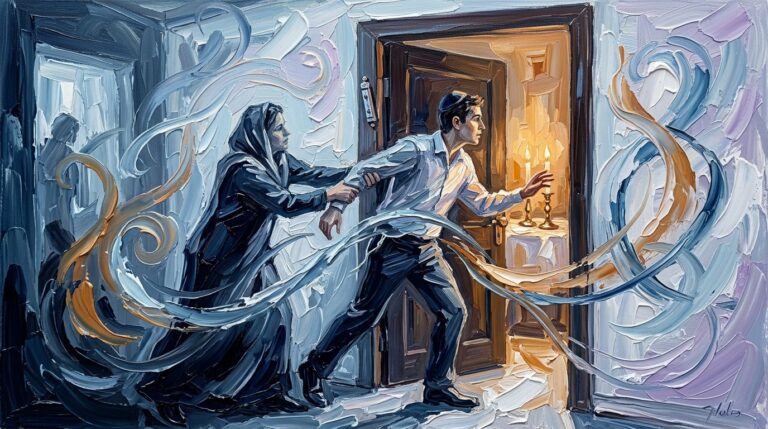

When your Best Friend Posts “From the River to the Sea”
- Seeing this phrase from a close friend produces a specific kind of wound – political, personal, and deeply Jewish – and all three dimensions matter
- Jewish tradition’s mitzvah of tochacha (loving rebuke) in Leviticus 19 gives us both permission and structure for speaking up
- Orthodox, Conservative, Reform, and Reconstructionist communities differ on how to classify the phrase and what it requires of us relationally
- Preparing for the conversation means understanding what your friend likely meant, what they almost certainly did not know, and what you need from them
- Jewish ethics allows – and sometimes requires – you to speak; it also gives you permission to grieve if the friendship cannot hold the weight of honesty
You see the post. Your stomach drops. The username is your best friend’s – the person who has been at your Shabbat table, who held you when your grandmother died, who knows that being Jewish is not a side note in your life but the spine of it. And there it is: “From the river to the sea, Palestine will be free.” Maybe a watermelon emoji.
Maybe just the words.
The disorientation is real. Jewish life has always involved navigating a world that does not always understand us, but when confusion crosses into our most intimate relationships, it arrives with a specific kind of grief that political language alone cannot capture. We are not just hurt in the abstract – we feel unseen, possibly endangered, and heartbroken about someone we thought we knew. This is not a hypothetical for thousands of American Jews right now.
It is Tuesday morning, it is a notification on a phone screen, and it is a friendship that suddenly has a crack in it that was not there yesterday.
Jewish tradition has a great deal to say about exactly this moment: what it demands, what it permits, and what it cannot promise. What it will not do is let us off the hook of our own humanity – or theirs.
Why This Particular Phrase Lands Like a Blow
To understand the conversation you need to have, you first need to understand why this phrase registers so differently for Jewish people than it often does for those who post it.
“From the river to the sea” refers to the geographic stretch between the Jordan River and the Mediterranean – the entirety of what is now Israel, the West Bank, and Gaza. Advocates for Palestinian rights often deploy the phrase to mean: across all of that land, Palestinians should be free. To many of them, it is a statement about human rights, not an endorsement of violence.
But for most Jewish people, especially in the aftermath of October 7, 2023, the phrase carries a different freight entirely. It describes a geography in which there is no Jewish state. The slogan was historically associated with Palestinian factions, including Hamas, whose founding charter explicitly called for the destruction of Israel and the killing of Jews. The words do not arrive in a political vacuum.
The Anti-Defamation League, the American Jewish Committee, and Jewish federations across the denominational spectrum have characterized the phrase as, at minimum, a call for the erasure of Jewish sovereignty.
Your friend may genuinely not have known any of this. Social movements spread language faster than history spreads context. Someone sees a phrase on a protest sign, feels it as solidarity with people suffering, and reposts. That is a real thing that happens.
But “I didn’t know” and “this didn’t hurt you” are two different sentences.
Both things can be true. Your friend may not be antisemitic. And you are still allowed to be wounded.
What Torah and Talmud Teach About Speaking Up
Here is where Jewish tradition offers something most contemporary frameworks do not: a specific ethical obligation to address a friend who has harmed us, rather than swallowing the pain or silently walking away.
The key text is Leviticus 19:17-18: “You shall not hate your brother in your heart. You shall surely rebuke your neighbor, and you shall not bear sin because of him. You shall not take vengeance or bear a grudge against the members of your people, but you shall love your neighbor as yourself.”
The Hebrew word is tochacha – loving rebuke – and the Talmudic tradition treats it as a genuine mitzvah, not merely a suggestion. The Talmud in Tractate Shabbat (54b) goes further, noting that one who sees another commit a wrong and remains silent bears some moral weight of that wrong. Silence, in Jewish law, is not neutrality.
Maimonides (Rambam) in the Mishneh Torah, Laws of Character Development (6:7-8), sets conditions on how tochacha must be delivered. The rebuke should be done privately. It should be gentle, without embarrassment, without shaming. It should name the specific behavior, not indict the person’s entire character.
And critically: it should be attempted more than once if the first conversation fails. We are required to try – genuinely try – before we are permitted to give up.
This is a demanding framework. But notice what it does not require. It does not ask you to pretend you are fine. It does not instruct you to absorb the wound silently in the name of keeping the peace.
Nor does it demand public denunciation. It asks you to love your friend enough to tell them the truth about what they did to you.
There is also the concept of chillul Hashem – desecrating God’s name – which runs in the other direction. If the Jewish community’s response to this kind of speech is perceived as vindictive or performative, it reflects poorly on us as well. The tradition asks us to rebuke with dignity, which ultimately reflects the dignity we claim for ourselves.
Denominational Perspectives: One Phrase, Multiple Jewish Responses
One of the remarkable things about asking “what does Judaism say” about a topic this charged is that the answer is genuinely plural – not because Judaism is vague, but because its denominations reflect real intellectual traditions with distinct emphases.
Orthodox communities generally hold a strong and unified position that “from the river to the sea” is an antisemitic slogan. In traditional Orthodox settings, the Jewish connection to the Land of Israel is not merely political but theological – rooted in covenant, prophecy, and halacha. From this vantage point, the phrase does not just threaten a state; it threatens a divine promise. Orthodox leaders tend to emphasize that the conversation with a friend is necessary, and that the line must be clear: you can disagree with Israeli government policy; you cannot endorse the elimination of Jewish life in the Land of Israel.
Conservative Judaism occupies a middle register. The movement strongly affirms Israel’s right to exist and has grown increasingly vocal about antisemitism in progressive spaces – yet it also contains serious scholars who draw careful distinctions between legitimate political critique and genuine calls for elimination. The Conservative approach would likely validate both your pain and your obligation to speak, while counseling against assuming the worst about a friend who may simply be politically uninformed.
Reform Judaism presents the widest internal range. The Reform movement is deeply committed to social justice, and its tent is broad enough to include both strong Zionists and members who hold more complex views on Israeli policy. Many Reform rabbis have spoken forcefully about the phrase as harmful. Some congregants, particularly those active in progressive politics, struggle with the tension between Palestinian solidarity frameworks they find meaningful and the real harm the phrase causes Jewish communities. The Reform emphasis on individual conscience means this conversation may be more complicated in some Reform circles – which is perhaps exactly why it needs to happen.
Reconstructionist and Renewal communities approach the question with explicit theological nuance, emphasizing relational repair, listening, and justice across lines of difference. These movements tend to be most open to internal criticism of Israeli policy while also taking Jewish pain seriously. A Reconstructionist framework might ask: what does your friend actually believe about Jewish people? Start there.
Across all four movements, a shared thread runs: the friendship is worth a real conversation, not a performative one.
How to Actually Have This Conversation
You do not have to do it the day you see the post. Taking a breath is not avoidance; it is wisdom. But Jewish tradition and basic psychology agree: the longer you wait, the heavier it gets.
Start with your own experience, not an accusation. “I saw what you posted and I have to be honest – it really hurt me, and I want to talk about it” is a different opening than “Do you know what that slogan actually means?” The first invites a conversation. The second opens with a quiz.
Explain the Jewish experience of the phrase. You do not need to win a political debate. You need your friend to understand that these words land in Jewish ears with a specific, historically grounded weight – that the phrase was used by movements that explicitly called for killing Jews, and that in the months after the worst massacre of Jews since the Holocaust it echoed in ways that were not abstract. You can share that without claiming to speak for all Jews, and without demanding your friend agree with Israeli government policy.
Listen for what they actually believe. Ask them what they meant. Ask what they know about the history of the phrase. You may find that they knew exactly what it implied and stand by it – that is a different situation than someone who picked up a slogan at a rally without knowing its genealogy. The tradition of tochacha asks us to be honest, but it also asks us to listen. Your friend deserves the chance to clarify before you make final judgments.
Be clear about what you need. You do not need your friend to become a political Zionist. You may simply need them to understand that this phrase is specifically painful to you as a Jewish person, and to take that seriously. That is a reasonable ask. Whether they can meet it is information.
Try more than once if the first attempt misses. Maimonides says we try again. If the first conversation is too charged, or ends without resolution, give it time and come back. The tradition does not demand that you exhaust yourself indefinitely, but it asks for genuine effort before you close the door.
- The phrase “From the River to the Sea” has a specific, documented history of association with movements calling for Israel’s elimination – explaining that history to your friend is not a political act, it is a personal one
- Leviticus 19:17’s mitzvah of tochacha (loving rebuke) means Jewish tradition asks you to speak up, not swallow the hurt
- Maimonides sets conditions for rebuke: private, gentle, specific, and without public shaming – a model that actually works for friendship repair
- Orthodox, Conservative, Reform, and Reconstructionist communities all affirm that this conversation is worth having, even while they differ on how exactly to characterize the phrase
- Begin with your own experience, not an accusation; ask what your friend actually meant before drawing conclusions
- You are allowed to grieve this – Jewish tradition does not require you to perform equanimity you do not feel
- If the friendship cannot hold an honest conversation about something this important, that is painful and real information about the friendship
When a Friendship Can’t Survive This – and What That Means
Sometimes you have the conversation. You explain the history, you share your hurt, you listen carefully. And your friend tells you, one way or another, that they stand by the post and are not particularly troubled by your pain.
Jewish tradition has something to say about this as well. Pirkei Avot (Ethics of the Fathers) 1:6 instructs us to “make for yourself a teacher, acquire for yourself a friend” – the deliberate choice of a friend framed as a value-laden act. Friendships in Jewish thought are not merely emotional; they are moral ecosystems. The people we keep close shape who we become and who we allow ourselves to be.
This does not mean you must immediately end every friendship that contains political disagreement. It does mean you are allowed to honestly assess what a friendship costs you, what it gives you, and whether it can bear the weight of who you actually are. A friend who cannot make room for your Jewish fear – who insists the slogan means only what they intended and that your history is not their problem – has told you something real about the kind of friend they can be.
You are permitted to mourn that. The Talmud in Tractate Sanhedrin (22b) takes friendship loss seriously enough to compare it to losing a close family member. The grief is proportionate to what was real.
But you are also permitted to be surprised. People change. Friendships can survive a crisis of understanding when both parties are willing to grow through it. Some of the most durable friendships have been forged precisely in the furnace of hard conversations like this one, because they proved that the relationship could hold something difficult and come out more honest on the other side.
The tradition does not promise a particular outcome. It promises a framework for showing up as yourself – fully, with your history, your hurt, and your hope intact.
- Q: What does Judaism say about confronting a friend who posts “From the River to the Sea”?
- Jewish law in Leviticus 19:17 establishes the mitzvah of tochacha – a loving, private rebuke – as an obligation rather than a suggestion. The Talmud (Shabbat 54b) holds that remaining silent in the face of wrongdoing carries its own moral weight. Maimonides’ conditions for proper rebuke – gently, privately, without shaming, focused on the specific act rather than the person’s character – offer a practical road map for exactly this kind of conversation. In most readings, you are not only permitted to speak up; you are required to try.
- Q: How do different Jewish movements approach “From the River to the Sea” and its impact on friendships?
- Orthodox communities generally hold that the phrase is unambiguously antisemitic and that a clear response is required, given the theological weight of Jewish connection to the Land of Israel. Conservative Judaism affirms Jewish pain around the phrase while asking us to listen for what the friend actually intended. Reform communities vary internally, but most Reform rabbis emphasize that regardless of intent, the hurt is real and the conversation is necessary. Reconstructionist frameworks tend to focus most explicitly on relational repair and listening across difference, while still taking the harm seriously. All four movements affirm that the friendship is worth a genuine conversation – and that absorbing the hurt in silence is not the Jewish approach.
- Q: What if my friend says they only meant it as a call for Palestinian rights, not the elimination of Israel?
- That explanation deserves genuine engagement, not dismissal. It may be entirely true that your friend had no eliminationist intent. But Jewish tradition distinguishes between intent and impact – and explaining why the phrase carries the weight it does for Jewish people is both fair and necessary. You can fully accept that your friend meant no harm while still asking them to understand that the history of the slogan means it lands as harm regardless. That is not a political argument; it is asking to be seen as a specific person with a specific history.
- Q: Is the phrase antisemitic if the person posting it is not Jewish and may not know its history?
- Jewish organizations including the ADL and AJC have characterized the phrase as antisemitic in effect, given its historical association with movements that explicitly called for the killing of Jews and the elimination of Jewish sovereignty. Whether any specific individual who posts it is personally antisemitic is a separate question – it depends on what they know, what they intend, and whether they are willing to engage with the harm it causes. Your first conversation with your friend is partly a data-gathering exercise. What matters most is what they do with the information you share.
- Q: What if the friendship ends over this?
- Jewish tradition takes friendship loss seriously – Talmud Sanhedrin 22b compares losing a close friend to losing part of oneself. You are permitted to grieve. What tradition asks of you first is genuine effort: the conversation, the honesty, the willingness to listen as well as speak. If, after real effort, your friend cannot make room for your Jewish reality, that is not a failure of the mitzvah. You will have done what the tradition required. What comes next – whether you step back, keep trying, or find a new equilibrium – is yours to decide, and no answer is without cost.
The question of what to do when someone we love causes us harm sits near the center of Jewish ethical life. We are a tradition that does not let people off the hook easily, including ourselves. Leviticus 19 puts loving your neighbor and rebuking your neighbor in the same breath, not as opposites but as two expressions of the same commitment. You cannot fully love someone while hiding your truth from them, and you cannot rebuke someone well without genuinely caring what happens next.
When your best friend posts “from the river to the sea,” the tradition asks something hard of you: to stay human about it. Not to disappear into abstract political positions, but to show up as a specific Jewish person, with a specific history, who is specifically hurt, asking to be seen. Give your friend the chance to know what they did and choose what they do next. That is all the tradition requires of us – and it turns out it is quite a lot.