The Quiet Crisis: Why So Many Observant Jews Secretly Doubt
- Religious doubt is widespread among observant Jews but rarely spoken aloud, creating private suffering in communities where faith is assumed as the baseline.
- Judaism’s own foundational texts preserve a tradition of wrestling with God – from Abraham’s argument at Sodom to Job’s unanswered complaints to Psalms that end in darkness without resolution.
- Modern pressures including academic biblical scholarship, post-Holocaust theodicy, and internet access have intensified the experience of doubt for this generation in historically distinctive ways.
- Different Jewish movements offer meaningfully different frameworks for holding doubt, from Orthodoxy’s emphasis on continued practice to liberal movements that build uncertainty into their theological structure.
- Practical paths forward exist for observant Jews navigating doubt without abandoning community, practice, or honesty.
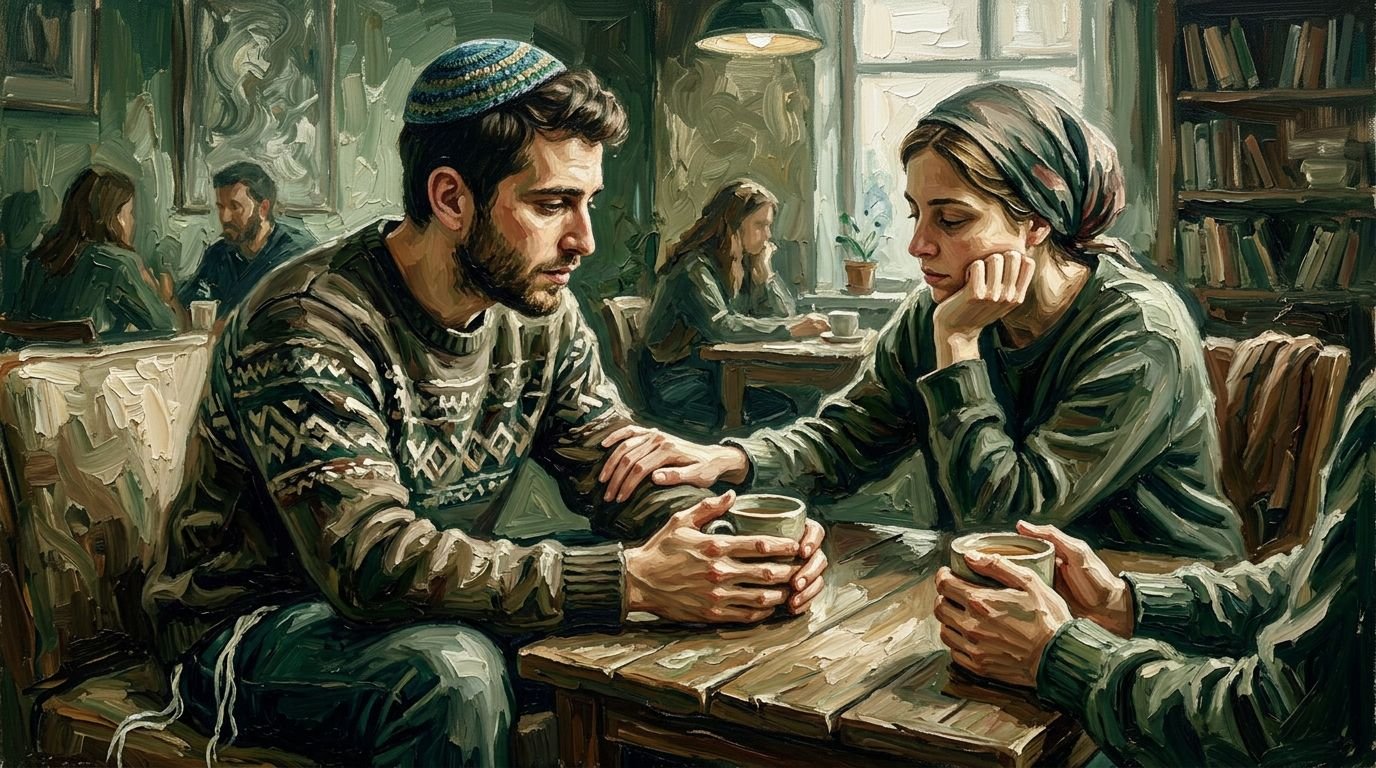
There is a person sitting in your shul right now who has not believed for years. They recite the Amidah with practiced fluency, know exactly when to answer “Amen,” show up for minyan, host Shabbat, and argue with appropriate conviction about the kashrut of a neighbor’s chicken. At night, alone, they wonder whether any of it points to anything real.
This is not a marginal phenomenon. Researchers studying religious behavior have consistently found that meaningful numbers of people who present as observant harbor sustained private uncertainty about core theological claims. Among Orthodox Jews, a population defined externally by behavioral compliance, the mismatch between outward practice and inner conviction can be especially acute. The social cost of naming doubt in these communities is high: family concern, changed social standing, complicated marriage prospects, the fear of being seen as failed or corrupted.
So people stay quiet. The quiet becomes its own kind of suffering, and the suffering remains invisible.
We rarely talk about this honestly. The topic feels dangerous, as if naming doubt might spread it, or as if the person who doubts has failed at something essential. But Judaism’s own textual tradition points in a different direction. Our ancestors did not treat doubt as a character flaw requiring correction.
They treated it as raw material for something more honest and, in many cases, more spiritually serious than easy certainty.
Traditional and Textual Sources: A Tradition That Wrestles
Our religious vocabulary includes a name that reframes everything: Israel. The name given to Jacob after he grappled through the night with an angel translates most plausibly as “one who struggles with God” (Genesis 32:29). We are, by our founding story, a people whose very identity is bound up in the struggle rather than the resolution. That is a remarkable starting point for any honest conversation about doubt.
The Torah does not offer a sanitized portrait of faith. Abraham, our first patriarch, argues directly with God over the fate of Sodom: “Shall the Judge of all the earth not do justice?” (Genesis 18:25). This is not polite disagreement or careful theological hedging. It is a challenge issued to the divine, and it is recorded without shame in our foundational text.
The rabbis amplified rather than suppressed this tradition. In the Talmud (Berakhot 31b-32a), the rabbis praise Hannah for her blunt, almost aggressive prayer: “Master of the Universe, among all the hosts of heaven and earth, You have none who should busy Himself with me?” The Talmud reads her boldness as a model, not a cautionary tale.
The Book of Job goes further still. God explicitly endorses Job’s honest complaint over the comfortable theology of Job’s friends, who insisted on defending divine justice with premade answers (Job 42:7-8). The message is unmistakable: false certainty deployed to make God look good is less acceptable to God than honest wrestling. Lamentations, the searing scroll we read on Tisha B’Av, gives us a narrator who describes God turning away, hiding His face, actively working against His own people.
“You have wrapped yourself in a cloud so that no prayer can pass through” (Lamentations 3:44). This is canonical text. This is scripture that the tradition chose to preserve.
The Psalms contain an entire sub-genre scholars call “psalms of complaint” or “psalms of lament.” Psalm 88 ends with no resolution whatsoever, no turn toward hope, just the word “darkness.” Psalm 22 opens with the anguished cry “My God, my God, why have You forsaken me?” These texts were not preserved as examples of spiritual failure to be corrected. They were preserved as honest human responses to the experience of divine absence, handed down for us to voice ourselves.
Maimonides, the twelfth-century philosopher whose influence on Jewish thought is without parallel, built his entire philosophical theology around what he called “negative theology” – the idea that we can know what God is not far more confidently than what God is. Any positive attribute we assign to God risks anthropomorphism and distortion. For Maimonides, intellectual humility about God’s nature was not a concession to doubt. It was the theologically rigorous position.
The Kotzker Rebbe, the fierce nineteenth-century Hasidic master Menachem Mendel of Kotzk, is reported to have said that a faith which has never been shaken is probably not faith at all. He had little patience for comfortable religion, and he would have recognized immediately the person who doubts in private while performing in public.
Denominational Perspectives on Doubt and Observance
Different branches of contemporary Jewish life approach religious doubt with meaningfully different frameworks, and understanding these differences matters for anyone navigating their own uncertainty.
Within Orthodox Judaism, including its Modern Orthodox, Haredi, and Centrist streams, the prevailing emphasis tends to be behavioral rather than credal. What matters most in traditional halakhic frameworks is what you do rather than what you believe in every moment. This creates an interesting space for doubt. Rabbi Joseph B.
Soloveitchik, in his landmark work “The Lonely Man of Faith,” described the experience of religious isolation and uncertainty not as a failure of the religious person but as an intrinsic feature of the religious condition in the modern world. He wrote of loneliness as the essential texture of contemporary faith – not something to be fixed, but something to be inhabited honestly.
Within Modern Orthodoxy, thinkers like Rabbi Yitz Greenberg have argued that post-Holocaust theology requires radical honesty about the silence of heaven. Greenberg’s concept of the “voluntary covenant” suggests that after Auschwitz, Jewish commitment can only be meaningful if it is chosen freely, with full acknowledgment that the covenantal promises appear to have broken down in catastrophic ways. That is a serious theological framework that holds doubt without dissolving into either despair or false comfort.
Conservative Judaism, drawing on the historical-critical tradition, has institutionally acknowledged that Torah emerged through human processes shaped by their historical moment. This can be genuinely liberating for some people: uncertainty about divine authorship does not automatically undermine the authority or meaning of the text. The movement produced serious theological thinkers including Rabbi Neil Gillman, whose work on the power of sacred myth offers a way of holding traditional practices with full intellectual honesty about their human dimensions.
Reform and Reconstructionist Judaism tend to treat doubt as entirely normal and to build community around ongoing interpretation rather than fixed belief. Reconstructionism frames Jewish practice as the evolving civilization of the Jewish people, which means doubt about supernatural claims is simply part of the operating system rather than a virus attacking it. For someone coming from an observant background, these approaches may feel like they give up too much, or they may feel like a relief. Both responses are legitimate data points about where a person actually is.
The common thread across denominations is the recognition, however stated, that faith is not a binary switch. It lives on a spectrum, and most serious Jews move along that spectrum throughout their lives.
Modern Applications: The Forces Driving Today’s Crisis
The experience of doubt is not new. What is distinctive about this generation is the combination of forces that have intensified it and the speed at which those forces operate.
Academic biblical scholarship is now accessible to anyone with a library card or a search engine. The documentary hypothesis, archaeology that complicates the Exodus narrative as traditionally understood, comparative ancient Near Eastern literature that illuminates the Torah’s literary context – this material, once confined to seminaries and university departments, is now a podcast or a YouTube video away. Many observant Jews encounter it without the intellectual preparation or communal context to hold it productively.
The result is not necessarily loss of faith, but it frequently produces a crisis that goes unnamed because naming it feels too risky.
The Holocaust remains the deepest wound in modern Jewish theology. Theodicy – the attempt to reconcile a good and powerful God with radical human suffering – has always been a challenge in Jewish thought. The murder of six million people, including one million children, carries a weight that strains every available framework. Elie Wiesel spent decades writing around this wound without fully covering it.
For many observant Jews, the theological problem of the Holocaust sits unresolved in the background of every prayer, acknowledged quietly and never quite set down.
Social media and internet communities have created spaces where people undergoing faith crises can find each other. This is a development with two edges. The isolation that has historically defined the secret doubter is now less absolute; there are forums, support networks, and communities for people questioning from within observance. At the same time, these spaces can accelerate deconstruction rather than supporting a more gradual renegotiation of belief.
Online communities optimized for engagement tend not to be optimized for nuance.
The COVID-19 pandemic produced a specific theological stress test. Prolonged isolation, compounded grief, and the disruption of communal religious life revealed for many people what their practice had actually been carrying. Some discovered that prayer itself was harder to locate when the synagogue that structured it was unavailable. Others found that the disruption clarified how much the communal dimension had been doing the work that they had attributed to personal faith.
Practical Guidance for Today
If you recognize yourself in this article – if you are among the quiet doubters who show up and wonder – there are specific, grounded steps that can help, without requiring you to resolve the questions prematurely or perform certainty you do not have.
Find a rabbi or teacher who can hold complexity without panic. Not every religious leader has the training or temperament to accompany someone through sustained doubt without either dismissing it or catastrophizing it. There are rabbis across all denominations who have worked through their own struggles and can be honest companions through yours. They exist in every community.
Ask around carefully and privately. The right conversation partner changes the experience significantly.
Study your way through it rather than away from it. The reflex when doubt arrives is often to read less, to distance from the texts that feel destabilizing. But the tradition contains many serious thinkers who lived with the same questions at full voltage. Soloveitchik’s “The Lonely Man of Faith,” Abraham Joshua Heschel’s “God in Search of Man,” Eliezer Berkovits’s “Faith After the Holocaust,” and Rabbi Adin Steinsaltz’s writings on prayer as practice rather than performance – these are resources written by people who knew exactly what was at stake and refused to give cheap answers.
Maintain practice even when belief is uncertain. This is the most counterintuitive guidance for someone shaped by Western assumptions that behavior should follow conviction. But the Jewish tradition has generally moved in the other direction: practice shapes, informs, and sometimes precedes belief. The Talmud (Pesachim 50b) preserves the principle that actions performed without pure inner motivation can gradually become genuine – that “from not-for-its-own-sake comes for-its-own-sake.” Continued practice through uncertainty is not hypocrisy.
It is patience, and it is consistent with how Jewish life has actually worked across generations.
Find community intentionally. The isolation of secret doubt is one of its most corrosive features. Organizations like Hadar, which provides serious traditional learning in environments that welcome hard questions, and various online communities for Jews navigating faith questions, have created spaces where doubt does not need to be concealed. Connecting with even one or two people who share the experience of honest uncertainty within observance can break the isolation that makes private doubt hardest to carry.
Distinguish between doubt about God and doubt about community. These often travel together, but they are different questions that call for different responses. A person may have serious uncertainty about theological claims while remaining deeply committed to Jewish peoplehood and practice. Someone else may have genuine confidence in some form of divine presence while finding their community’s specific culture alienating.
Sorting out what exactly is being doubted matters for figuring out what kind of support is actually needed.
- Judaism’s foundational texts – from Abraham’s argument at Sodom to the complaint Psalms to Job – establish honest wrestling with God as a legitimate spiritual mode, not a failure to be corrected.
- The Hebrew word “emunah” (faith) means loyal relational steadfastness rather than intellectual certainty, which reframes what doubt actually threatens.
- Modern forces including academic biblical scholarship, post-Holocaust theodicy, internet exposure, and the COVID-19 pandemic have intensified doubt for this generation in historically distinctive ways.
- Different Jewish movements provide distinct frameworks: Orthodox emphasis on behavioral continuity through uncertainty, Conservative engagement with historical complexity, liberal movements’ explicit embrace of doubt as theologically normal.
- Maintaining practice through periods of doubt is consistent with the Talmudic principle that action can precede and shape belief rather than merely express it.
- Finding a rabbi or teacher equipped to hold complexity, and connecting with intentional community, can break the isolation that makes private doubt most corrosive.
- The quiet doubter is not alone, is not a failure, and is in distinguished historical company within the very tradition they are struggling to hold onto.
- Q: What does Judaism say about religious doubt among observant Jews?
- Judaism does not treat doubt as a simple spiritual failure. The Torah records Abraham challenging God’s justice, Job demanding answers that never fully come, and Psalms that end in darkness without resolution. The Talmud praised Hannah’s blunt, questioning prayer as a model for how to approach God. Maimonides built his philosophical theology around epistemic humility about what we can actually know of the divine. What the tradition consistently resists is false certainty – the premade comfort that pretends harder questions do not exist. Honest struggle with faith has always been part of how serious Jews engage with tradition.
- Q: How do different Jewish movements approach doubt within observant life?
- Orthodox Judaism, particularly in its Soloveitchik-influenced Modern Orthodox expression, tends to hold that practice should continue through periods of doubt and that behavioral continuity is primary. Conservative Judaism acknowledges the historical complexity of how Torah developed while maintaining that the tradition remains binding and meaningful. Reform and Reconstructionist Judaism tend to build honest uncertainty into their frameworks from the beginning, treating it as a normal feature of contemporary Jewish life rather than a problem requiring a fix. Across movements, the serious thinkers have generally concluded that faith is better understood as an ongoing practice than a permanent achieved state.
- Q: Is it possible to remain observant while experiencing serious doubt?
- Yes, and many people do, across denominations and throughout history. The Jewish tradition has generally prioritized ongoing action over inner conviction in ways that create genuine space for sustained uncertainty. The Talmudic principle that practice performed without perfect inner motivation can over time generate genuine engagement (Pesachim 50b) suggests that continuing mitzvot through doubt is not hypocrisy but a form of patient loyalty to a relationship that may develop. Many people who have navigated serious doubt describe their continued practice as both a discipline and an anchor – something that kept them connected to community and tradition while the theological questions remained open.
- Q: Why don’t more observant Jews speak openly about their doubts?
- The social costs of naming doubt in observant communities are real. Visible uncertainty can affect how one is perceived in communities where marriage prospects, social standing, and professional relationships are tied to religious reputation. There is also a widespread but historically inaccurate assumption that doubt is unusual, which leaves people experiencing it feeling uniquely failed or corrupted. In reality, private uncertainty is common among observant Jews. The silence is not an accurate report of how many people are struggling – it is a measure of how high the perceived cost of honesty remains, which is itself one of the most important problems this conversation needs to address.
- Q: Are there Jewish resources specifically designed for people navigating faith crises?
- Yes. Organizationally, institutions like Mechon Hadar provide serious traditional learning in environments that welcome difficult questions, while various online communities support Jews navigating uncertainty within observance. Bibliographically, Rabbi Joseph Soloveitchik’s “The Lonely Man of Faith,” Abraham Joshua Heschel’s “God in Search of Man,” and Eliezer Berkovits’s “Faith After the Holocaust” are serious, rigorous engagements with the difficulty of modern belief, written by people who understood exactly what was at stake. Many communities also have individual rabbis specifically suited to this kind of accompaniment – asking around carefully within trusted relationships is usually the most direct path to finding them.
The person sitting quietly in your shul, reciting words that feel hollow tonight, is not an outlier. They are part of a tradition that has always included people who showed up despite uncertainty, who argued with heaven and came back to the table anyway. What our ancestors called “emunah” was not a permanent inner state of conviction. It was something closer to loyal showing-up: the choice to remain in relationship even when the relationship was hard to locate.
If you are carrying this quietly, you are not alone, and you are not wrong to be honest about it. The tradition that begins with a man named Israel, one who struggles with God, has room for you. It was built, in no small part, by people navigating exactly what you are navigating now.