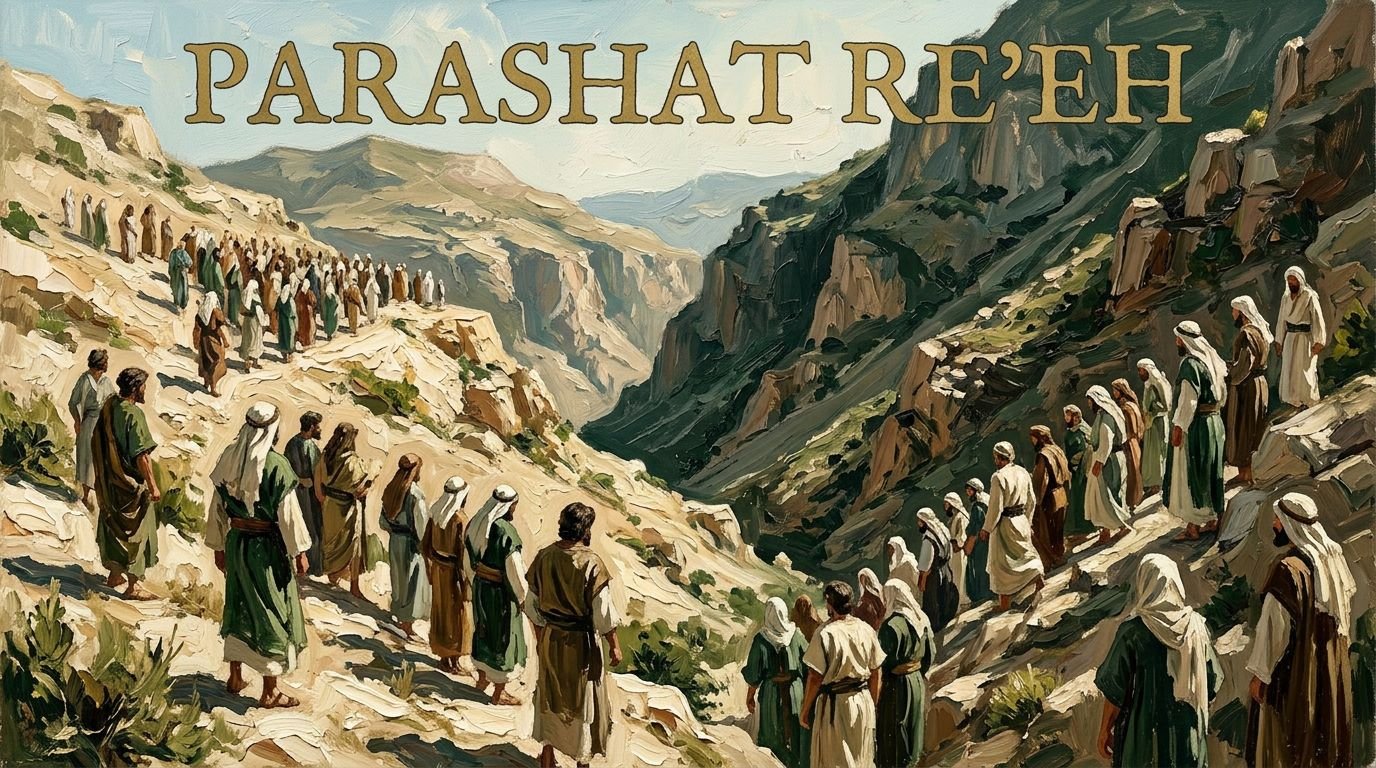
Parashat Re’eh: The Architecture of Sacred Choice and Covenantal Life
Parashat Re’eh: The Architecture of Sacred Choice in Deuteronomy
- Parashat Re’eh opens with the word “see,” summoning Israel to recognize the full moral weight of covenantal choice before entering the land.
- The twin mountains of Gerizim and Ebal stage blessing and curse as a communal, geographic drama of public accountability.
- The command to worship at one central sanctuary challenges religious fragmentation and binds Israelite identity to shared sacred space.
- Laws on kashrut, tithes, the Sabbatical year, and Hebrew servitude weave worship, economics, and social compassion into one covenantal whole.
- Re’eh insists that genuine freedom requires structure: holiness is a discipline practiced in community, not a private spiritual feeling.
The opening word of Parashat Re’eh, re’eh (“see”), shifts Deuteronomy’s dominant mode from hearing to interior vision. Rabbi Chaim ibn Attar (Or HaChaim), the eighteenth-century Moroccan commentator, reads this imperative as a call to internalize truth at the level of the soul, grasping with the inner eye what external observation alone cannot reach. In a book dense with commands to listen and obey, this turn to vision is theologically arresting.
Parashat Re’eh spans Deuteronomy 11:26 through 16:17, gathering laws on blessing and curse, the central sanctuary, idolatry, dietary practice, tithes, the Sabbatical debt release, and the three pilgrimage festivals. These laws are not isolated statutes; together they construct a single covenantal vision. Israel’s holiness is architectural, built law by law into the rhythms of eating, lending, worshipping, and celebrating. A people becomes sacred not through private feeling but through shared, disciplined covenantal practice.
Blessing and Curse in Deuteronomy 11:26: Individual Accountability and the Moral Architecture of Choice
Deuteronomy 11:26 presents the covenant as a direct binary: “See, I set before you today a blessing and a curse.” Rashi, reading the verse’s unusual grammar, notes that the singular imperative “see” is addressed to every Israelite individually, even though Moses speaks to the entire assembled nation. The covenant is not a collective abstraction; it lands on each person as a direct, personal summons, demanding individual accountability for individual choice.
Sforno understands the blessing and curse not as consequences imposed from outside, like weather visiting a passive people, but as the natural unfolding of the paths Israel chooses. Obedience orders the soul and the community toward flourishing; departure disorders both. National destiny and individual moral choice are, for Sforno, two registers of a single reality, not competing concerns.
The theology of choice in Deuteronomy moves beyond the standard mechanics of ancient covenant formulae. The blessing-curse framework is common in second-millennium suzerainty treaties, but Deuteronomy’s emphasis on Israel’s ongoing moral agency, rather than merely ritual compliance, gives the book a distinctive ethical gravity that later generations of Jewish readers found inexhaustible.
Ibn Ezra, attentive to the text’s surface structure, notes that blessing appears before curse in Deuteronomy 11:26. This ordering is not neutral: the default invitation is toward blessing, and departure from it requires a kind of active refusal. The sequence encodes hope as the covenant’s baseline orientation.
Did You Know? The mountains of Gerizim and Ebal, where Moses commands the blessing-and-curse ceremony, stand near the ancient city of Shechem, in the heart of Canaan. Joshua carries out this precise ceremony in Joshua 8:30-35, immediately after Israel’s first victories in the land, making it one of the founding liturgical acts of Israelite national life. The two mountains are still visible today in the northern West Bank, their opposing profiles a permanent geographical reminder of the choices Re’eh sets before every generation.
Mount Gerizim and Mount Ebal: Public Covenantal Accountability Inscribed on the Land
The ceremony at Mount Gerizim and Mount Ebal is a public, collective enactment of the covenant’s binary of blessing and curse. Moses instructs the tribes to divide: some stand on Gerizim to pronounce blessings, others on Ebal to pronounce curses, with the Levites calling out the covenant’s terms in the valley between them. This is not liturgy for its own sake but a political and theological staging of accountability inscribed in the geography of the promised land.
The Ramban, Rabbi Moses ben Nachman, understands the Gerizim-Ebal ceremony as the formal taking of the land under covenantal conditions. The land does not belong to Israel by ethnic right or military conquest alone; it is held in covenant, under conditions. The mountains themselves stand as permanent geographical witnesses to Israel’s commitment, and every generation that walks those hills inhabits a space consecrated to the covenant’s demands.
The ceremony at Gerizim and Ebal establishes that blessing and curse are shared conditions, not individual fates, leaving no room for religion conducted in private isolation from the community’s moral life. Archaeological and textual study of Deuteronomy has long noted this communal, public quality as one of the book’s most distinctive theological signatures, setting it apart from other ancient Near Eastern legal corpora.
Or HaChaim returns to his theme of spiritual vision in describing the ceremony at the two mountains. To stand on Gerizim or Ebal is to see, in the most literal geographical sense, where the covenant paths diverge. The land itself becomes a moral map, rendering invisible choices visible and irrevocable, so that the stakes of covenantal life cannot be reduced to a purely private matter of the heart.
The Central Sanctuary in Deuteronomy 12: Centralized Worship Against Religious Fragmentation
Deuteronomy 12:5’s repeated command to worship only at “the place that the Lord your God will choose” centralizes all sacrificial life in a single, divinely designated sanctuary. This marks a decisive break with Canaan’s religious world, where every hilltop and grove could host a shrine to a local deity. Drawing all worship to that single place changes who Israel is, not only how Israel prays.
The Ramban understands the command to centralize worship as the foundation of Israel’s land-based holiness. Worship dispersed across many local shrines would inevitably absorb the character of surrounding Canaanite religion, blending covenantal service with the sensory appeals of local cult practice. The single sanctuary is, in Ramban’s reading, a protective boundary around Israel’s theological integrity and the surest guarantee of its distinctiveness among the nations.
Scholarly analysis of Deuteronomy and the centralization of worship has long debated whether this command reflects seventh-century Josianic reform or a more ancient tradition. Whatever its historical setting, the theological logic is plain: a community that worships together, in one place, under shared norms, is far less likely to fragment into incompatible private religious worlds. The sanctuary is, at bottom, what keeps a people recognizably one.
Orthodox readers take centralization as a principle of enduring Torah law, shaping the structure of communal worship across the generations. Conservative readers locate the command historically, seeing it as a formative development that established principles of communal obligation still instructive today. Reform readers tend to read the central sanctuary symbolically, as an image of shared purpose rather than a prescription for any single institution. On that last point, all three agree: religion that turns entirely inward loses its capacity to form and sustain a people.
False Prophecy and Idolatry in Deuteronomy 13: When Covenant Loyalty Supersedes Miraculous Signs
Deuteronomy 13:2-4 addresses the false prophet who performs genuine signs and wonders yet leads Israel toward other gods. The Torah does not say the sign fails; it says Israel must not follow, even when the miracle is real. This is one of Deuteronomy’s most demanding passages, asking Israel to privilege covenant loyalty over seemingly conclusive evidence.
Rashi explains that God sometimes permits a false prophet to succeed precisely in order to test Israel’s loyalty. The test is not intellectual but covenantal: Israel has already received the Torah at Sinai, and no subsequent wonder, however impressive, can overturn that foundational commitment. Covenant loyalty is logically prior to any argument or spectacle, however compelling the surface appearance may be.
The tradition of Jewish philosophy has long wrestled with the relationship between received tradition and new experience, between covenant certainty and the claims of striking evidence. This passage suggests that covenant loyalty operates on a different register than ordinary evaluation of competing claims: the covenant is not one option among many but the framework within which all options are assessed.
Ibn Ezra, attentive to the legal precision of the text, notes that the private inciter who seduces a single person toward idolatry, rather than prophesying publicly, receives separate and even stricter treatment in Deuteronomy 13. The enticement that happens quietly, friend to friend or family member to family member, is regarded as more dangerous precisely because it bypasses communal accountability. The intimacy of the seduction makes it harder both to resist and to name.
Kashrut, Tithes, and the Sabbatical Year: Sanctifying Everyday Life in Parashat Re’eh
The kashrut laws, tithes, the Sabbatical year’s debt release, and the liberation of Hebrew servants are not afterthoughts appended to the parasha’s theology; they are where that theology takes hold in daily life. Holiness inhabits what we eat, what we give, and how we treat those who depend on us. These laws extend the sacred from the sanctuary into the kitchen and the harvest field.
Sforno reads the kashrut laws as disciplines that train the will. When eating, perhaps the most elemental of human drives, becomes a site of conscious covenantal decision, every meal is a small act of sanctification. The person who pauses before eating, asking what is permitted, practices the same moral attentiveness that the entire parasha demands in every other domain of life.
The shemitah, the Sabbatical year in which debts are cancelled and Hebrew servants set free, extends this logic into the economy. Scholars of the Sabbatical year and social release in ancient Israel have noted that the shemitah represents one of antiquity’s most radical experiments in periodic economic reset. Moses’ instruction “You shall not harden your heart or shut your hand” against the poor as the Sabbatical year approaches (Deuteronomy 15:7-9) ties the interior disposition directly to the concrete economic act.
Re’eh’s vision of social ethics structures compassion into law, not merely into aspiration. The care of the poor neighbor, the vulnerable person, and the released servant is scheduled into the agricultural calendar as a feature of the social order itself. The Torah does not leave that care to individual generosity alone. It legislates it.
- The word “see” at the parasha’s opening calls Israel to an active, internalized moral vision, not passive reception of commands from outside.
- The ceremony at Gerizim and Ebal teaches that covenant life is public and communal, not a private arrangement between the individual soul and God.
- The central sanctuary is both a theological statement and a social mechanism: shared worship sustains communal identity against the pressure of religious fragmentation.
- The prohibition on following false prophets, even those who perform real signs, establishes covenant loyalty as prior to any competing evidence or argument.
- Kashrut and tithes extend the parasha’s central argument into the most ordinary corners of life: the table and the harvest field are sites of holiness as much as the altar.
- The Sabbatical year’s debt release and servant liberation show that Israel’s social ethic is legislated, not merely aspirational, built into the rhythm of time itself.
- Re’eh’s deepest teaching is that freedom without structure dissolves: Israel is called to a disciplined, covenantal liberty that orders both the individual soul and the common life.
- Q: Why does Re’eh begin with “see” rather than “hear”?
- The shift from the more familiar “hear” to “see” signals a distinctive quality of attention. Rashi reads the singular imperative as a personal summons to each Israelite: see, with your own eyes and conscience, what lies before you. The Or HaChaim deepens this, understanding “see” as a call to internalize truth at the level of the soul rather than merely registering it externally. To see, in Re’eh’s sense, is to grasp the full weight and consequence of moral choice before you act, not simply to receive information about it.
- Q: Why is worship centralized in one place in this parasha?
- The command to worship at a single sanctuary serves both theological and communal purposes. Theologically, it insists that Israel’s worship be offered to God on God’s own terms, not absorbed into Canaan’s decentralized shrine culture, where different communities could develop incompatible religious identities. Communally, it creates a shared focal point for national life: when all Israel gathers in one place, the covenant is enacted together rather than in isolated regional variations. The Ramban sees the sanctuary as the center around which Israel’s land-based holiness organizes itself, the geographical expression of a unified covenantal people.
- Q: What is the significance of the three pilgrimage festivals here?
- Passover, Shavuot, and Sukkot appear in Re’eh as mandated occasions of communal rejoicing at the central sanctuary. Each memorializes a dimension of Israel’s foundational story: liberation from Egypt, the gift of Torah at Sinai, and the wilderness journey. Their placement in this parasha alongside laws of kashrut, tithes, and debt release is deliberate. The festivals are not separate from the social and economic legislation; they are the celebratory frame around it. The joy commanded at each pilgrimage is a communal declaration that God’s covenant, when lived faithfully, produces gratitude, abundance, and shared rejoicing.
- Q: How do kashrut and tithes fit with the larger themes of the parasha?
- Both kashrut and tithes extend the parasha’s central argument into the most ordinary corners of life. Kashrut makes eating a site of covenantal decision, training the will through daily, repeated choices about what enters the body. Tithes take the produce of the land, itself a gift of the covenant, and return a portion to God and to the community, including the Levite, the stranger, the orphan, and the widow. Together they enact Re’eh’s core insistence: that holiness is not an interior state alone but a discipline performed through the body, in time, in relation to others who depend on our faithfulness.
Parashat Re’eh’s central teaching is that holiness is not a separate zone but the quality that disciplined, covenantal life brings to every ordinary moment. The parasha moves from the mountaintops of Gerizim and Ebal through the kitchen, the harvest field, the lending relationship, and the festival procession. At each step, the Or HaChaim’s reading of “see” holds: blessing is not granted apart from how we live but is built into the structure of a life shared in covenant.
To see, in Re’eh’s sense, is to begin to become the community the covenant envisions.