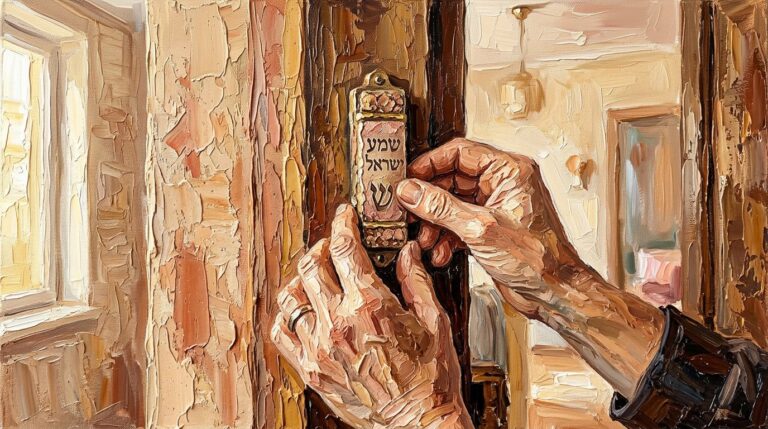

The Bedtime Shema for People Who Can’t Sleep
The Bedtime Shema for Sleep: Ancient Jewish Practice for Restless Nights
- The Bedtime Shema (Kriat Shema al haMitah) is a Talmudically grounded Jewish nighttime ritual designed to ease the transition from wakefulness to sleep through prayer, reflection, and trust in God.
- The halakhic minimum requires only the first paragraph of Shema and the Hamapil blessing, but classical liturgy adds Vidui (confession), Psalm 91, and additional verses for a richer experience.
- For those living with insomnia or anxiety, this traditional structure can function as a compassionate ritual container: a way to name the day’s weight, release it, and practice surrender.
- Different Jewish movements offer approaches ranging from strict adherence to the traditional liturgy to mindful, personalized adaptations drawing on contemporary psychology and trauma-sensitive design.
- Contemporary sleep research supports the core insight embedded in this ancient practice: consistent pre-sleep rituals reduce anxiety and help the nervous system shift toward rest.
The bedroom at 2 a.m. is a particular kind of alone. The house is quiet, the day is technically over, and yet the mind keeps running its late inventory: things said and unsaid, worries about tomorrow, the low hum of unresolved feeling that refuses to wind down. Many of us know this space well. What is less well known is that Jewish tradition has been attending to it for thousands of years.
Kriat Shema al haMitah, the Bedtime Shema, is not simply a shortened version of the prayer we recite in synagogue. The Talmud teaches it as a distinct practice, a nighttime act of spiritual preparation at the intersection of protection, accountability, and trust. Its classical form includes confession, ancient Psalms, and a blessing specifically designed to accompany the soul as it releases its grip on consciousness. For those of us who struggle to sleep, whether from anxiety, grief, chronic worry, or just the relentless pace of modern life, this practice offers something worth exploring: not a quick fix, but a time-tested ritual for approaching the night with honesty and, eventually, with rest.
What Is the Bedtime Shema and Why It Matters for Sleep
The Bedtime Shema, known in Hebrew as Kriat Shema al haMitah (“the recitation of Shema upon the bed”), is a practice with roots that run deep into Talmudic literature. The Talmud in Berakhot 4b teaches that even a person who has already recited the Shema during the evening synagogue service should repeat it when lying down in bed. The Gemara supports this teaching with a verse from Psalm 4: “Tremble and do not sin; commune with your heart upon your bed and be silent, Selah” (Psalm 4:5). That phrase, “commune with your heart upon your bed,” becomes a foundation for the entire practice.
This is significant because it tells us something about the intention behind the ritual. The Bedtime Shema is not conceived as mere liturgical repetition. It is an invitation to an interior conversation, a moment of gathering the self before releasing consciousness into sleep. Sleep, in the rabbinic imagination, carries the weight of a miniature death, a partial departure of the soul from which we trust God to return us each morning.
The Hamapil blessing, recited just before sleep, makes this explicit: it asks God to lay us down in peace and raise us up to life again. Every night rehearses mortality, and every morning rehearses renewal.
For people who cannot sleep, this framework already offers something meaningful. The experience of insomnia often involves a kind of hypervigilance, an inability to let go, to trust the dark, to release control. The Bedtime Shema addresses this directly, not as a technical sleep aid, but as a practice of surrender rooted in relationship with something larger than our anxious minds.
Classic Sources: Protection, Presence, and Letting Go Before Bed
Classical Jewish sources frame the night as a spiritually charged time requiring both preparation and protection. The core liturgical requirement for the Bedtime Shema has two parts: the first paragraph of the Shema (Deuteronomy 6:4-9, beginning “Hear O Israel, the Lord is our God, the Lord is One”) and the Hamapil blessing. These two elements form the halakhic minimum that rabbinic authorities generally agree a person should recite before sleep.
The traditional practice builds considerably beyond this base. A complete Bedtime Shema service, as found in many traditional siddurim, includes a brief Vidui (confession) asking forgiveness for wrongs committed during the day; the three paragraphs of the full Shema (Deuteronomy 6:4-9, 11:13-21, and Numbers 15:37-41); Psalm 91, known as “the Psalm of Protection”; Birkat Kohanim, the priestly blessing; and in some kabbalistic traditions, the mystical prayer Ana b’Koach, before closing with the Hamapil blessing itself.
The Bedtime Shema – All’s Well That Ends Well guide from Chabad describes a fourfold spiritual movement within this structure: relax, re-examine the day, refocus on what matters, and repent for shortcomings. This is not an accident of liturgical accumulation. It is a deliberate psychological architecture for ending the day with integrity.
Psalm 4, cited in the Talmud as scriptural support for the practice, gives us a particularly honest emotional arc. The psalm moves from a cry of distress (“How long will you turn my glory to shame?”) through trust (“Know that the Lord has set apart the faithful for Himself”) to peace (“I will lie down and sleep in peace, for You alone, Lord, make me dwell in safety”). The Bedtime Shema asks us to trace this arc every night: from whatever difficulty we carry, through honest acknowledgment, toward a resting point of trust.
Step-by-Step: A Simple Bedtime Shema Practice for Restless Nights
For those new to the Bedtime Shema, or those returning after years away, the goal is not to perform every component perfectly on the first night. The practice is layered by design, and there is genuine halakhic and spiritual support for beginning simply and building over time. Bedtime Rituals: Using the Shema for Better Sleep from Neshamah suggests graduated levels of engagement, beginning with just the first line and a moment of intentional release. Here is a graded approach for restless nights.
Level 1 – The foundation. Recite the first line of the Shema slowly, aloud if possible: “Shema Yisrael, Adonai Eloheinu, Adonai Echad” (Hear, O Israel: the Lord is our God, the Lord is One). Then say the Hamapil blessing. That is the core. Even this minimum, done with genuine attention, fulfills the spirit of Kriat Shema al haMitah.
Before reciting, take three slow breaths to mark the transition from the day’s activity to the night’s stillness.
Level 2 – Adding reflection. Before the Shema, spend two or three minutes in cheshbon hanefesh, personal accounting. Ask: What am I carrying from today that I want to name? What am I grateful for? Is there something I need to release, a regret, a resentment, a worry, before I try to rest?
This does not need to be elaborate. Even a few moments of honest, quiet attention do the work.
Level 3 – The first paragraph. Add the full first paragraph of Shema (Deuteronomy 6:4-9), which moves from the declaration of divine unity into the command to love God with all your heart, soul, and strength, and to bind these words to yourself and your household. Reciting these words slowly, treating them as an anchor rather than a recitation, can interrupt the anxious thought-loop that makes sleep so difficult.
Level 4 – Psalm 91 and protective verses. Psalm 91 (“You who dwell in the shelter of the Most High, who rests in the shadow of the Almighty”) has been associated with nighttime protection across Jewish tradition for centuries. The How To Go To Bed: The Bedtime Shema guide on Sefaria explicitly notes that some communities add additional Psalms “just in case you are still awake,” treating prolonged wakefulness not as failure but as extra time for sacred text. That reframing alone can reduce the secondary anxiety that sleeplessness generates.
Level 5 – The full traditional liturgy. The complete Bedtime Shema service, including Vidui, the three paragraphs of Shema, Psalm 91, Birkat Kohanim, and Hamapil, is available in most traditional siddurim and in the Bedtime Shema (Liturgical Guide) from the JBI Library. For those who find sustained liturgy soothing, working through the full service creates a calming, repetitive structure that gently detaches the mind from the residue of the day.
Expanding the Ritual: Psalms, Vidui, and Mindful Reflection When You Can’t Sleep
For those whose insomnia is chronic or whose nighttime anxiety is significant, the extended Bedtime Shema tradition offers something genuinely useful: a structured way to engage with wakefulness rather than fight it.
The Vidui, or confession, is an underappreciated element of the service. In the bedtime context, it is not a formal Yom Kippur-style reckoning but a quiet personal acknowledgment: I know where I fell short today. I am naming it. I am asking to release it and not carry it into sleep.
This act of naming and releasing is psychologically distinct from rumination. Rumination loops endlessly on the same material without resolution. The Vidui creates a kind of closure, a moment of honest self-accounting followed by an explicit letting go. Many people who struggle with intrusive nighttime thoughts find that structured acknowledgment of what went wrong is more effective than trying to suppress those thoughts altogether.
Denominational Approaches: How Different Movements Adapt the Bedtime Shema
Bridging Ancient Wisdom and Sleep Science: Why Nighttime Rituals Work
- The Bedtime Shema (Kriat Shema al haMitah) is rooted in Talmudic teaching (Berakhot 4b) and requires at minimum the first paragraph of Shema and the Hamapil blessing before sleep.
- Classical liturgy adds Vidui (confession), Psalm 91, Birkat Kohanim, and protective verses, each serving a distinct psychological and spiritual function within the service.
- A graded approach works well for restless nights: begin with just the first line and Hamapil, then add elements as the practice deepens and feels natural.
- The tradition itself acknowledges prolonged wakefulness by offering additional Psalms for those still awake, reframing insomnia as sacred time rather than spiritual failure.
- Jewish movements adapt the Bedtime Shema to their own theological priorities, from Orthodox halakhic structure to Reform mindfulness adaptations, but all affirm its value as a nighttime spiritual practice.
- Contemporary sleep science supports the core insight: consistent pre-sleep rituals with predictable structure help the nervous system shift from vigilance toward rest.
- Reciting the Bedtime Shema with children creates a reliable, calming family touchstone associated with emotional regulation and reduced nighttime anxiety.
- Q: If I already said the Shema in the evening service, do I still need to say the Bedtime Shema before going to sleep?
- Yes. The Talmud (Berakhot 4b) treats these as two distinct practices with different purposes. The evening Shema fulfills a communal liturgical requirement tied to the time of prayer. The Bedtime Shema is a personal practice focused on preparing the soul for sleep, anchored in the specific act of surrender embedded in the Hamapil blessing. Think of it as the difference between dinner and a cup of tea before bed: they share some ingredients but serve entirely different moments.
- Q: What if I’m too anxious or exhausted to say the full traditional Bedtime Shema – is just the first line enough?
- The first line, “Shema Yisrael, Adonai Eloheinu, Adonai Echad,” together with the Hamapil blessing, constitutes the halakhic core of the practice, and many authorities affirm that this minimum is fully sufficient, especially for people in difficult circumstances. If even that feels like too much on a given night, say the first line alone, slowly, with intention. Jewish tradition is clear that sincerity of heart carries weight. The goal is not a flawless liturgical performance but a moment of sacred attention at the threshold of sleep.
- Q: Is the Hamapil blessing still appropriate if I often don’t fall asleep right away, or I might get out of bed again?
- This is a genuine halakhic question, and rabbinic authorities handle it practically. The standard guidance is that Hamapil should be recited when you are genuinely about to attempt sleep, not as an opener to an extended bedtime service conducted hours earlier. If you know you will get up again before settling in, it makes sense to delay Hamapil until you are actually lying down to sleep. Some authorities hold that if you do get up after reciting Hamapil, you need not repeat it when you return to bed, unless significant time has passed or circumstances have substantially changed.
- Q: Can I personalize the Bedtime Shema to address my anxiety, trauma, or chronic insomnia without losing its traditional core?
- Absolutely, and the tradition itself invites this. The extended Bedtime Shema liturgy has always included personal reflection, confession, and texts chosen to speak to specific fears and vulnerabilities. You can add a personal prayer in your own language before or after the core texts, choose Psalms that resonate with your specific situation, incorporate breathing or grounding practices as you recite, and allow the Vidui to become a personal, specific naming of what you are carrying. As long as the Shema and Hamapil remain your anchors, the surrounding practice has always been adaptable to individual need.
- Q: Is it okay to say the Bedtime Shema with my children as part of a family bedtime routine, even if they’re very young?
- Not only is it fine, it is one of the most natural expressions of the practice. Deuteronomy 6:7, embedded within the Shema paragraph itself, instructs us to teach these words to our children and to speak of them “when you lie down.” Young children do not need to grasp the full theological content of the Shema to benefit from hearing it. The regularity, the physical closeness, and the calm of a known sequence of words and melody create a secure, predictable transition to sleep that is itself a form of spiritual formation. Contemporary research on family bedtime rituals confirms the emotional and psychological benefits of consistent pre-sleep connection.